
Obituaries offer window into lives, death in COVID era
Trending
To read a breakdown of local obituaries by day, click here.
If it seems like there were record numbers of obituaries in The Vindicator on recent Sundays, there are reasons for that.
For starters, the COVID-19 pandemic has increased the number of people dying, especially in Mahoning County.
But it's also a common practice for funeral homes and families to ask for an obituary to run in the Sunday newspaper where it might get more readership, explained Dave Knarr, a funeral director for Lane Family Funeral Homes.
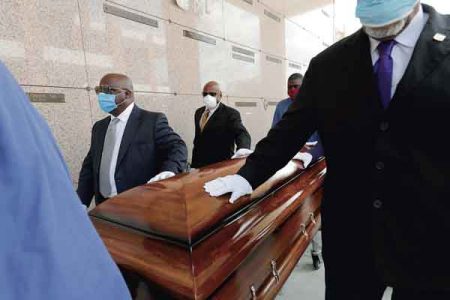
Another reason is that relatively few people are allowed to attend funeral services right now because of the virus and social distancing guidelines.
That means there is less of a need for timely notice of the calling hours or services, meaning more obituaries are waiting until the Sunday newspaper, Knarr said.
Inexplicably, it also appears that the number of deaths in Mahoning County has been significantly higher than in Trumbull County.
"We have been much busier in our Mahoning County locations than our Trumbull County locations for about the past month," Knarr said recently.
Statistics show that Mahoning County has had more than double the number of confirmed COVID-19 deaths compared to Trumbull County. As of Thursday, Mahoning County had 80 COVID-19 deaths; Trumbull had 31; and Columbiana County had 24.
A review of obituaries in The Vindicator and the Tribune Chronicle, which covers primarly Trumbull County, also shows a higher number of deaths in Mahoning County.
In The Vindicator, there were 286 obituaries in February -- before the virus struck -- and 377 during the first 29 days of April, the biggest month for COVID-19 deaths so far -- an increase of 91 obituaries or 32 percent.
The Vindicator does reach readers outside of Mahoning County. Many in the Hubbard-Liberty-Girard area of Trumbull County subscribe to The Vindicator.
By comparison, the Tribune Chronicle published 234 obituaries in February and 247 during the first 29 days of April, an increase of 13 obituaries or 6 percent.
VIRUS IMPACT
As for Sunday obituaries, the numbers seem to offer a glimpse at when the virus impacted the area.
In The Vindicator, the number of Sunday obituaries jumped from eight March 8 to 48 April 19. In the Tribune Chronicle, the increase was milder, rising from four March 8 to 20 on April 5. Ohio's first recorded COVID-19 death was reported March 20. The first Mahoning Valley COVID-19 death was reported March 26.
In Mahoning and Trumbull counties, there have been 111 COVID-19 deaths. Mahoning County's 81 deaths means it accounts for 73 percent of the deaths in the two counties. Trumbull County's 30 deaths represents 27 percent.
In terms of obituaries, the numbers show a similar lopsidedness by county: The Vindicator had 91 more obituaries in April compared to February, and the Tribune had 12 more for a total of 103. The Vindicator made up 88 percent of that increase, and the Tribune made up 12 percent.
Peter Rossi Jr., owner of Peter Rossi and Son Memorial Chapel in Howland, agreed that the record number of obituaries in The Vindicator appears to be related to the higher number of virus deaths in Mahoning County than Trumbull.
Though most of his business comes from Trumbull County residents, families sometimes want the obituary to be included in The Vindicator edition if they have relatives in areas such as Girard, Liberty or Hubbard.
Rossi said he was not surprised to hear that the increase in obituaries in The Vindicator was 32 percent.
"I know the other day on Sunday, I couldn't believe how many there were in that paper," he said. "I kept turning the page and there was more and kept turning."
He also agreed that the Sunday newspaper is getting more of the obituaries "because that's the most widely distributed paper during the week."
And he agreed that because services are private, the family has less of a reason to have the obituary published on a weekday for purposes of notifying the public of calling hours and funeral.
CAUSE OF DEATH
Rossi and Knarr also agreed that some families do not want an obituary or any kind of public notice of their loved one's death, but neither funeral director said he was aware that anyone made that choice because the person died from the virus.
"The people I've had with the virus, they have said, 'Go ahead and say the cause of death was the virus,'" Rossi said. "They want other people to know that it is a very serious situation, that we have to be serious about it."
Officials from Mahoning County Public Health were asked last week whether they know of any reason the number of COVID-19 deaths being reported to the public would be lower than the true number. They said they could not point to a specific reason that would have happened.
Ryan Tekac, director of Mahoning County Public Health said, "We wouldn't know."
Erica Horner, director of nursing, said someone who may have died with symptoms of COVID-19 but was not tested could still be listed as having had the virus if his or her doctor indicated it on the death certificate, and it would be counted as a "probable" case.
Knarr, who has been in the funeral business 22 years, said something families might consider if they have lost a loved one during the COVID-19 pandemic is the timing of a public service when social distancing limits have been reduced.
"Our fear from the funeral home is that people won't do a public service later -- not from a business standpoint from us. Whether they do it with us or in our funeral home or whatever, that doesn't matter.
"When is it a good time to do it? Something is always is going to come up, and it's never going to be a convenient time," he said. "We're hoping that doesn't happen.
"We've suggested to folks, 'Wait until the person's birthday' -- all of the firsts when somebody passes -- the birthday, the first set of holidays that comes around, those are always really hard on the family. Those are the worst ones. We've heard of people waiting until the person's birthday or some other important date."
erunyan@tribtoday.com