

Comic superheroes drawn from Jewish experiences
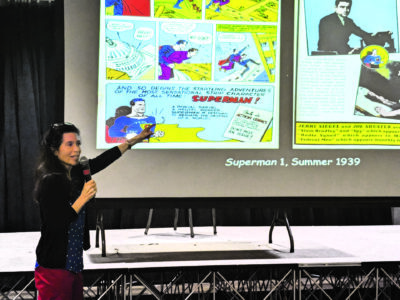
Correspondent photo / Brandon Cantwell ... Author, journalist and Cleveland State University professor Samantha Baskind describes one of the pages of Superman’s first issue at her presentation, “Up, Up, and Oy Vey!: Jews, Comics, and the Graphic Novel” at the Jewish Community Center of Youngstown on Sunday.
YOUNGSTOWN — For Samantha Baskind, a fascination with comic books and graphic novels was a love affair that blossomed for her as a child.
“From a young age, I loved comics. I love art, and I love literature. It’s a marriage of text and image. There are so many interesting ways to tell these stories,” Baskind said. “And then I love, you know, detective comics and humor and superheroes, and it combines everything that I enjoy intellectually, and I get to write about it, and I get to speak about it.”
Baskind, a journalist, author and art history professor at Cleveland State University, shared this passion through her 45-minute discussion of Jewish creators’ massive contribution to comics and the graphic novel Sunday afternoon at the Jewish Community Center, as part of the J. Newman Levy Speaker Series. Approximately 30 people attended the event.
Baskind pointed out that Superman and his arrival and success on Earth is the story of Jewish immigration and achievement in the United States.
“He’s taken in by a kind couple, the Kents. And he comes to a strange land and is given a chance to make good. That happened to a lot of our families as well. His origin story is very similar to the Moses story. Moses was put on the Nile in a little basket. Superman comes to America in a tiny little spaceship,” Baskind said. “Moses and Superman are taken care of by strangers, and both are strangers in a strange land. Like Moses, Superman never forgets who he is. Again, he’s a stranger at home, and he’s at home simultaneously, and that’s the heart of Jewish tradition, where every Jew remembers a stranger and remembers themselves as strangers.”
Baskind added that Superman’s real name on his home planet Krypton has Hebrew roots, as the “El” part of “Kal-El” means “deity.”
A lot of the early issues of comics dealt with World War II, which the country was in the midst of at the time. Baskind noted the earliest issues of “Batman and Robin,” created by Jewish artist Bob Kane and writer Bill Finger, featured plot lines where the duo would fight Nazi soldiers and used the comic story “Swastika over the White House” as an example.
Baskind said such stories were sold on newsstands in the U.S., but were considered “good propaganda,” as Kane and Finger were trying to get the larger public to pay attention to Europe and what was happening there.
The stories also helped in selling war bonds, too, as some pictures depicted imagery of superheroes treating U.S. soldiers as the real heroes.
Baskind discussed the impact of Art Spigelman’s “Maus,” a controversial Pulitzer Prize-winning graphic novel serialized from 1980 to 1991 depicting Spigelman interviewing his father about his experiences as a Holocaust survivor through animal personifications, such as Jewish people as mice, the French as frogs and Germans as cats.
“This is one of what he worked through to figure out, ‘how can I tell this story? How do I tell the story of a Holocaust survivor?’ Baskind said. “It got great reviews, but in one interview, he was interviewed and the question was, ‘how could you write about the Holocaust with animals? That’s absurd.’ And Spigelman replied, ‘no, Auschwitz was absurd.'”
While Superman co-creators Jerry Siegal and Joe Shuster might have sold the rights to the character to Detective Comics in 1938, Superman and Siegal, who was born in Cleveland, are both celebrated by the city.
“Cleveland is so proud of their native son. He’s (Superman’s) not from Cleveland, he’s from Krypton, but he was invented in Cleveland. So we celebrate him so much that Jerry Siegal’s house is a shrine,” Baskind said.
Baskind concluded by answering the question of whether comics truly were influenced by their Jewish creators’ roots.
“There are clues indicating that these Jewish writers and artists did get inspiration from their Jewish background. But the empowerment that superheroes give to us, this dream, isn’t specifically suited just to Jews,” Baskind said. “There are a lot of people who need that kind of empowerment. The double identity of superheroes connected to the need of Jews to hide. A lot of people need to hide their identities. They aren’t comfortable in their skin.”
“I’m not saying everything I said today is not right; I’m saying I just want you to think about nuance,” Baskind added.
Baskind opened the floor to questions following her presentation, fielding queries about Superman’s aggressive stance toward fascism, Siegal and Shuster selling the rights to the character for $138 ($2,814 when adjusted for inflation) and how well-known the Jewish roots of the comic industry are.
Local News
CNBC: Ohio ranks No. 1 for business
Why yes, Ohio wants your business, and a global business and financial news outlet is exclaiming the wonders of the ...
180th Trumbull County Fair opens Tuesday
Liberty 250 looks to celebrate roots
LIBERTY — Sharon Wathen said she did not grow up in Liberty, but has lived in the area for 50 years. However, ...
YLIVE ENLIVENS DOWNTOWN YOUNGSTOWN: Concert revelers get early start
City council to act on $170M water project
YOUNGSTOWN — With an estimated $170 million wastewater improvement project expected to commence in the fall, city ...
Mahoning County courts
Marriage licenses granted June 29 to July 2 in Mahoning County: Reece Aaron Kackley, 25, Sebring, and ...