
Hubbard plans data center moratorium
Opponents flood city council; legislation to be drafted
Trending
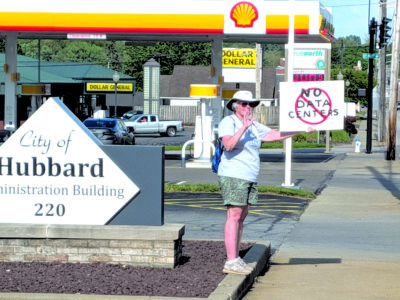
HUBBARD -- Both city and township residents have expressed renewed concerns about a potential data center entering the community throughout the month, and city officials moved forward with action to quell those concerns Monday.
Councilwoman Robin Zambrini, D-2nd Ward, requested Law Director Mark Villano draw up the necessary legislation for a moratorium on the construction, placement or operation of data centers in the city, and declaring an emergency, in front of more than 200 residents who attended to speak out against one entering the community.
Councilwoman Bonnie Viele and Councilmen Mike Kerr, Jerome Crowe and Jonathan Rose all agreed during caucus that the moratorium would last a year. Councilwoman Lisha Baumiller and Councilman Ryan Hallapy were absent.
Zambrini said she is confident in the city's process, noting zoning rules are in place and residents need to trust the process, but there are times when things don't go as planned.
"I believe, at this time, it needs to be bypassed; speaking as far as myself, my main concern is, I was elected by the people," Zambrini said. "It really makes me mad for well over a year now, when people say 'What's going on with that data center?' and I have to say 'I have no idea.' I am tired of saying I have no idea."
Zambrini said the request doesn't immediately put the moratorium into effect, but it will be when it gets approved during council's June 1 meeting.
The strong attendance follows Mayor Ben Kyle's statement last week that his administration and council have been engaged in Project Milo through Lake to River, one of the city's regional economic development partners.
He previously spoke about the project in February 2025, and in November he said that the project was still in the site selection phase and utility research phase, which the unidentified company was doing in five other communities across Ohio.
Kyle also acknowledged signing a nondisclosure agreement in December 2024 with the intent of allowing the city to gather the "technical and utility" information necessary to see whether the city could accommodate something of that scale.
Kyle said last week that Monday's meeting would be the appropriate forum for residents to voice concerns, ask questions and engage with officials, adding that the city is not cutting corners, and legal procedures are being followed at every step.
Kyle reiterated during his report that the city has received no proposals regarding Project Milo, adding that he would bring it to the city council's attention if one reached his desk.
RESIDENT COMMENTS
Ron Yobe, who lives a street away from the proposed location, said he was only 16 when Interstate 80 went through his property, noting his parents received $7,000 in damages for it.
"I've been living on that property my whole life; the noise associated with that highway is unbearable. Very little we can do to have that adjustment," Yobe said. "However, you people are talking about putting in a data center on the other side of me now -- the noise associated with that is substantial."
Yobe said if one were to go in, officials would need to make sure it's soundproof, but problems come along with it, such as the loss of nature and jobs.
"AI is gonna have a dramatic effect on everybody's lifestyle, their working life, how they earn their living," Yobe said. There's going to be a massive dislocation of work; the more data centers that go in, the more AI is going to be used -- it's a 24-hour operation."
Margie Johnson, a township resident, noted the proposed location is surrounded by township property and would affect the township's residents the most, adding that the moratorium discussions were great.
"I encourage you to change the zoning; you can make it complicated for them to build here, you can make it unsavored -- we need to enact regulations. The air base being out there, lighting is going to be an issue," Johnson said. "I have seen these things lit up brighter than a football field at night.
"It's every night, all night long. We need to enact regulations that they control the amount of electricity they're using, because let's face it, it's Hubbard. Our power goes out if the wind blows."
Katie Costello, another resident who lives seven doors from the Deer Creek Golf Course site, said a large-scale data center entering her neighborhood threatens everything they've built over the last 20 years, starting with property values.
Costello said she has reasons to distrust words like "safe" and "nontoxic," noting that her dad died from Agent Orange, a chemical herbicide and defoliant the U.S. military heavily sprayed in several countries, especially in Vietnam, from 1962 to 1971.
"When I hear words like forever chemicals in connection with data centers, I listen -- even the closed loop systems introduce PFAS chemicals into the ground," Costello said. "The ground that your children, grandchildren (and) all of our pets play in every single day, beyond the chemicals, backup generators, and gas turbines emit fine particles and nitrogen oxides."
Costello said Kyle was hiding behind the NDA he signed "without a public conversation."
"Nobody here is asking for proprietary information; we are asking for the scope and type of this facility," Costello said. "We are asking for basic transparency. We are asking for our voices to matter. Small governments across this country are standing up and saying no to developments that harm their communities. Hubbard can be one of them."