

CDC nominee says she won’t betray science — and also backs actions of Kennedy
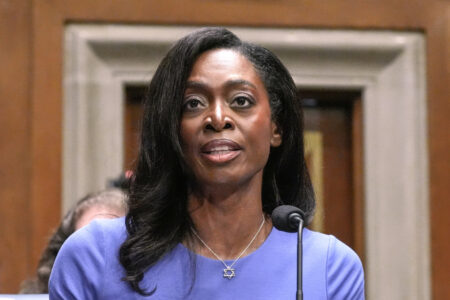
Erica Schwartz testifies during a Senate Health Education Labor and Pensions committee confirmation hearing to be the director of the Centers for Disease Control and Prevention on Capitol Hill, Wednesday, July 15, 2026, in Washington. (AP Photo/Mariam Zuhaib)
WASHINGTON (AP) — The Trump administration’s latest nominee to lead the nation’ top public health agency drew frustrated reactions from some U.S. senators on Wednesday when they pressed her on whether she would protect the Centers for Disease Control and Prevention from political meddling.
Dr. Erica Schwartz told the Senate health committee she “will never betray the science” and pledged to use “radical transparency” in a bid to rebuild public trust in the agency. But several senators questioned how she might handle pressure from U.S. Health Secretary Robert F. Kennedy Jr., who has repeatedly moved to alter U.S. vaccine and CDC policies. Schwartz repeatedly declined to dissent from some of those actions.
Schwartz, 54, is up for director of the Atlanta-based CDC, which is charged with protecting Americans from preventable health threats.
Her career has largely been spent in military uniform, including in a leadership position at the U.S. Coast Guard where she oversaw the organization’s system of 41 clinics and 150 sick bays — as well as policies promoting vaccinations of service members. She later served as deputy surgeon general, where she helped lead uniformed medical and health professionals posted at the CDC and government health agencies that serve the general public.
The CDC long enjoyed a sterling international reputation but has been in turmoil since Trump returned to office last year. Largely due to layoffs and resignations, the agency has lost more than 3,000 employees, or more than a quarter of its workforce. Morale has plummeted as a succession of mostly temporary leaders have come and gone — the front office filled with political appointees, many of them with little or no training in medicine or public health.
“There’s still really good people who work there (at the CDC). They are doing their best to navigate choppy waters,” said Dr. David Margolius, director of Cleveland’s health department and a leader in a U.S. coalition of big city health departments. But CDC no longer seems to the authoritative and communicative lead that it was on outbreaks and other public health emergencies.
“Basically everybody’s got to kind of choose their own adventure, as opposed to being led by a national public health department,” Margolius said.
The agency is overseen by Kennedy, who was a leading voice in the anti-vaccine movement before he was tapped to lead the CDC and other federal health agencies. Kennedy had promised not to change the nation’s vaccination schedule. But shortly after taking office, Kennedy said he was going to investigate the childhood vaccine schedule and went on to attempt a substantial rewrite of vaccine recommendations for kids. Some of those efforts were put on hold earlier this year by a federal judge.
The administration’s first pick to run the CDC was former Florida congressman Dr. David Weldon, but his March 2025 Senate confirmation hearing was canceled an hour before it was to begin. Weldon said at the time that he’d been told not enough senators were willing to vote for him.
The White House then moved on to Susan Monarez, who had been serving as the CDC’s acting director. Monarez was confirmed by the Senate, but she was ousted in less than a month. Trump administration officials said she wasn’t aligned with their agenda so they terminated her.
Several key CDC scientific leaders resigned in protest, saying Monarez’s dismissal dashed their hopes that a CDC director would be able to guard against political meddling in the agency’s scientific research and health recommendations.
Since then, there’s been a revolving door in agency leadership, with the short-term role of acting director being passed from one Washington-based HHS official to another. National Institutes of Health Director Jay Bhattacharya has been overseeing the CDC most recently.
On Wednesday, some senators suggested Schwartz should follow Monarez’s example, and they asked her about actions Kennedy has taken that have affected CDC.
Schwartz said she was unaware that CDC programs that worked to prevent smoking and promote vaccinations had been curtailed. She declined to commit to taking down a CDC website that suggests there’s a link between childhood vaccines and autism (she said she had not seen it), though she agreed existing medical evidence has not found a link.
Sen. Maggie Hassan, a New Hampshire Democrat, asked if she would — if Kennedy ordered her — suspend promotion of a flu vaccination campaign during a deadly flu season.
“Senator, I don’t speak in hypotheticals,” Schwartz responded.
“It isn’t hypothetical. It happened,” said Hassan, referring to internal CDC emails, released by U.S. Sen. Bernie Sanders last month, that documented such a directive from Kennedy to CDC staff last year.
National News
Hegseth announces policy to test troops for low testosterone
WASHINGTON (AP) — Defense Secretary Pete Hegseth announced Wednesday that he is rolling out a new screening ...
CDC nominee says she won’t betray science — and also backs actions of Kennedy
House Republicans unveil a $95 billion plan for the Iran war, farm aid and elections
WASHINGTON (AP) — House Republicans on Wednesday unveiled a $95 billion legislative plan focused on boosting ...
Congress unveils $95B plan for Iran war, voting reforms
WASHINGTON (AP) — House Republicans on Wednesday unveiled a $95 billion package focused on boosting defense, ...
Nation and world at a glance for July 15
Man, 74, becomes oldest inmate executed in Florida
STARKE, Fla. (AP) — Florida put to death one of its oldest prisoners in its history on Tuesday, a 74-year-old ...