What to know about a midair collision between 2 Navy jets at an Idaho air show
BOISE, Idaho (AP) — After the two Navy jets collided in midair, the planes sandwiched together, all four crew members were able to eject and deploy their parachutes, floating down to safety as the aircraft careened into a field, exploding into a fireball.
The collision happened Sunday during the “Gunfighter Skies” air show at the Mountain Home Air Force Base some 57 miles southwest of Boise.
Here are some things to know about the crash.
JUST ONE INJURED
Only one of the four crew members on the two planes was injured and was being treated at a hospital, Cmdr. Amelia Umayam, spokesperson for Naval Air Forces, U.S. Pacific Fleet, said Monday. The injury was not life-threatening.
The fact that all four were able to safely eject and make it to the ground without landing in the wreckage is “truly remarkable,” said Billie Flynn, a former F-35 senior test pilot and demonstration expert.
“It is astonishing considering the way the airplanes impacted each other — incomprehensible even,” Flynn said.
The two U.S. Navy EA18-G Growlers were from the Electronic Attack Squadron 129 in Whidbey Island, Washington. Each held two crew members.
The EA-18G Growler, measuring just over 60 feet long, made its first flight in August 2006 and was the first newly designed electronic warfare aircraft produced in more than 35 years, according to the Navy. Its “baptism of fire” was in 2011 in Libya, according to the Navy, and since then it’s been used worldwide.
PLANES APPEARED SANDWICHED TOGETHER
Videos taken by spectators show one of the jets was slightly behind the other before impact, and the two aircraft then appeared to become sandwiched together, with the belly of one jet just behind and to the side of the top of the other jet.
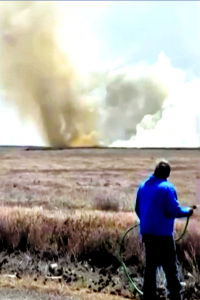
The jets then twisted and rocked together, pointing straight up for a moment before turning downward and falling to the ground. The subsequent impact resulted in a fireball, black smoke rising into the sky.
The crew members ejected in quick succession with their parachutes opening as the jets began to pivot toward the ground.
CAUSE UNKNOWN
Videos of the collision suggest human error is to blame, Flynn said.
Before colliding, Flynn said the video shows they were trying to line up closely — wing tip to wing tip — but failed to safely rejoin in formation, a routine maneuver.
“This is clearly a pilot error,” Flynn said.
Officials have not yet released any information about what may have contributed to the crash. The incident is under investigation, Umayam said, and efforts to recover the damaged aircraft are underway.
“Our priority is to ensure the safety and well-being of our personnel, as well as security of the aircraft during the recovery,” Umayam wrote in an email to The Associated Press.
The skills used in air show performances are different from those used in day-to-day routine flying or flying in combat, Flynn said. He calls it “the difference between showmanship and airmanship.”
That’s why most military air show crews are assigned to just do display flights during the show season, he said.
The Growler display flight crews are all flight instructors from Whidbey Island. Their core duties generally include training pilots and electronic warfare officers from the Navy, Marine Corps and Air Force.
AIR SHOWS ARE
INHERENTLY DANGEROUS
Pilots who perform at air shows are among the best, but there is little room for error, said aviation safety expert John Cox, who is CEO of Safety Operating Systems.
“Air show flying is demanding. It has very little tolerance,” Cox said. “The people who do it are very good and it’s a small margin for error. I’m glad everybody was able to get out.”
The air show industry has been working to improve safety for years at the roughly 200 events held each year in the U.S. The last fatal crashes at an air show came in 2024 when two people were killed in separate accidents at different events.
This year’s Gunfighter Skies event was the first at the base since 2018, when a hang glider pilot died in a crash during an air show performance.
In 2003, a Thunderbirds aircraft crashed while attempting a maneuver. The pilot, who was not hurt, was able to steer the plane away from the crowd and eject less than a second before it hit the ground.
Between 1991 to 2006, there was an average of 3.8 deaths a year at a U.S. air show, said International Council of Air Shows president John Cudahy. That number has been steadily improving and since 2017 there have only been an average of 1.1 deaths per year.
National News

Trump creates $1.8B fund to compensate his allies
Five killed in shootings at mosque in San Diego
What to know about a midair collision between 2 Navy jets at an Idaho air show
BOISE, Idaho (AP) — After the two Navy jets collided in midair, the planes sandwiched together, all four crew ...
Trump holds off on planned strike on Iran
WASHINGTON (AP) — President Donald Trump said he is holding off on a military strike on Iran planned for Tuesday ...
Nation and world at a glance for May 19
Deal reached to end commuter railstrike in New York City NEW YORK — Negotiators have reached a deal to end a ...