
Trending
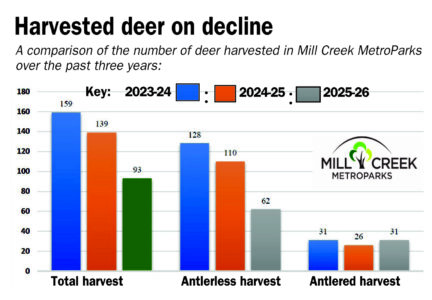
YOUNGSTOWN -- The end-of-year summary of deer reductions in the Mill Creek MetroParks last fall and winter puts the number at 93 deer killed by hunters selected through the Ohio Department of Natural Resources hunting lottery system -- the lowest number removed over the first three years.
The number of deer removed by hunters was 159 the first year and 139 the second year, according to the newest numbers in this year's end-of-year summary. The total was 197 deer the first year when adding the 38 killed by sharpshooters in Mill Creek Park the first year. The total was 214 the second year when adding 75 deer killed by sharpshooters.
The total for the hunting and sharpshooting done last fall and winter is 143 when adding the 50 removed by sharpshooters. The three years together total 388 removed by hunters and 554 overall.
When Mill Creek MetroParks Natural Resources Manager Rachel Sobnosky was asked whether the fewer deer removed last fall and winter by hunters suggests that the deer population is decreasing, she stated that the numbers "could be consistent with a reduction in the deer population, particularly given the program's emphasis on antlerless harvests."
But she stated that "harvest totals alone don't provide a direct measure of population size. Factors such as weather conditions, hunter participation and deer behavior can all influence annual harvest numbers."
Asked whether the 93 hunter reductions mean the program has been successful in moving toward the goal of reducing the deer population, Sobnosky stated in an email, "The program is designed to reduce deer densities over time, and a continued downward trend in harvest could align with that goal. That said, it's important to evaluate success using multiple data sources over several years rather than relying on harvest totals alone."
When she was asked whether the 93 deer removed by hunters suggests that the number removed in the upcoming year also is likely to be lower, she stated that it is "difficult to predict future harvest totals. Annual harvest can vary based on a number of factors, including environmental conditions and hunter participation, so we would expect some variability from year to year."
However, when Sobnosky was asked whether the 93 deer removed by hunters suggests a possible time when the deer reductions may no longer be necessary, she stated, "Deer management is typically an ongoing process, particularly in an open system like the MetroParks, where deer can move freely between park properties and surrounding areas.
"Even if population goals are achieved, continued monitoring and management are generally necessary to maintain those conditions over time. Management approaches may evolve as conditions change, but it would be unlikely to eliminate the need for management entirely," she stated.
HUNTING PHILOSOPHY
The 2025-26 end-of-year summary offered some remarks on the 93 deer removed by hunters.
"The use of regulated hunting has proven to be a safe, effective and ethical tool to manage wildlife populations for long-term sustainability at the national, state and local levels. Controlled hunting programs have been successfully implemented by other park districts and municipalities across the state to successfully manage white-tailed deer populations in urban, suburban and rural environments," the summary states.
Hunting took place at the following parks this year: Collier Preserve, MetroParks Farm (archery only), Sawmill Creek Preserve, Mill Creek Wildlife Sanctuary, Springfield Forest, Hawkins Marsh, Vickers Nature Preserve, Huntington Woods (archery only) and Hitchcock Woods (archery only).
The archery hunting dates were Sept. 28 to Nov. 22, 2025; and Sept. 28, 2025, to Jan. 31, 2026, in Hitchcock and Huntington Woods.
The firearm hunting dates (all properties excluding Hitchcock, Huntington Woods and MetroParks Farm) were Nov. 29 and 30, 2025; Dec. 6 and 7, Dec. 13 and 14, Dec. 20 and 21, and Dec. 27 and 28.
SAFETY
The end-of-year summary reported that during last year's deer reduction program, there was "extensive law enforcement oversight, including multiple (ODNR) wildlife officers from the Ohio Division of Wildlife and Mill Creek MetroParks Police Department.
The report stated that there were zero safety-related incidents reported, zero incidents of hunters trespassing onto neighboring properties or hunter harassment and no instances of illegal "baiting" or injured deer.
The Mill Creek MetroParks Police Department "routinely monitored hunting areas and oversaw facility closure / traffic control" for the deer removals that involved USDA-employed sharpshooters in parts of Mill Creek Park south of Youngstown. There were no safety-related incidents involving that part of the program, the document states.
Hunters reported no incidents in which hunters were deliberately harassed. There was one incident in which a non-hunting park user was off-trail in Hitchcock Woods in Boardman during hunting, the report states. A hunter reported the matter to MetroParks staff after the hunter's time period to hunt was over, "resulting in no actions being taken," the document states.
NO HUNTER SURVEY
The end-of-year summary notes that Sobnosky did not carry out a post-hunt survey of hunters this time as had been done the two previous years. The reason was "a transition in program management," the report states.
Sobnosky became natural resources manager in 2025, taking over after former natural resources manager Nick Derico left for another job in July.
Sobnosky stated in the report that ODNR conducted a similar survey, but the results of that survey in some cases provided "limited insight into hunter experiences" and were "not directly comparable to prior years due to differences in survey administration and response rates."
When Sobnosky was asked to further explain the reason Mill Creek MetroParks did not carry out its own survey, she stated that "during the transition in program management, the timing and administration of the internal post-hunt survey did not carry over as it had been conducted in previous years. Once it became clear that the survey had not been distributed during the appropriate window, we determined it was best not to administer it late, as that could have affected response quality. Instead, we relied on harvest data and a similar survey conducted by the Division of Wildlife, which provided comparable information for evaluating the season."