

California congressman’s heartland tour makes stop at Ultium Cells
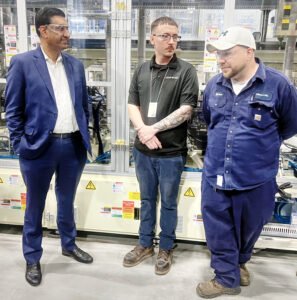
Correspondent photo / Chris McBride U.S. Rep. Ro Khanna, D-California, left, speaks with Ultium employees Paul Wright and Nate McCann during his Ultium Cells visit in Lordstown Friday. Khanna is the ranking member of the U.S. House Select Committee on China.
WARREN — U.S. Rep. Ro Khanna during a visit to Ultium Cells Friday morning called for renewing electric vehicle tax credits and blocking Chinese battery companies from U.S. incentives as he stated federal support is “critical” to reviving manufacturing jobs locally.
The California Democrat visited the Ultium Cells facility for a tour as the plant has idled more than 1,000 workers amid slower EV sales following the end of a federal $7,500 consumer tax credit.
“This is such an impressive facility,” Khanna said.
His visit was part of the congressman’s “Heartland Tour,” where he has been discussing restoring manufacturing, job creation and EV technology. It began Thursday in Pittsburgh, included the Friday stop in Lordstown and was to conclude with a stop in Michigan.
He highlighted workers who had been laid off when the nearby General Motors assembly plant closed and were able to return for jobs with Utium.
“This is providing a good living. It’s allowing America to lead when it comes to battery technology,” Khanna said.
He outlined three priorities: Preventing Chinese firms from receiving U.S. production tax credits, restoring the EV tax credit to boost demand and expanding charging infrastructure.
He said electric vehicles make up only 5% to 6% of U.S. sales and argued that stronger policy support could push that higher while creating jobs.
“EV tax credits were taken away, and it’s literally taking jobs away from people here in Warren,” he said.
Khanna also framed EVs as a national security issue, noting that high gas prices leave the U.S. vulnerable to foreign oil producers. He urged lawmakers to depoliticize the issue and focus on American manufacturing and consumer choice.
Thomas Gallagher, vice president of operations at Ultium Cells, said the company initiated market-driven layoffs in January after EV sales slowed when the consumer tax credit ended in September.
He said the workforce reduction is tied directly to lower demand from GM. The company hopes to recall workers in the third quarter between July and September but has not set a firm date, he said that any restart will prioritize quality and safety.
Gallagher also noted the facility is investing downtime in maintenance, equipment upgrades and maintaining clean-room conditions to emerge stronger.
He said production is down significantly — by as much as 50% in some cases from 2024 levels — but Gallagher said the company remains focused on supplying GM’s lineup of electric trucks and SUVs.
George Goranitis, president of UAW Local 1112, described the slowdown as painful for a region long hit by industrial losses from steel mills to the Lordstown plant closure. He said the $7,500 tax credit helped drive earlier demand and its removal contributed to the current challenges.
Goranitis, who once relocated to Tennessee after the GM plant shut down, spoke of personal hardships, including family moves, divorces and other stresses, that ripple through communities when a large employer closes its doors.
Workers who spoke with Khanna during the tour were cautious, but optimistic. Some described the battery plant as a chance to return home after years away and voiced belief in the long-term potential of the technology despite current ups and downs in the auto industry.
Khanna said he would push colleagues in Congress for an emergency extension of EV tax credits, particularly given current gas prices, and argued the policy supports blue-collar workers in areas that backed Republican President Donald Trump.
The congressman also stressed the need for continued research funding to drive down battery costs, which he said represent about 25% of an EV’s price.
He praised the Ultium plant for relying on American innovation and intellectual property rather than licensing foreign technology.
Plant officials said they have no plans to shift production at the Warren site to other battery types, such as those for data centers. They are consolidating EV battery manufacturing here while another LG facility handles energy storage.
Khanna said broader investment in chargers, especially in the nation’s interior, is essential to ease “range anxiety” and build consumer confidence.
He argued that seeing American jobs tied to EVs could shift public perception from climate debates to economic renewal in places like the Mahoning Valley, which has struggled since the days of Black Monday in the 1970s.
Local News
Man arrested in aggravated robbery with deadly weapon
YOUNGSTOWN — A man, 32, was arrested following the aggravated robbery of a cellphone store on Mahoning Avenue on ...

Man gets two years in prison for ‘deliberate act of violence’
Coitsville trustees respond to concerns over reopening of McGuffey Preserve
Man sentenced to 2-3 years of prison on bribery, protection-order violations
YOUNGSTOWN — Judge Anthony Donofrio of Mahoning County Common Pleas Court sentenced Edward D. McLane Sr., 40, of ...

DeWine vetoes Valley rep’s bill on submetering
YNDC gets $1M grant for Glenwood Avenue cleanup work
YOUNGSTOWN — The Youngstown Neighborhood Development Corp. received a $1 million federal grant to clean up at ...