

Poland vet reveled as member of Old Guard
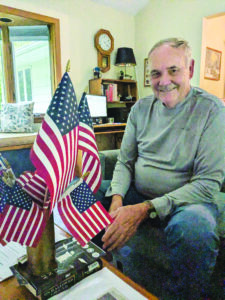
Staff photo / Brandon Cantwell Frank DeRhodes, 77, of Poland, was drafted into the Army in 1967 and served as a member of the Old Guard.
EDITOR’S NOTE: To suggest a veteran for this series, which runs weekly through Veterans Day, email Metro Editor Marly Reichert at mreichert@tribtoday.com or call her at 330-841-1737.
POLAND — Frank DeRhodes’ time in the Army could be punctuated by several major events: the death of a civil leader and an attorney general, and a 21-gun salute hiccup during a state funeral.
A Youngstown State University student prior to receiving his draft notice in 1967, DeRhodes said he told his dad he was “going on vacation” when he handed it to him as he returned home from work.
“I knew I was going to get drafted, probably, because I was going to YSU and I got a D in a five-hour class. And so I knew that was going to take away my deferment,” DeRhodes said. “I was just waiting on the letter. I knew it was coming, and I just figured I’d go. I didn’t have any thoughts of trying to get out of it. I just accepted it.”
DeRhodes was stationed at Fort Knox, Kentucky, for basic training, later going to Fort Ord, California, for advanced infantry training as a gunner on a mortar. DeRhodes said he felt at home while at Fort Knox because he was around people from a similar background, but Fort Ord exposed him to unfamiliar territory.
“I got a different mix of people. You got different, a lot of different ideas there than at Fort Knox because Fort Knox, most of the guys that you run into were from Ohio, Indiana, PA, Kentucky,” DeRhodes said. “But when you go to California, we had guys from all over the West; they were from everywhere and you started to get the feeling you were all going to Vietnam.”
DeRhodes admitted that he never figured out how he got involved with the Old Guard — the Army’s oldest active duty infantry unit, ceremonial unit and president’s escort, as well as Washington D.C.’s security in civil disturbances or national emergencies.
“The only thing I can tell you is at the time that I got there, I found out you have to be a certain stature. Everybody was between 6 foot 1 and 6 foot 3 and I qualified on all the tests that they had. Whether that had anything to do with me getting selected to go there or not, I have no idea. In fact, when I got the orders, I had no idea what it was,” he said.
The Old Guard, even today, demands a degree of perfectionism in all aspects — conduct, uniform and concentration. DeRhodes said he saw his fair share of people who left because they couldn’t handle it.
DeRhodes was part of the Old Guard when the riots following Martin Luther King Jr.’s assassination happened, patrolling D.C.’s streets. They arrested anyone without any identification permitting them to be there, which was nearly everyone but police officers, DeRhodes said.
“It was a mess. When we got the orders that we were going into D.C., we thought, ‘oh boy, we’re gonna have fun now.’ It wasn’t fun at all, it was pretty serious,” DeRhodes said. “And the people that you caught, most of them had weapons on them and at that point in time, it wasn’t guns, although we were shot at a couple times. Most of them had knives. One guy had a sharpened screwdriver.”
DeRhodes said he handled the basic responsibilities, such as cannon salutes for dignitaries, funerals and flag officers as a sergeant, but was assigned other things like helping to plan President Richard Nixon’s inauguration ceremony and Attorney General Robert Kennedy’s funeral.
DeRhodes said they plan the funerals of important figures like former President Barack Obama or Bill Clinton years in advance, but Kennedy’s assassination sent them into the unknown.
“With Robert Kennedy, he was assassinated. There was no plan, and so it jumped around. They had all different kinds of plans flying,” DeRhodes said. “We didn’t even know for sure that he was coming to Arlington. And finally it was said, ‘OK, he is coming to Arlington.'”
DeRhodes assumed Nixon’s inauguration would be the last major affair he’d be involved in, but then President Dwight Eisenhower died, filling D.C. with people from across the world for his state funeral.
A lesser known fact, DeRhodes said, was that the funeral’s 21-gun salute was off by four seconds, a big deal considering they plan events down to the minute.
“He was going to Kansas to be buried, and so we had orders that we were to give his second 21-gun salute when he came down Constitution Avenue and turned on Delaware, we were to start firing a 21-gun salute, and that salute was supposed to end with the 21st round being fired when (Eisenhower’s) hearse stopped at Union Station,” DeRhodes said. “The lieutenant that was in charge of us was a new guy to the Old Guard. He had been there for about a month. He was in a panic, so when it turned the corner, he wasn’t firing the round. And so I fired the round.”
DeRhodes said while they timed it out and it looked on time, they found it to be four seconds off upon arrival to Union Station. However, he said no one caught it and their lieutenant colonel praised them.
Eisenhower’s funeral led to a change of protocol in similar situations, including a sentry where each round is supposed to be fired to time things perfectly.
DeRhodes has managed to stay busy after retirement, focusing on hunting, trap shooting and fly fishing, giving seminars on the latter at the Middletown Sportsmen’s Club every summer.
He also does maintenance for his church and teaches an adult Sunday school class.