
Marine goes from Ursuline to Vietnam
Trending
CANFIELD -- Marine Corps veteran Paul C. Boucherle spent his military life working on black boxes as part of a specialized mission in Vietnam in the 1970s.
Boucherle grew up on the North Side of Youngstown and attended Ursuline High School. He graduated in 1970, and already had committed to military service.
"As the middle child of three, I wanted to prove myself by taking on something difficult," Boucherle said. "I joined the Marines during my senior year at Ursuline."
Because he was 17 at the time, his parents, Charles H. and Nancy Boucherle, had to sign for him. His brother Charley and sister Mary were both college bound, but Boucherle wanted to go a different route.
"School bored me," he said. "I had more interest in seeing the world and experiencing it."
On Sept. 20, 1970, Boucherle headed for boot camp at Parris Island Marine Base in South Carolina. Entering with him was Al Bowman, who played football at Ursuline. At recruitement, they were asked if they wanted to enter under the buddy program where two from the same community could serve together.
Bowman and Boucherle were an odd pair. Bowman was 6-foot-5, 260 pounds. Boucherle was the opposite, standing 5-foot-6, weighing 125.
"We were like Mutt and Jeff," Boucherle said. "The Marines typically pick on the biggest and the smallest, so we both got it."
Boucherle and Bowman completed training Nov. 30, 1970. Both were sent to Camp Lejeune, N.C., to begin training in advanced weaponry. Because Boucherle excelled at electronics, he went to Memphis, Tenn., for six months of training. From there, he was assigned to HAMS 14 (Headquarters Maintenance Service) and began working on the Grumman EA-6A aircraft.
Boucherle explained the EA-6A had most of its weapons removed and replaced with some high-tech, radar-jamming equipment.
"The job of the converted aircraft was to fly in ahead of an Alpha strike or bombing run to jam enemy radar and communications," Boucherle said. "Our planes picked up signals from radar and we could confuse it and, if close enough, could melt their screens."
Boucherle's actual job involving the AE-6A was in "bench-level repair." He said each aircraft had 16 black boxes that controlled the functions of the aircraft. Those boxes were checked out using an analog computer to simulate what happens in flight. If one of the boxes failed, it was Boucherle's job to find out why and fix it. Some of the boxes had up to 50 replaceable modules in them.
Once Boucherle completed his specialized training, he was assigned to VMCT-2 -- Marine Composite Reconnaissance Squadron Two -- and was to report to the USS Saratoga aircraft carrier in Florida. For 40 days, Boucherle served on the ground crew aboard the ship as the pilots of his unit's 12 aircraft got their certification in landing on a carrier at sea. That was in early 1972.
After the 40-day certification period, Boucherle's unit got a 30-day shore leave, but that ended April 14, 1972, when all leaves were cancelled and the unit had to return to the Saratoga to depart for Vietnam -- a 28-day journey. The day before the ship was to depart, the military made the decision to send his unit via commercial aircraft to Vietnam as the AE-6A aircraft were needed immediately.
Boucherle said his unit boarded a Northwest Airlines commercial plane and headed to the Philippines, where it was married to VMCJ 1, the sister unit. Together the two units were moved to the Subic Bay Naval Port in the Philippines.
From the Philippines, Boucherle said the unit was flown daily to Da Nang, Vietnam, to work 12 to 14 hours servicing the AE-6A aircraft.
"Every single day we flew into Da Nang on two C-130 aircraft with a lot of replacement black boxes," he said. "We were the ground support for every mission and we had to keep our aircraft in the air."
He said during daily work in Da Nang, the base constantly was attacked by rockets. The aircraft were sectioned into walled areas that prevented the loss of multiple aircraft from one rocket. When the strikes came, Boucherle and his comrades had to seek shelter in sandbag bunkers. He said normally eight to 10 rockets came in a strike.
Boucherle helped keep the American planes in the air for close to a year. On Jan. 27, 1973, the Paris Peace Accord was signed and the following day, Boucherle's unit left Vietnam and headed home to a different world.
"When we landed at a San Francisco airport, we were still enlisted, but were told to not wear our uniforms in the public airports due to soldiers being harassed," Boucherle said. "I was spit on."
He said even people he had attended school with changed their opinion of those who served in Vietnam.
"They didn't want to accept our service," he said. "I was just as angry as the next guy, but I put my energy into doing something instead of turning to drugs and alcohol as so many did."
In September 1974, Boucherle was honorably discharged and returned to civilian life. He immediately signed up for classes at Youngstown State University to study electrical engineering.
In January 1975, Boucherle was hired by the city of Youngstown as a traffic signal lineman. He said he enjoyed that job for two years before being hired at ADT in 1977.
"At ADT, I was an alarm service investigator," Boucherle said. "I worked midnight shift for five years. When a burglar alarm went off, I would notify police and then head to the site (of the alarm) with my tool box and armed."
He graduated with an electrical engineering degree after 6 1/2 years at YSU and earned a Bachelor of Science degree in business administration. He said he didn't have a lot of time to relax as he was working 40 to 50 hours per week while attending YSU as a full-time student.
"All those 18-hour shifts in the Marine Corps paid off," Boucherle said.
After graduation, Boucherle transferred to the Columbus ADT where he met a secretary -- Jayne Duffett of Canfield -- and then married her. The couple moved to Canfield and bought the house next to the home where Jayne grew up. They help her father, Daryl Duffett, who recently turned 100.
After 21 years with ADT, working his way up to director of national accounts, Boucherle left to start his own business. He opened Matterhorn Consulting, named in honor of his great-grandfather, Louis Boucherle, an immigrant from Switzerland.
Boucherle also is a writer and has a column in a magazine for the security industry.
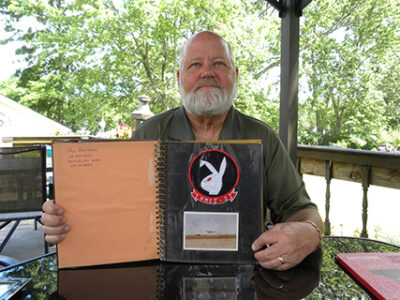
He keeps photos of his time in Vietnam and has his unit's patch, the head of a Playboy bunny. He said his unit was known as "The Playboys." He said the logo was controversial in the states, so it was only used on ships at sea.
Paul C. Boucherle
AGE: 69
RESIDENCE: Canfield
SERVICE BRANCH: U.S. Marine Corps
MILITARY HONORS: Vietnam Service Medal
OCCUPATION: Business security consultant, certified protection professional
FAMILY: wife, Jayne Boucherle; children, Brian and Lauren