

Ohioans still seek unemployment benefits
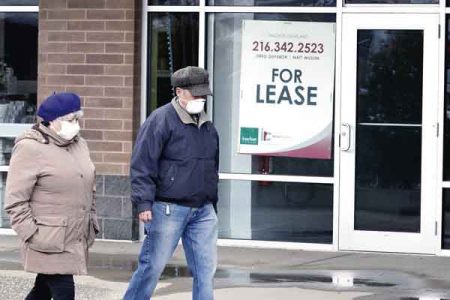
Two people walk past a closed storefront April 16 in University Heights. Ohio has seen 1.16 million claims for jobless benefits since March 15 because of the coronavirus pandemic. AP/Tony Dejak
Nearly 53,000 out-of-work Ohioans and almost 3 million laid-off workers across the U.S. sought unemployment relief last week as the COVID-19 outbreak continues to be an anchor on the economy.
Thursday’s jobless reports come as most states have begun to ease restrictions on businesses and stay-at-home orders to slow the spread of the virus. But those orders badly depressed the economy and caused jobless numbers unseen since the Great Depression.
Ohio this week began to let some businesses start to reopen, including in-store consumer, retail, barbers and salons. Restaurants and bars can reopen today, but for outside areas only. Dine-in service begins next week.
Ohio received 51,125 new unemployment claims last week, pushing the total to 1.16 million claims in the eight weeks since the state put into place its stay-at-home order, according to the Ohio Department of Job and Family Services.
Of the new claims, there were 951 in Trumbull County, marking the first time since mid-March the number fell below 1,000. It also represents the least amount of claims filed in two months.
In Mahoning County, there were 1,051 new claims, also the least amount filed over the period.
The state has paid out more than $2.4 billion in unemployment compensation to more than 587,000 claimants, and of the claims filed, about 90 percent have been processed.
In the U.S., the more than 3 million new claims pushes the total to more than 36 million, according the U.S. Department of Labor. An additional 842,000 people applied for aid last week through a separate federal program set up for the self-employed and gig workers.
Claims are down 57 percent from their peak of near 7 million in late March, but are still “at levels that would have seemed unconceivable a couple months ago,” Gus Faucher, chief economist for Pittsburgh-based PNC Bank, said.
“Claims were running at a pace of slightly above 200,000 per week in early March, prior to the viral recession. And the previous all-time high for claims was less than 700,000 during the 1982 recession,” Faucher said. “What the U.S. economy has experienced over the past couple of months is simply unprecedented.”
Despite the pace slowing, the labor market remains under tremendous pressure — with the key question being how quickly can businesses rehire workers as restrictions are lifted, Faucher said.
“If businesses are able to quickly restart and hire back their workers, the permanent hit to the economy from the viral recession would be limited,” Faucher said. “But if businesses remain closed, either because they cannot reopen or their customers won’t return, then temporary job losses would become permanent, extending the viral recession and weighing on the eventual recovery.”
The latest jobless claims follow a devastating jobs report last week. The government said the unemployment rate soared to 14.7 percent in April, the highest rate since the Great Depression, and employers shed 20.5 million jobs. A decade’s worth of job growth was wiped out in a single month.
Most economists have forecast that the official unemployment rate could hit 18 percent or higher in May before potentially declining by summer.
The Associated Press contributed to this report.
rselak@tribtoday.com