
What’s not to love about salvia?
Trending
For me, salvia (sage) checks all the boxes as a nearly perfect flower garden plant.
They are easy to grow, drought tolerant once established, available in a range of colors and sizes, great in containers or beds, and finally, pollinator magnets.
As a genus that boasts more than 1,000 species made up of annuals, biennials and perennials, there is something for everyone. And let's not forget the mouth-watering aroma it gives to a stuffed turkey on Thanksgiving!
The genus salvia is part of the mint family, which explains the square stems, aromatic foliage, deer and rabbit resistance, and growing ease. This genus has worldwide distribution with many in the Mediterranean countries and Mexico reaching the size of small shrubs.
They grow best in full sun and well-drained soil, and when grown where they are happy, there will be few disease and pest problems.
Salvia's foliage can be glossy or fuzzy, according to Iowa State University.
The flowers are tubular with a split lower petal arranged in spikes above the leaves. Many perennial varieties develop a deep taproot over time; others have an extensive root system, both leading to drought tolerance. They will rebloom if deadheaded after the first flush of bloom, and if they start to look rough by mid-summer, a hard prune will result in new growth and bloom.
I have had cultivars of perennial salvia in my gardens for years. Colors range from deep purple to blue, pink, magenta, white and a blue/white variety I really like. Some reseed, especially "May Night." If they become overwhelming, I dig out the extras and transplant them to a new location.
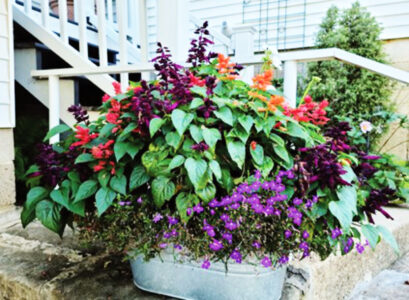
Although the perennial varieties are garden "workhorses," it is the annuals that put on the best show. Their spikes of bloom offer a much wider color palette from deep red and purple to various pastels. Their height and width can range from 1 foot to 5 feet. Removing the spent blooms encourages more flowering, continuing until frost.
The University of Minnesota lists four main species of ornamental annual salvias: coccinea (Texas sage), farinacea (mealycup sage), splendens (scarlet sage) and patens (gentian sage). In trials, they rated the following as good to excellent: Purple & Bloom, Victoria Blue, Rockin' Series, Mystic Spires and Sallyfun Series.
It is recommended that large varieties should not be used in containers and I have filled large holes in borders with them. However, I have discovered that if the container is large enough, it will accommodate a large plant without the risk of blowing over.
As for the pollinators, observe bumblebees feeding on salvia. Because they cannot reach the nectar through the long tube, they will chew a hole in the side of the bloom to feed. Hummingbirds love tubular flowers and will be faithful visitors.