Tree crickets give summer concerts nightly
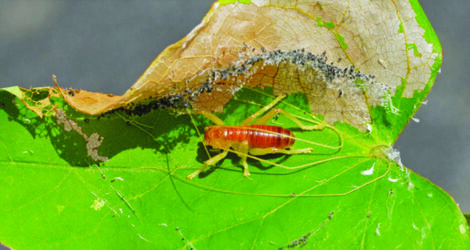
Submitted photo ... This image shows a Carolina leaf-roller cricket. Tree crickets are rarely seen, but their summer symphonies are familiar sounds.
Spending my summers in Mississippi, I remember hot, humid nights full of sounds. I love those sounds and now know these as the songs of katydids and crickets.
I did not realize these sounds are duplicated up here until I went to presentations Dr. Lisa Rainsong presented for the Ohio Certified Volunteer Naturalists.
Fast forward — I was out examining my houseplants on the porch when I discovered one of my favorite insects, the tree cricket.
These soft green, long-bodied insects are noted for long back legs, narrow 1/2- to 1-inch bodies, very long antennae and gossamer wings.
The most amazing thing about these beauties is their song. In late summer, the crickets, katydids and grasshoppers emerge to eat, sing and mate. All night into the early morning hours, the cacophony of the chorus is magnificent.
The family Orthoptera (crickets, katydids and grasshoppers) has up to 20 species in the north and all are omnivores, with tree crickets being classed as predators, eating aphids, scales and other soft-bodied insects, as well as plant materials. So, they sing and are a beneficial insect!
Living at least a foot off the ground, many tree crickets are never seen, living on shrubs, trees and flowers. At night, the male uses his wings to rub a rasp and file to make his song, called stridulations.
Air temperature can affect the sound and frequency of the songs. Indeed, scientists have worked out a formula to count the chirps, and through calculations, you can figure out the temperature. Females are attracted to base songs. When a female responds to the male’s song, the couple begin courtship with a dance lasting up to an hour, including antennae waving. The male lifts his wings to display his “honey pot,” a trough between his wings holding a fluid made by glands to promote egg production. She drinks the fluid and they mate.
Females have a sword-like ovipositor to lay her eggs in the bark of trees, or stems of plants, and covers them with frass (a mixture of mouth fluids and feces). The following summer, these new insects will emerge as nymphs. Through incomplete metamorphosis (egg to nymph instars to adult), these young go through five stages of instars to mature adults. The cycle is complete.
Ohio is on the verge of this nightly symphony as these insects strive for their imperatives of eating and reproduction to ensure the next generation. I am so excited to have a front row seat!
To learn more about tree crickets, go to https://go.osu.edu/treecricket .
There are many other insect symphonies during this time of year. Take some time to sit outside and enjoy nature.
Hughes is a Master Gardener Volunteer for the Ohio State Univeristy Extension in Mahoning County.
Lifestyles
Religion news
102 YEARS: The 102nd anniversary of New Bethel Baptist Church, 1507 Hillman St., Youngstown, where the Rev. Kenneth ...
Diocese receives national Catholic Media awards
The Catholic Diocese of Youngstown and The Catholic Echo Magazine earned 10 awards at the 2026 Catholic Media ...

The necessary components of an estate plan
DEAR ANNIE: Running out of reassurances for worried mom
DEAR ANNIE: I am an adult now with grown siblings, but it seems my mother’s anxiety is growing right along with ...

FRIDAY EVENING TV LISTINGS