Tour strolls through city cemetery and US history
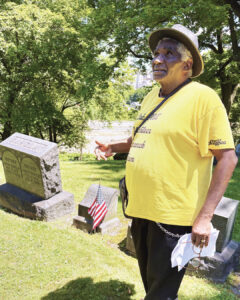
Correspondent photo / Sean Barron Steffon Jones, a longtime area historian and Civil War reenactor, gives a brief presentation during a tour Saturday of Oak Hill Cemetery in Youngstown about Thomas Anderson, who fought in the War of 1812 and may also have seen combat in the Revolutionary War. Anderson’s headstone is marked with an American flag. The tour was part of area America250 events.
YOUNGSTOWN — Capt. James S. Gibson’s life trajectory was largely an east-to-west journey, the endpoint at which he settled in the Mahoning Valley.
However, his travels were anything but smooth sailing — or riding.
“In 1763, he left his family and went to Cumberland County, Pa., with friends,” Steffon Jones, a longtime area historian and Civil War reenactor, said.
After that, Gibson, who was born in Tyrone County, Ireland, fought in the Revolutionary War as part of the U.S. Army’s 4th Battalion Cumberland Militia. Gibson and his company of volunteers spent much of five years fighting Native Americans, Jones said.
Gibson was among the six veterans who fought in the Revolutionary War or the War of 1812 who were the centerpiece of a one-hour tour Saturday at Oak Hill Cemetery. The event also represented a partnership between the Oak Hill Volunteer Research Team and a team from the Public Library of Youngstown and Mahoning County.
In addition, the gathering was to celebrate the nation’s 250th anniversary.
The other five men were Jonathan Smith, William Wick, William Holland, Daniel Shehy and Thomas Anderson.
In 1799, Gibson and his family sold their Cumberland County farm, traveled over the Allegheny Mountains via wagons through Pittsburgh and Beaver County, Pa., before arriving on the Mahoning River and settling first in Warren for several weeks, then in Youngstown. Gibson found Warren unsuitable for property, so he stayed on land near a spring off what is now Poland Avenue, then bought about 289 acres from John Young, who was Youngstown’s founder.
In addition, Gibson enjoyed farming and “grubbing,” which is digging to remove unwanted buried roots and debris,” and did both to pay his room and board, Jones said.
Anderson, who served in the U.S. Frigate Constitution during the War of 1812, also spent four years with the British government. In addition, he may have fought in the six-year Revolutionary War in the late 1770s at age 17, but that remains unclear, Jones said.
“I’m kind of skeptical about him fighting in the Revolutionary War,” he said.
Anderson, who died at 88 or 89, also spoke seven or eight languages, Jones added.
Elizabeth Carnahan, a genealogist with the main branch of the Public Library of Youngstown and Mahoning County, spoke to a crowd of several dozen who attended the tour about Smith and Wick, saying the latter was an enlisted private in the New Jersey militia before coming to Youngstown. He also retained that ranking throughout the war, she said.
After the war, he received a $23.36 monthly pension, “which was pretty generous,” Carnahan added.
In March 1787, Smith enlisted in the 5th Virginia Regiment as a lieutenant before moving to the Mahoning Valley in 1820, where he spent 20 years before relocating to New Castle, Pa., where he died in 1847 at 92 and is buried, she noted.
Narrating parts of the lives of Shehy and Holland was Susan Wojtowicz, who is with the volunteer research group.
“He was an outspoken enemy of the British government,” she said about Shehy, whose bitterness, presumably, was attributable largely to two relatives who had been brutally executed in Ireland for being Catholic and opposing British policies, Wojtowicz said.
After leaving his native Tipperary County, Ireland, Shehy had $2,000 in gold to invest, along with an accepted proposal to relocate to the Connecticut Western Reserve, she added. Later, Shehy came to Youngstown, where he bought 1,000 acres — 400 on one side of the Mahoning River and 600 on the other.
Eventually, however, he and John Young became embroiled in a land dispute that apparently began when Young sold to another purchaser the property Shehy had agreed to buy, Wojtowicz said. She added that Shehy was jailed and fined $25 for threatening Young’s life before their differences were settled amicably.
While in the Revolutionary War, on Sept. 11, 1777, his unit fought in the Battle of Brandywine at Chadds Ford, Pa. The battle, led by Gen. George Washington, was the largest one-day engagement, where “nearly 30,000 soldiers on 35,000 acres squared off to defend Chadds Ford,” Wojtowicz noted.
On Dec. 19, 1777, Shehy’s unit marched to Valley Forge, Pa., and set up a winter encampment, under Washington’s command. Three months earlier, the Second Continental Congress had been forced to flee Philadelphia following Washington’s defeat during the Battle of Brandywine. As a result, the future president led his 12,000-member Army to Valley Forge, where many of them suffered the effects of prolonged cold, starvation and disease, Wojtowicz said, adding that others were captured and imprisoned.
On June 28, 1778, Shehy and his men also fought in the Battle of Monmouth near present-day Freehold Borough, New Jersey, after Washington had attacked rearguard elements of the British Army. The battle also pitted the Continental and British armies against each other, and it marked the final battle of the Philadelphia campaign after Washington’s troops had suffered two defeats at the hands of the British. The last battle resulted in the British Army’s withdrawal.
Nevertheless, the Battle of Monmouth was hard fought, with many troops “dressed in rags at that camp in Monmouth,” then having to endure months without pay, Wojtowicz explained.
Holland, whose birth and date of death are unknown, also fought in the War of 1812 and Revolutionary War — specifically, in the Battle of Brandywine, she said. He was from Montgomery County, Maryland, and became one of Youngstown’s earliest settlers.
“He was an early resident of Youngstown when it was still part of Trumbull County,” Wojtowicz said.
At one point, Holland was stationed at present-day Sandusky to protect against British incursions from Lake Erie, she added.
The next Oak Hill Cemetery tour is set for noon to 1 p.m. Aug. 8, when area police officers and firefighters will be honored.
Local News
Nature guides America250 festivities
AWL seeks donations following animal rescues
VIENNA — The Animal Welfare League of Trumbull County is seeking donations following the rescue of 56 animals in ...
Historic cemetery in North Jackson gets new lease on life
Storms whip in damage in the Valley
WARREN — While most of Sunday was sunny with clear skies, by late afternoon skies turned dark and severe ...

Juneteenth events set in Valley