
Nature guides America250 festivities
Mosquito Lake State Park participates in Ohio 250 BioBlitz
Trending
BAZETTA -- A sunny Saturday at Mosquito Lake State Park found locals filling up the beach, fishing, taking out their boats, walking their dogs and more. For a small group of nature lovers, it meant time for the Ohio 250 BioBlitz.
The event presented an opportunity to explore, learn and celebrate the beauty of the park's biodiversity and conservation history. Hosted as part of the America250 festivities, a lineup of programs and wildlife experiences took place all weekend.
"The Ohio BioBlitz is an amazing idea to introduce people of all ages to citizen science," said Mason Kyle, a volunteer with Mosquito Lake through Scouting America and the Ohio Chapter of the American Chestnut Foundation (Ohio TACF). "It's important to introduce everyone to nature so that they can learn to love and appreciate it. Only by experiencing and understanding nature will people be encouraged to protect it."
A lifelong Cortland resident, Kyle said, "Ever since I was a kid, I have loved going to Mosquito Lake, fishing and hiking around the park. I grew up heavily involved in scouting, so I was constantly outside exploring my surroundings."
With a background in physical sciences, he's a student at Ohio University, studying meteorology and Geographic Information Systems as well as a conservation intern at the Trumbull County Soil and Water Conservation District.
"Our local event at Mosquito Lake was developed through conversations between myself, Mason Kyle, and local Scoutmaster Ed Detre," said Jason Lee, part-time naturalist for Mosquito Lake State Park and Nelson-Kennedy Ledges State Park as well as a Howland High School science teacher.
"We wanted to create an event that combined citizen science, education and community involvement while highlighting the incredible diversity of life found in and around Mosquito Lake," Lee added.
Friday's events included the "Owl Prowl" with a guided evening hike to listen and look for barred owls in the campground, and "Mothing: Discover the Magic of Moths After Dark."
On Saturday, the BioBlitz continued with Lake to Plate Fishing at the marina, guided walk with U.S. Army Corps of Engineers, wildlife show and a documentary screening of "Wild at Heart," which highlights Mosquito Lake.
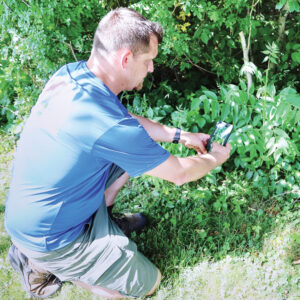
Most importantly, participants documented the biodiversity of the park by using the iNaturalist app on Saturday.
"The event brings together naturalists, conservation organizations, educators, volunteers and community members to document as many species as possible while introducing participants to the tools and techniques used in modern biodiversity monitoring," Lee said.
More than 60 naturalists cataloged what they found -- plants, trees, insects, birds, fish, amphibians, mammals -- with the iNaturalist app, which also gave the GPSinformation for an exact location. They were able to hike around two-thirds of the park, south of the causeway and down to the dam.
"We didn't want anything north of the causeway," said Lee. "I don't want anybody to think that just because we're doing this program they can go in the Nature Preserve because it's illegal to step in there. I have to get individual permits throughout the year to take people there. So, that's a very special place."
According to Lee, there were 456 observations with 236 species "100% identified" as of Sunday afternoon.
However, he added, "There is still the difference to be looked at. So, the absolute number won't be known for a few days but we will be over 250."
Noting the importance of iNaturalist, Lee said, "When you think about citizen science and having everyday people work together, you can take that information and actually do something with it."
Discussing the app, Kyle said, "It was awesome to be able to use iNaturalist for the BioBlitz at Mosquito Lake. I have used it for years to help with projects for scouting and school. More recently, I used it to begin tracking surviving American chestnut trees around Ohio. It's a great educational tool to help people learn more about the living world around them."
As an example of the app's usefulness, Lee brought up the Tree of Heaven, an invasive plant species he had just catalogued by using the app.
"You can then see where it's around the park and do we need to do something with invasive species here or that particular invasive species? This is an individual 24-hour snapshot that we can look at and see how we are going to handle some of this stuff," he said.
Emphasizing the importance of the weekend's program, Lee said, "The Ohio 250 BioBlitz is an incredible opportunity to celebrate Ohio's natural heritage while creating meaningful scientific data. One of the most exciting aspects of the project is that it relies heavily on citizen science. Every observation submitted helps scientists, land managers, educators and conservation organizations better understand the biodiversity of our state.
"Just as importantly, the BioBlitz helps connect people to nature. When someone identifies their first bird, discovers a rare wildflower, photographs an insect or learns how to use a platform like iNaturalist, they become invested in the conservation of those species and habitats. Conservation begins with awareness, and awareness often begins with simple observation.
"The BioBlitz is about much more than counting species. It is about creating connections between people and the natural world while contributing valuable information that can be used for conservation and research."