

Foes of Poland library move vow to battle on
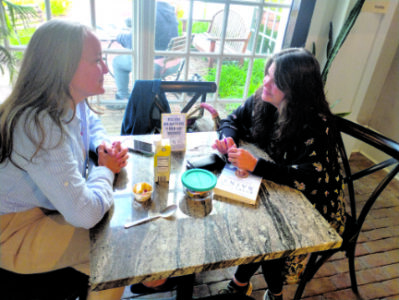
Staff photo / Dan Pompili Patti Wanat, left, a member of the Save Our Library committee in Poland, talks with her friend Cheryl Shartle of Canfield at the Poland library branch Thursday. Wanat has been among those most outspoken about the value of the building and the community’s access to the property it inhabits
POLAND — It has been just over a week since the community learned the fate of its public library branch, but passion for the issue remains as fiery as ever.
Though the Public Library of Youngstown and Mahoning County’s board of trustees voted to relocate the branch and ultimately sell the 25-year-old building at 311 S. Main St. in Poland on April 29, “Save Our Library” advocates say they’re not done.
“This thing is far from over. We had a very large meeting on Saturday,” said Village Councilman and library committee member Chris Graff. “We haven’t had one positive comment from anyone in the community, and there’s enormous public outcry to keep it.”
Graff said the committee and community aren’t just upset about the board’s decision but also about an editorial in The Vindicator that implied their group’s cause was a lost one. He said they took particular exception to the claim that they have not provided a compelling counterargument to the library’s claims about the Poland branch’s problems and the costs to fix them.
Graff said, on the contrary, they have done exactly that.
“We have tried from Day One with the board to put people in front of them, especially [local contractor] Ted Downie,” Graff said. “We have offered to have our engineer submit a report to them. Mr Downie has even met with several members of the board and explained his thoughts on what the problems are and what it would cost to repair them.”
Graff said Downie has built churches, schools, funeral homes and other large buildings throughout his construction career. At the April 29 board meeting, Downie addressed the board.
“The current problems with the Poland library building are fixable,” he said. “If you vote to relocate the Poland library, I believe you will be making a mistake because the information in this summary is incomplete and inaccurate.”
Downie was referring to the information packet that library Executive Director and CEO Amy Fifarek and Chief Operations Officer Jordan Shaver presented to the board.
Downie said the board should follow the repair recommendations made by BSHM Architects.
He said the differences conveyed in the executive summary between the costs of renovation and a new building were incomplete and inaccurate.
“It’s not an apples-to-apples comparison. The budget to complete the necessary repairs to the library, completed by BSHM, is $6 million plus $1 million of unidentified interior renovations and half a million for exterior repairs to the parking lot and painting, for a total of $7 million,” Downie said. “In the $6 million repair figure, $380,000 is for design fees and $1.1 million worth of contingencies; that’s about $1.5 million.”
Downie said that the budget for the proposed new building, near the corner of state Route 170 and Denver Drive, does not include architecture and engineering fees, land costs or contingencies.
“Also the low- and mid-range square footage numbers presented are four to five years old and out of date,” he said. “Using the most current square footage number and adding in the land cost results in a total of roughly $10 million without design fees and a contingency. That’s not an accurate comparison.”
Downie also criticized the maintenance estimates for the current building. He said the summary assumes annual maintenance costs based on current expenses, in the amount of $150,000, and extends it for 30 years “to arrive at a number that is truly eye-watering. There is no analysis of what the true maintenance costs will be once the repairs are made. Obviously, they will decrease significantly.”
Concluding his three minutes at the podium, Downie challenged Fifarek’s assertion that the Poland library would need to be closed for two years and accrue the costs of moving to and maintaining a temporary location while the renovations were completed.
“I believe the repairs outlined in the BSHM report can be safely completed while the library remains open,” he said. “This opinion is based on 50 years of experience in working around people in office buildings, retail stores, banks and hospitals.”
THE VOTE
The board voted 11-3 against renovor the purpose of building ation and identically in favor of relocation. They voted 12-2 for acquiring property for a new 15,000-square-foot building.
The probable location is a 4.25-acre plot along Denver Drive in Poland Township — about 1.1 miles from the current branch — which is still privately owned and zoned residential. It will cost PLYMC $360,000 to purchase. The site already has electrical and water service but would require a connection to a nearby sewer line.
Fifarek said site preparation costs would be about $1.57 million, and the estimated cost of building the new branch would be between $4.8 million and $8.8 million, putting the total estimated cost for the new library at between $6.3 million and $9.6 million.
For the renovation vote, board President Carol Weimer, Vice President Mariel Sallee, and Secretary Denise Glinatsis Bayer joined Timothy Bresnahan, Heather Chunn, Delores Crawford, Angela Duskey, Thomas Frost, Matt Morrone, Ron Strollo and James Viano in voting no. Alexa Sweeney Blackann, James Meehan and JoAnn Stock voted yes.
The vote to relocate was the exact opposite, with Stock, Meehan and Blackann voting no and the others all voting yes. The vote to purchase the property was similar, 12-2, the only difference being Blackann’s vote in favor.
Frost, speaking for the trustees after last week’s meeting, said the decision was the hardest he has had to make in his 15 years in his seat.
“We have to think about the entire county. Poland people are wonderful; they were very cordial to us throughout this whole discussion and very cordial tonight as well, and I wouldn’t expect anything less from them,” he said. “In the end, they’re going to end up with a beautiful new library.”
Fifarek said she is glad the matter seems to be resolved for the time and executive staff can begin to move forward in a clear direction, something they could not do before the vote.
She noted that public speculation about the exact location of the property is not quite on the mark, although close. One Poland resident along Denver Drive made a video that was posted on YouTube showing a parcel that appears to be what they called “swampland.”
“The intent of the board was for us to make sure that the property will not face any substantial hurdles and to make sure that all of those are cleared before the property is actually acquired,” she said. “Since we have to have the owner’s agreement that they will sell to us on contingency of things like zoning, I am reluctant to say. It is near there but not the exact location.”
Fifarek said that for the next few years, as long as Poland does not encounter any substantial structural problems, it will be business as usual at the branch, because PLYMC is committed to starting the Struthers library project first. That building, estimated to cost between $6.8 million and $8 million, will be located near the entrance to Yellow Creek Park and should be completed in or close to January 2029.
“As soon as we are far enough along with the Struthers project, we can begin the Poland project,” she said.
The current Poland building is expected to be sold. Shaver told the committee that two separate firms appraised the building’s value. Sammartino, Stout & Lo Presti of Erie, Pa., valued the building at $900,000, while Tricomi and Associates of Niles gave a more generous opinion of $1,950,000.
Frost said no formal decision has been made on that yet, but he is confident the building will not be left to deteriorate.
“The library has a strong history, with buildings we vacate, for repurposing of some sort, but no decisions have been made for now,” he said.
LONELY LIBRARY?
While Fifarek and Frost are pleased with the outcome, government officials elsewhere in the county, especially in Poland, are firmly opposed.
Poland Village Council President Michael Thompson wrote a letter to the PLYMC board, which was read in two parts during the meeting by Council Members Laurie LaPlante and Graff. The letter was approved by unanimous vote of the village council.
“It is clear that the library administration went into this discussion with their minds made up in advance. They may sincerely believe that they are correct but they have been blind to the bigger picture,” he wrote. “Decisions like this are what boards are for. Decisions like this are when the board should say ‘stop.’ This process has already done incredible … harm to the library system’s reputation for fiscal probity, for good stewardship of public funds and for listening to the community.”
At one point later in the meeting, Thompson interrupted proceedings to clarify a point in his letter. He said that while Poland has a reputation for being particular about its architectural and aesthetic standards, the community and its governing boards would be willing to compromise and provide help if the library remained on Main Street.
“If this building is to be preserved, we ought to be willing to be more flexible than we have in the past. I have also heard through the grapevine … the sort of financial support that the library received from the Poland community when this library was built might well be forthcoming if you make a choice to renovate. It’s a drive no one can start because no one knows.”
The community raised roughly $1.8 million that was used to include features like the dome and the elevator. The money came from everyone, from private prominent donors to independent fundraisers in schools and neighborhoods.
Mahoning County commissioners also voiced unanimous support for repairing and retaining the current library.
Commissioner Anthony Traficanti, a Poland resident, lamented the decision.
“This Poland library thing became somewhat personal now, because it’s been in the village for 25 years, and it’s one of the most beautiful libraries, and people are having trouble understanding why they did what they did,” he said.
“They want to build new, and they want to scale down, and there’s really not much we as commissioners can do. We’re going to have to live with their decision. But I’m disappointed and I wish they would have looked at it differently.”
Among the concerns voiced at the meeting by community members and some board members, namely Stock, was the concern that the 4,100 names on the Save Our Library committee’s petition, as well as many others, might be less inclined to support the library’s renewal levy in 2029.
Canfield resident and former library board member John Yerian noted the last countywide library levy in 2024 only passed by 6% compared to a 42% margin in 2009. He said the 2029 levy could be lost by at least 2,600 votes, by his calculations.
Stock said a failure of that levy would cost PLYMC 50% of its operating budget.
“As board members, we are accountable. I believe the social cost of relocating this branch would be a huge risk, and I’m not willing to take that chance,” she said.
Traficanti noted that it’s not only sentiment that could be to the library’s detriment in three years, but simple economics as well.
“Their board is created to Ohio Revised Code specifications, so it’s up to them to get their levies passed, but as commissioners we allow them to put their levies on the ballot,” he said. “It’s possible [levy failure]. Look at inflation. People are going to vote with their pocketbook, and there’s many other levies at risk for that same reason.”
POLAND — It has been just over a week since the community learned the fate of its public library branch, but passion for the issue remains as fiery as ever.
Though the Public Library of Youngstown and Mahoning County’s board of trustees voted to relocate the branch and ultimately sell the 25-year-old building at 311 S. Main St. in Poland on April 29, “Save Our Library” advocates say they’re not done.
“This thing is far from over. We had a very large meeting on Saturday,” said Village Councilman and library committee member Chris Graff. “We haven’t had one positive comment from anyone in the community, and there’s enormous public outcry to keep it.”
Graff said the committee and community aren’t just upset about the board’s decision but also about an editorial in The Vindicator that implied their group’s cause was a lost one. He said they took particular exception to the claim that they have not provided a compelling counterargument to the library’s claims about the Poland branch’s problems and the costs to fix them.
Graff said, on the contrary, they have done exactly that.
“We have tried from Day One with the board to put people in front of them, especially [local contractor] Ted Downie,” Graff said. “We have offered to have our engineer submit a report to them. Mr Downie has even met with several members of the board and explained his thoughts on what the problems are and what it would cost to repair them.”
Graff said Downie has built churches, schools, funeral homes and other large buildings throughout his construction career. At the April 29 board meeting, Downie addressed the board.
“The current problems with the Poland library building are fixable,” he said. “If you vote to relocate the Poland library, I believe you will be making a mistake because the information in this summary is incomplete and inaccurate.”
Downie was referring to the information packet that library Executive Director and CEO Amy Fifarek and Chief Operations Officer Jordan Shaver presented to the board.
Downie said the board should follow the repair recommendations made by BSHM Architects.
He said the differences conveyed in the executive summary between the costs of renovation and a new building were incomplete and inaccurate.
“It’s not an apples-to-apples comparison. The budget to complete the necessary repairs to the library, completed by BSHM, is $6 million plus $1 million of unidentified interior renovations and half a million for exterior repairs to the parking lot and painting, for a total of $7 million,” Downie said. “In the $6 million repair figure, $380,000 is for design fees and $1.1 million worth of contingencies; that’s about $1.5 million.”
Downie said that the budget for the proposed new building, near the corner of state Route 170 and Denver Drive, does not include architecture and engineering fees, land costs or contingencies.
“Also the low- and mid-range square footage numbers presented are four to five years old and out of date,” he said. “Using the most current square footage number and adding in the land cost results in a total of roughly $10 million without design fees and a contingency. That’s not an accurate comparison.”
Downie also criticized the maintenance estimates for the current building. He said the summary assumes annual maintenance costs based on current expenses, in the amount of $150,000, and extends it for 30 years “to arrive at a number that is truly eye-watering. There is no analysis of what the true maintenance costs will be once the repairs are made. Obviously, they will decrease significantly.”
Concluding his three minutes at the podium, Downie challenged Fifarek’s assertion that the Poland library would need to be closed for two years and accrue the costs of moving to and maintaining a temporary location while the renovations were completed.
“I believe the repairs outlined in the BSHM report can be safely completed while the library remains open,” he said. “This opinion is based on 50 years of experience in working around people in office buildings, retail stores, banks and hospitals.”
THE VOTE
The board voted 11-3 against renovor the purpose of building ation and identically in favor of relocation. They voted 12-2 for acquiring property for a new 15,000-square-foot building.
The probable location is a 4.25-acre plot along Denver Drive in Poland Township — about 1.1 miles from the current branch — which is still privately owned and zoned residential. It will cost PLYMC $360,000 to purchase. The site already has electrical and water service but would require a connection to a nearby sewer line.
Fifarek said site preparation costs would be about $1.57 million, and the estimated cost of building the new branch would be between $4.8 million and $8.8 million, putting the total estimated cost for the new library at between $6.3 million and $9.6 million.
For the renovation vote, board President Carol Weimer, Vice President Mariel Sallee, and Secretary Denise Glinatsis Bayer joined Timothy Bresnahan, Heather Chunn, Delores Crawford, Angela Duskey, Thomas Frost, Matt Morrone, Ron Strollo and James Viano in voting no. Alexa Sweeney Blackann, James Meehan and JoAnn Stock voted yes.
The vote to relocate was the exact opposite, with Stock, Meehan and Blackann voting no and the others all voting yes. The vote to purchase the property was similar, 12-2, the only difference being Blackann’s vote in favor.
Frost, speaking for the trustees after last week’s meeting, said the decision was the hardest he has had to make in his 15 years in his seat.
“We have to think about the entire county. Poland people are wonderful; they were very cordial to us throughout this whole discussion and very cordial tonight as well, and I wouldn’t expect anything less from them,” he said. “In the end, they’re going to end up with a beautiful new library.”
Fifarek said she is glad the matter seems to be resolved for the time and executive staff can begin to move forward in a clear direction, something they could not do before the vote.
She noted that public speculation about the exact location of the property is not quite on the mark, although close. One Poland resident along Denver Drive made a video that was posted on YouTube showing a parcel that appears to be what they called “swampland.”
“The intent of the board was for us to make sure that the property will not face any substantial hurdles and to make sure that all of those are cleared before the property is actually acquired,” she said. “Since we have to have the owner’s agreement that they will sell to us on contingency of things like zoning, I am reluctant to say. It is near there but not the exact location.”
Fifarek said that for the next few years, as long as Poland does not encounter any substantial structural problems, it will be business as usual at the branch, because PLYMC is committed to starting the Struthers library project first. That building, estimated to cost between $6.8 million and $8 million, will be located near the entrance to Yellow Creek Park and should be completed in or close to January 2029.
“As soon as we are far enough along with the Struthers project, we can begin the Poland project,” she said.
The current Poland building is expected to be sold. Shaver told the committee that two separate firms appraised the building’s value. Sammartino, Stout & Lo Presti of Erie, Pa., valued the building at $900,000, while Tricomi and Associates of Niles gave a more generous opinion of $1,950,000.
Frost said no formal decision has been made on that yet, but he is confident the building will not be left to deteriorate.
“The library has a strong history, with buildings we vacate, for repurposing of some sort, but no decisions have been made for now,” he said.
LONELY LIBRARY?
While Fifarek and Frost are pleased with the outcome, government officials elsewhere in the county, especially in Poland, are firmly opposed.
Poland Village Council President Michael Thompson wrote a letter to the PLYMC board, which was read in two parts during the meeting by Council Members Laurie LaPlante and Graff. The letter was approved by unanimous vote of the village council.
“It is clear that the library administration went into this discussion with their minds made up in advance. They may sincerely believe that they are correct but they have been blind to the bigger picture,” he wrote. “Decisions like this are what boards are for. Decisions like this are when the board should say ‘stop.’ This process has already done incredible … harm to the library system’s reputation for fiscal probity, for good stewardship of public funds and for listening to the community.”
At one point later in the meeting, Thompson interrupted proceedings to clarify a point in his letter. He said that while Poland has a reputation for being particular about its architectural and aesthetic standards, the community and its governing boards would be willing to compromise and provide help if the library remained on Main Street.
“If this building is to be preserved, we ought to be willing to be more flexible than we have in the past. I have also heard through the grapevine … the sort of financial support that the library received from the Poland community when this library was built might well be forthcoming if you make a choice to renovate. It’s a drive no one can start because no one knows.”
The community raised roughly $1.8 million that was used to include features like the dome and the elevator. The money came from everyone, from private prominent donors to independent fundraisers in schools and neighborhoods.
Mahoning County commissioners also voiced unanimous support for repairing and retaining the current library.
Commissioner Anthony Traficanti, a Poland resident, lamented the decision.
“This Poland library thing became somewhat personal now, because it’s been in the village for 25 years, and it’s one of the most beautiful libraries, and people are having trouble understanding why they did what they did,” he said.
“They want to build new, and they want to scale down, and there’s really not much we as commissioners can do. We’re going to have to live with their decision. But I’m disappointed and I wish they would have looked at it differently.”
Among the concerns voiced at the meeting by community members and some board members, namely Stock, was the concern that the 4,100 names on the Save Our Library committee’s petition, as well as many others, might be less inclined to support the library’s renewal levy in 2029.
Canfield resident and former library board member John Yerian noted the last countywide library levy in 2024 only passed by 6% compared to a 42% margin in 2009. He said the 2029 levy could be lost by at least 2,600 votes, by his calculations.
Stock said a failure of that levy would cost PLYMC 50% of its operating budget.
“As board members, we are accountable. I believe the social cost of relocating this branch would be a huge risk, and I’m not willing to take that chance,” she said.
Traficanti noted that it’s not only sentiment that could be to the library’s detriment in three years, but simple economics as well.
“Their board is created to Ohio Revised Code specifications, so it’s up to them to get their levies passed, but as commissioners we allow them to put their levies on the ballot,” he said. “It’s possible [levy failure]. Look at inflation. People are going to vote with their pocketbook, and there’s many other levies at risk for that same reason.”