

Youngstown forks out $3.25 million in police OT
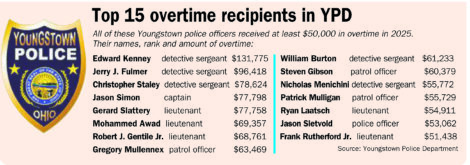
YOUNGSTOWN — Fifteen Youngstown police officers each made more than $50,000 in overtime in 2025 with a detective sergeant again at the top of the list, making nearly twice his regular salary.
For at least the fourth year in a row, Detective Sgt. Edward Kenney received more overtime pay than any other city employee. In 2025, Kenney was paid $131,775 in overtime, which was down from the $150,681 he received in overtime in 2024 and $139,296 in 2023, but still considerably higher than the $79,824 in overtime pay he got in 2022.
Working seven days most weeks and almost 100 hours during some weeks, Kenney ended being paid for more than 2,000 hours of overtime in 2025. Regular overtime is paid at 1.5 times his salary though among those hours are 154.5 hours on holidays, which is paid at 1.75 times his salary. Kenney’s base pay as a detective sergeant for 2025 was $73,655.
On Juneteenth, Labor Day, Columbus Day and Christmas, Kenney was paid for 24 hours — eight “holiday regular hours” and 16 hours of holiday overtime with the latter at 1.75 times his salary, according to his timesheet.
Kenney was paid for 23 hours, including 15 at 1.75 times his salary for Martin Luther King Jr. Day and Presidents Day. He was paid for 22 hours on New Year’s Day and Thanksgiving — eight “holiday regular hours” and 14 hours of holiday overtime at 1.75 times his salary.
Kenney was also paid additional money for close to 1,000 hours for out-of-rank pay given to officers who cover for an officer at a higher rank.
Including that money, his salary, overtime and other bonuses given to police officers, such as longevity and hazardous duty pay, Kenney made $216,329 in 2025. He was the only city employee to make more than $200,000 last year.
For at least the fourth year in a row, Detective Sgt. Jerry J. Fulmer received the second-most overtime pay in the city at $96,418 in 2025.
Of the 22 city employees who were paid at least $120,000 in 2025 in salary, overtime and other bonuses, 18 of them were police officers — 15 ranking officers and three patrol officers.
City council approved $2 million in overtime for the police department in 2023 and 2024, with the department blowing through that amount each year: $2.92 million in 2023 and $3.25 million in 2024.
Council agreed to increase police overtime in 2025 to $3 million. The department again ended the year with $3.25 million in overtime.
The city pays 19.5% of money earned by police officers toward their pensions. Overtime last year cost the city more than $630,000 in pension payments.
But the 2025 budget for police wages was $9,085,194 and the department ended up spending $8,580,934 on wages. That was $504,260 less than budgeted.
One reason 2025 salaries were down and overtime wasn’t higher is the patrol officers union didn’t settle its contract for that year until earlier this month.
The patrol officers will receive a 4% retroactive pay raise for 2025, including for overtime in that year, as well as 4% raises in both this year and 2027 plus an additional $1 an hour. The ranking officers, who are paid higher salaries and had the top seven overtime payouts in 2025 and 11 of the top 15, received a 2.5% pay raise in 2025 compared with the previous year.
But the ranking officers union has a “me-too” clause in its contract meaning it gets whatever the patrol union receives. The ranking officers will get a 1.5% retroactive pay raise for 2025 as well as for overtime earned last year.
Also, the new contract makes holiday overtime double pay rather than 1.75 times an officer’s salary.
CHIEF’S RESPONSE
Sharon Cole, a former detective sergeant who started serving Jan. 1 as police chief, said: “We are diligently monitoring overtime to ensure its operational necessity and prevent any compromise to officer safety. Youngstown, like departments across the country, is facing a decline in officer numbers for various reasons. To help address this and reduce the reliance on overtime, a competitive pay structure is essential for recruiting and retraining officers. In the interim, it is our responsibility to fulfill our duty to serve the residents and respond to calls.”
The newly signed contract that gives 4% annual raises for three years plus the additional $1 an hour in the final two years is the largest increase for police officers in decades and possibly since police started collective bargaining.
Cole said: “The department has also taken proactive measures to address overtime. As a result of staff restructuring within the department, mandated overtime has been significantly reduced. Overtime is being offered and filled in accordance with union contracts and brass officers are required to fill any gaps. The primary objective of managing overtime is to ensure that it is warranted and reasonable.”
Cole didn’t provide specifics on staff restructuring, but one longstanding issue that has driven up overtime for ranking officers is most of them work the dayturn rather than have them divided between the three shifts, with the two others being afternoon and overnight. That results in ranking officers getting overtime for those two other shifts to provide supervision. In several cases, it results in out-of-rank pay as detective sergeants handle the responsibilities of lieutenants.
Cole also declined to comment on Kenney’s overtime and allowing him to work six to seven days a week and as much as 100 hours a week without explaining how the department isn’t compromising officer safety. She also didn’t respond to a question about whether officers can be effective working so many hours.
The department last year implemented a cadet program in which a person is hired at $16.49 an hour as an unclassified employee until they graduate from the police academy, pass the city’s civil service test and can then be hired as a patrol officer. The city is paying for the police academy for cadets, which can be as much as $8,000.
Cole said: “We are also confident that the police cadet program will continue to contribute to our recruitment efforts and help us achieve staffing goals. However, recruitment must be balanced with the ability to retain officers.”
The cadet program has been a mixed bag so far.
During the most recent civil service exam for patrol officers, 11 members of the cadet program passed it with seven failing and one not showing up for the test.
After The Vindicator reported last year about escalating police overtime, city council agreed in June to spend $120,000 on a performance audit of the police and fire departments in an effort to make them more efficient and effective. The audit is ongoing and should be finished in the summer.
Aaron Shaw, deputy director of the state auditor’s performance team, wrote in a June 9 email to city council the “performance audit will identify recommendations for improved economy, efficiency and / or effectiveness.”
Local News
200 students in Valley launch drones, futures
On the record: Lowellville
WHAT: Board of education April 22 meeting PRESENT: Gerald Dubos, Joseph Sturm, Brian Wharry and Stephanie ...

Boardman students bring Japan to class
City man arrested on multiple charges
YOUNGSTOWN — The U.S. Marshals Service Northern Ohio Violent Fugitive Task Force arrested Randy T. Reese, 37, ...

AMERICA250: Frontier forts built foundation for revolution
Rulli measure seeks to condemn British over free expression
With British King Charles III addressing a joint session of Congress, U.S. Rep. Michael Rulli, R-Salem, introduced ...