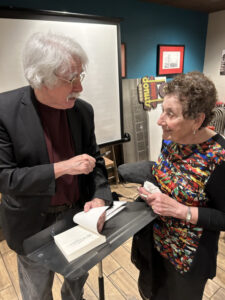
Warren native tells Marion Motley’s story
WARREN — Warren native David Lee Morgan Jr. was a producer on the PBS documentary “Lines Broken: The Story of Marion Motley,” which aired on PBS Western Reserve in 2021 and won a regional Emmy Award in the documentary historical category.
He soon realized a half-hour just wasn’t enough time to tell the story of Motley, a Canton native who was one of four players who broke professional football’s color barrier in 1946, a year before Jackie Robinson did it in baseball.
“We just had so much information,” Morgan said. “There was a still a lot to tell that we couldn’t do in a 30-minute doc.”
Morgan wrote “Breaking Through the Lines: The Marion Motley Story,” which was published last month by North Star Editions ($14.99 paperback). Morgan will talk about the book and Motley’s importance in a free program at 2 p.m. Saturday at the Warren-Trumbull County Public Library, 444 Mahoning Ave. NW.
Morgan worked at the Tribune Chronicle, The Vindicator and the Akron Beacon Journal and now lives in Canton and teaches high school English. He has written eight other books, including “LeBron James: The Rise of a Star,” the first biography of the NBA superstar and Akron native.
“I’ve learned a lot of the time you don’t know where your next idea will come from. Sometimes they just fall in your lap,” he said. “This one fell in my lap.”
Morgan was approached by James Waters II, Dave Jingo and Shaun Horrigan, who were looking for a way to honor Motley in his hometown.
“They were trying to raise money to put up a sign and it mushroomed,” Morgan said. “We were getting all kinds of donations and decided, why don’t we do a documentary? We handed off fundraising to another group of friends, and a statue was unveiled (in 2022) in Stadium Park.”
Morgan relied on the full interviews they did for the documentary with people ranging from Warren native and Pro Football Hall of Famer Paul Warfield to Cincinnati Bengals President Mike Brown, whose father Paul Brown coached Motley at the Great Lakes Naval Academy and signed Motley and offensive lineman Bill Willis to play for the Brown-led Cleveland Browns in ’46.
But the greatest asset Morgan had was about 10 hours of audio interviews with the Pro Football Hall of Fame inductee that belonged to Eric Loughery.
“It sounds like he’s in a hotel room with a reporter talking about his life,” including stories of the abuse he suffered from players on opposing teams, Morgan said. “It’s almost hair-raising to hear him speak in this 1950s, ’40s vernacular about what happened. A lot of the dialogue, the quotes in the book, are directly from Marion Motley, and that’s what’s unique about this book. I thank Eric and all those other guys who were a part of the documentary. If it wasn’t for them, I couldn’t have done the book.”
One of the most disheartening things he discovered while writing is that Motley desperately wanted to continue in football after his playing career as a scout or a coach, but no one would give him an opportunity.
The all-pro runner died in 1999 at the age of 79 in Cleveland. He played eight seasons in Cleveland, four of those when the Browns originally were part of the All-American Football Conference. His final season in 1955 saw limited duty with the Pittsburgh Steelers.
Morgan didn’t have an answer for why Motley and Willis with the Browns and Kenny Washington and Woody Strode with the Los Angeles Rams aren’t remembered and revered in the same way Jackie Robinson is for integrating baseball a year later. He referred to them as “the forgotten four.”
“His legacy just sort of faded. The game moved on, no one did much to keep his name in the forefront about his role in integrating professional sports,” Morgan said. “(Brooklyn Dodgers General Manager) Branch Rickey, he’s from Ohio, and he studied what Paul Brown was doing in Cleveland in ’46. He saw if they could do it in a hard-contact sport like football, he could do it in baseball. Who knows how long it might have taken (if the NFL hadn’t gone first).”
agray@tribtoday.com
Local News
Hubbard honors, memorializes officers
Pleasant Valley Church suspends services, activities
Staff report LIBERTY — The parking lot outside Pleasant Valley Church off Pleasant Valley Road is usually ...
On the record: Austintown
Austintown WHAT: Board of Education meeting Wednesday PRESENT: Katie Berdis, Fred Marcum, Harold Porter, Don ...
Man indicted on felonious assault, attempted rape
YOUNGSTOWN — Allen M. Smith, 21, of Parkman Road in Warren, was indicted last week on charges of felonious ...

Hundreds at Austintown Fitch march toward graduation glory