Holborn herb growers get growing again
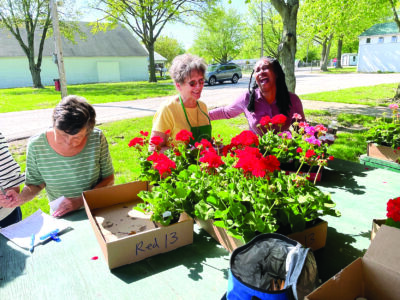
Working the geranium pickup at the Canfield Fairgrounds is Holborn Herb Growers Guild member Kathy Costa, left. Sharing a laugh together are members Bunny Pavlov and Latrell Hall. The women will be back at the fairgrounds Saturday for the annual plant sale. It will take place in the vegetable barn near the main entrance from 9 a.m. to 2 p.m.
CANFIELD — The Holborn Herb Growers Guild is planting the seed of getting back to normal this year.
The guild will have its annual plant sale Saturday and its high tea will return in October.
“The pandemic hurt us,” Bunny Pavlov, guild president, said. “We couldn’t have our annual tea for the past two years, and that is a major fundraiser for us.”
Holborn Herb Growers Guild takes care of herb gardens at the Western Reserve Village inside the Canfield Fairgrounds and the herb gardens at Boardman Park.
The guild was formed in the early 1980s by a group of women who enjoy growing, understanding and using herbs. The name itself came from a well known herbalist from London.
Holborn dates back to the 1500s in England, as guild founding member Carrie Burkey learned while on a trip to New England.
“I met Adelma Simmons, who ran a huge herbal farm in Connecticut called Caprilands,” Burkey said. “She authored several herb books, one of which told a story about Holborn.”
According to Burkey, Holborn was a fashionable area of London. One of its residents was John Gerard, an English herbalist who wrote “Generall Historie of Plantes.” The book, dealing with English herbals, became widely circulated and is considered the most famous book dealing with herbs. Gerard also was known for his large herb gardens in which plants were labeled and placed on lists.
In 1665, London was stricken by the Great Plague, followed by the Great Fire in 1666. Everything in Holborn burned, including Gerard’s gardens. But over time, the herbs from his garden made a comeback on their own.
GREAT NAME
Because the founders of the local herb guild wanted to create an herb garden at the Western Reserve Village in the Canfield Fairgrounds, the name seemed a good fit. The group of women became the Holborn Herb Growers Guild.
“We were established in 1982 and incorporated in 1984,” said Pavlov. “Our purpose was to educate the membership and the public on herbs.”
As part of that education, the guild has laid herb gardens around most of the Western Reserve Village’s historic buildings.
During the fair, the herbs are labeled, and guild members answer any questions about them. They also have a garden for the vision-impaired that uses the sense of feel and smell.
The first three gardens at the historic village were planted in 1983 around the country store, the doctor’s office and the law office. Each garden was themed to the building it complements. The country store garden contained parsley, sage, rosemary, thyme, basil, oregano and horseradish as herbs used in cooking.
The doctor’s office had medicinal herbs in its garden. These included chamomile and peppermint used for upset stomachs, horehound for treating colds and coughs, comfrey for broken bones and aloe for burns.
In 1984, the library was provided with separate gardens. One was the American Indian garden with herbs used by Native Americans, such as mountain mint, monarda and lovage among others. The other was the Shakespeare garden containing herbs mentioned in Shakespeare’s works, such as lavender, rue and honeysuckle.
Other gardens were added in 1984 to include the children’s, tea, and dyer’s gardens. In 1985 a garden was built around the gazebo to attract butterflies.
The guild took on a second location in 1987 at Boardman Park. The first of several herb gardens were planted in front of the Schiller-Chuey Summer Kitchen behind the historic St. James Church.
The guild not only planted herb gardens but also started handling the decorations for the church. At Christmas the guild members would make wreaths and dry flowers and herbs for decoration. They also decorated for weddings. Today they have use of a small greenhouse to help members with their growing tasks.
In 1988 a culinary garden was planted and in 1989, a bee and butterfly garden was built to the north side of the kitchen. In the mid-1990s, the guild took over the flower gardens at the brick sidewalks and the stone wall at the park.
According to Pavlov, the guild also helps plant gardens in downtown Youngstown.
HIGH TEA
“We also try to give out a $1,000 scholarship to a local student going into horticulture,” Pavlov said. “That is if we have the funds to do so, but the loss of the garden tea has meant the loss of our major fundraiser.”
The tea will come back Oct. 1 at the fairgrounds. Funds raised from the event might enable a scholarship and will help fund the gardens in 2024. Pavlov said the plant sale doesn’t yield a big amount, but does help cover the cost of mulch.
At the Saturday plant sale, the guild will have a vast variety of herbs, bulbs and plants. It also will have its popular “Twice Loved” plants that have been grown by guild members and offered to help raise funds. The event will take place from 9 a.m. to 2 p.m. at the vegetable barn near the main entrance.
Local News
Mahoning County courts 5-9
Marriage licenses granted April 27 to May 1 in Mahoning County: Jonathan Mark Imler, 43, Youngstown, and Callie ...
Hubbard trustee questions cemetery board deficit
HUBBARD — City officials paused action at this week’s council meeting to approve a financial boost for a ...
Mill Creek deer hunts likely to continue
Average mortgage rate increases to 6.37%, a four-week high
The average long-term U.S. mortgage rate rose again this week, reflecting ongoing bond market volatility as surging ...

California congressman’s heartland tour makes stop at Ultium Cells