

Slices of kindness
West Side Bowl owner, friends help keep his business open
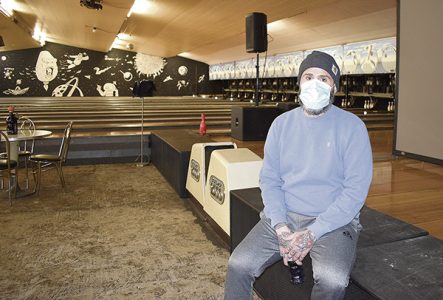
West Side Bowl owner Nate Offerdahl sits near the stage and dining area at his business recently. He removed part of seven bowling lanes to make room for an area for patrons of live music to stand and for dining room tables.
YOUNGSTOWN — Nate Offerdahl and his wife, Jami, bought the West Side Bowl on Mahoning Avenue in March 2018 and modified it so live music could be performed there — both on the main floor and in the basement.
They took out the front of seven bowling lanes on one side of the bowling alley and used the wood to construct a second bar. They left the rear part of the lanes to serve as a live music stage.
The area where the lanes were removed became the floor area for music patrons.
Shows began right away, and the popularity of the repurposed venue grew. “We had four to five nights of live music every week,” he said.
“The goal was to emulate the Beachland Ballroom in Cleveland,” he said.
Then COVID-19 arrived March 15, and West Side Bowl had to shut down everything but carryout food, which was a small part of the operation up to that point.
But Offerdahl had some good friends in a band called Rebreather who came in around March 16 and said, “We want to buy the next 10 pizzas,” Offerdahl said. “When they come in, just tell them it’s on us.”
Offerdahl put together a video that he posted on social media to let the community know about the idea.
“As soon as we posted it, another local band called Daggers … saw the video and called immediately and said, ‘We want to buy the next 10.'” A photographer friend contacted him next and also wanted to help out.
“By the end of the month, I think we had 400 pizzas paid for in advance. By the time it was all said and done two or three weeks ago, (our friends) had given away over 2,500 pizzas.”
Some people were willing to also “pay if forward” by paying for their free pizza to allow someone else to get a free pizza. By now, people were aware that helping West Side Bowl might be the only way to help Offerdahl save his business.
People started to donate to the business. A man from Australia donated 20 pizzas every month.
“That’s a big reason for how we went from being shut down 90 percent to not going out of business,” Offerdahl said. “Those guys coming in that first day created a way to engage the community and to sell a lot of food.”
It also elevated the business’s presence on social media, centered around food. “Prior to that it was centered around live music. It keeps us going now.”
In August, the business allowed people to eat and drink outside on a new patio. As the weather got colder, the business started to allow people to eat inside, setting up tables in the converted music area on the former bowling alley floor.
West Side Bowl allowed bowling to return after the state allowed it, but Offerdahl waited about an extra month “to see how everything worked out,” he said.
“I’m high risk and so are some of my employees,” Offerdahl said, so they took it slow. “You don’t want to be the place that doesn’t follow the rules and has a cluster of people getting sick,” he said.
He doesn’t know when he will be able to start offering live music.
As for assistance from the federal government, Offerdahl was approved for a payroll protection loan, which allowed him to pay payroll 2 1/2 months.
The owners also were approved for Economic Injury Disaster funds, which they used for equipment as they ramped up their takeout food and to buy equipment to provide barriers to block infection transmission.
“We’re operating at about 30 to 35 percent saleswise of what we did before the virus,” he said. The company’s bills are pretty much the same as before the virus.
In the first CARES ACT package from the federal government, they received a Small Business Administration loan that paid their mortgage for six months, but that money has run out.
“From my perspective, I don’t see any return to normal business in the next year,” he said. “This is the first business I’ve ever owned. But the next three to six months is going to be just dealing with the coronavirus spike, in my opinion.”
The most recent funding West Side Bowl got was $10,000 of CARES ACT funding through the Valley Economic Development Partners of Liberty Township, formerly known a the Mahoning Valley Economic Development Corp.
The money came from about $2.5 million allotted to the Mahoning County commissioners, which they in turn alloted to VEDP.
Offeredahl said the $10,000 is important.
“That’s a huge thing. It is potentially a full month’s worth of payroll. It’s three mortgage payments,” Offerdahl said. “If you had a refrigerator break, you could replace it immediately.”
“It’s not a huge amount of money, but it’s lifeline at a time when every lifeline is much appreciated,” Offerdahl said.
“It’s crazy I went from not owning a business to owning one, and then having to sort of do all of the things you have to do to build it into what you want it to be. And then in one day … we went to selling pizza only to go. It was a radical shift.”
The entire music industry has been “decimated,” he said. Based on industry information he receives, a large percentage of businesses in the music industry will shut down if they don’t get help in the next three to six months.
“Our business model is people congregating,” Offerdahl said. “This is a 30,000-square-foot building that has enormous built-in costs,” he said.
“You’re looking at the very real possibility that the arts and entertainment infrastructure in the United States will be permanently altered,” he said.
Local News
Thieves broke into safe at Strouss-Hirshberg store
100 Years Ago, 1926 transcribed as originally published in the Youngstown Vindicator: “Blindfold, bind man, ...
Mahoning County courts marriage licenses
Marriage licenses granted March 30 to April 10 in Mahoning County: Carmen Jeffrey Arsuffi, 36, North Lima, and ...

3 Mahoning Democrats seek seat in Ohio House of Representatives
Liberty board hears more updates on road projects
LIBERTY — Township officials learned the status of a pair of community improvements that are moving forward as ...
Canfield school board weighs options to prevent big deficit
Valley road work update
The Ohio Department of Transportation has announced the following projects that will lead to road closures and ...