
Trending
YOUNGSTOWN -- With state Rep. Lauren McNally choosing to run for Mahoning County commissioner, three Democrats are competing in their party's primary to be the nominee for the 58th Ohio House District seat.
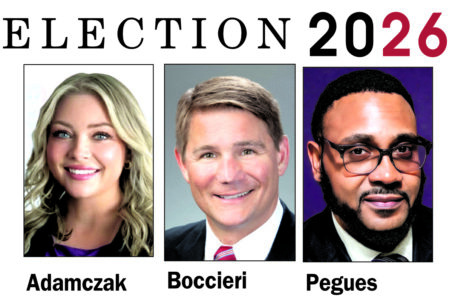
Running in the Democratic primary are John Boccieri of Poland, a former congressman and state legislator; Basia Adamczak, a former Youngstown 7th Ward councilwoman; and Jordan Pegues of Austintown, a senior quotations specialist for Wesco Distributions.
Heather Fronk of Poland, founder of Clothed In Strength, is the lone Republican candidate for the seat.
The district includes Youngstown, Austintown, Poland, Lowellville, Jackson, Milton, Craig Beach and Coitsville. The 58th District favors Democrats by more than 21% based on partisan statewide voting results.
This is the only contested primary for a state legislative seat in the Mahoning Valley.
BOCCIERI
Boccieri served nine years in the state House, two years in the state Senate and two years in the U.S. House. He is a United Airlines pilot and has spent the past 32 years as a member of the Air Force, Air Force Reserve and Air National Guard, currently working part-time at the Pentagon. Boccieri said he plans to retire from the Air Force shortly.
Boccieri said his years of experience make him the strongest candidate seeking the Ohio House seat. The Mahoning County Democratic Party endorsed him.
Boccieri said: "This is not a time for training wheels. This is not a time for learning on the job. There are some significant policy issues that are in front of us, issues that have lingered for decades, frankly, where the state Legislature has chosen not to represent the people's wishes. We need meaningful tax reform. There are big policy issues in front of us, and this is not a time for learning on the job."
Boccieri said he successfully worked with the Republican majority during his previous time in the state Legislature and doesn't see that as an obstacle.
"I worked across the aisle before and got things done," he said.
Boccieri said, if elected, his top priorities are affordability, property tax reform and urban renewal.
With working families seeing increased prices for groceries, gas, utilities and health care, Boccieri said he wants to increase funding for food banks, help small businesses by offering a temporary reduction of the Commercial Activity Tax, and implement a temporary suspension of the state's gasoline tax, which is 38.5 cents per gallon on regular gasoline and 47 cents per gallon on diesel.
A temporary suspension of the gas tax by Ohio has never been enacted.
Over a six-month period, it would cost the state $1.24 billion if regular and diesel fuel taxes were suspended or $800 million for just regular gas. Boccieri said that funding loss could be offset by using money from the state's rainy day fund.
Regarding property tax reform, Boccieri said he supports an increase in the homestead exemption for seniors, and has concerns about legislation recently passed that limits property tax increases that don't require a vote by citizens.
"Property tax measures voted on by citizens is a hallmark of how we fund our schools, emergency services and public libraries, and I do not support taking that right away from our citizens," he said.
Boccieri also wants to scrutinize state funding that goes to charter schools though that money has increased during Republican control of state government.
Boccieri also said he wants a "focus on rebuilding and renewing our crumbling cities. Infrastructure repairs, economic development and reducing food deserts are critical for our state's cities to rebound."
ADAMCZAK
Adamczak served two terms on Youngstown City Council, losing reelection in 2023 by eight votes. She worked at Mahoning County Job and Family Services from March 2023 until leaving this past February to run for the state House seat. She currently operates a consulting firm.
Adamczak said the district "deserves representation that understands not only what needs to be fixed, but how state government actually fixes it. My experience as a former election official combined with my administrative leadership within county government and direct work in systems regulated by the Ohio Department of Job and Family Services has given me first-hand knowledge of how state budgets, mandates and agency regulations impact Mahoning County families."
Adamczak said she has worked with Democrats and Republicans before, and if elected, she is confident she can continue that.
"It really comes down to being able to build those relationships and work across party lines," she said. "I have great relationships here locally with elected officials who are both Democrats and Republicans because ultimately a lot of the issues that we are facing aren't even so much party issues, but they're people issues. Just being able to have good communication skills, build those relationships and explain to my potential colleagues, regardless of political party affiliation, that these are the needs and the priorities of not only the district, but of the state."
Adamczak said her three top priorities are property tax stabilization without destabilizing schools, infrastructure and neighborhood investment through capital budget leverage, and economic redevelopment and workforce retention through targeted state programs.
Regarding property taxes, Adamczak said she would advocate for the full implementation of the state's Fair School Funding Plan to reduce the overreliance on local property taxes, seek to expand eligibility thresholds for the homestead exemption and support the modernization of rollback provisions to create predictability in tax liability.
As for infrastructure projects, Adamczak supports the issuance of bonds in the state capital budget and other state and federal funds to address aging sidewalks, waterlines and roads, particularly in urban neighborhoods and near schools and senior housing.
With Mahoning County continuing "to experience workforce outmigration and redevelopment stagnation in former industrial corridors," Adamczak said she wants to renew funding for the Ohio Brownfield Remediation Program in the state's capital budget, expand TechCred credential reimbursement through the operating budget, effectively deploy Workforce Innovation and Opportunity Act funds and provide accountability to incentives given by JobsOhio.
Adamczak said: "Having worked within county government systems that implement state and federal workforce programs, I understand how funds move from Columbus to local agencies. I will advocate not only for funding levels, but for administrative flexibility and performance-based reporting to ensure resources are deployed efficiently and transparently."
PEGUES
Pegues, who has never run for office, has spent 20 years in manufacturing and has worked for Wesco Distributions since 2022.
Pegues said during his professional career, he has collaborated and that will translate well to working with Republicans who control the state Legislature.
"I know how to negotiate," he said. "In the world of manufacturing, I have to work with suppliers. I have to work with vendors. I have to work with different customers. So you can't be in a silo where you're only focused on you or what you believe in or your priorities. You have to make sure that you're working with everyone because at the end of the day, you have to get the goal accomplished."
But Pegues acknowledged: "I'm new to it. You don't know until you try. All I can say is I can put my best foot forward. I'm not a quitter."
Pegues said his top priorities are improving the job market, addressing school funding and working on cost-of-living issues.
Pegues said: "Workforce development is essential to strengthening the pipeline of qualified workers. To achieve this, I propose starting with the highest employment sectors, manufacturing and health care. I want to utilize the capital budget and available grants money to increase new and existing businesses here in the Valley."
As for school funding, he proposes the full implementation of the Fair School Funding Plan.
Pegues said: "We must also update the formula on how much it costs to educate a student. The current one is outdated and flawed resulting in resource-deficient schools. With my experience as a project manager, I can use my skill set to help fix this very important issue."
Pegues said he wants to address housing, transportation, utilities, health care and groceries to reduce the cost of living.
Pegues added he wants to create funds for the rehabilitation of houses and the creation of affordable new homes, increase funding for public transportation, create funding for low-cost care centers and community programs, and eliminate or reduce taxes on food products while creating funding for food deserts.
"The goal is to make everyone's lives better, focusing on common-sense legislation that makes people want to get interested again and where you can actually have a better quality of life," Pegues said.