
Millennial Theatre brings Tony winner to Playhouse
Trending
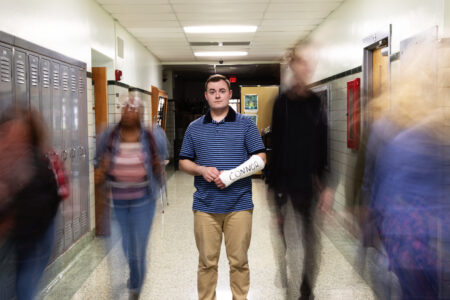
The Millennial Theatre Company will stage the nonprofessional Ohio premiere of the musical "Dear Evan Hansen."
Desire and persistence made it possible. MTC Director Joe Asente said he fell in love with the show when he saw the national tour in Cleveland in 2019.
"It was the first time as a theatergoer that I experienced true collective emotion in a theater, just that collective exhale from everybody in the audience. It was such a powerful experience to be in a space like that with everyone feeling an emotion. That really made an impact on me, and I knew as soon as it came out it was something that we had to do.
"It also ties into our generation as the first social-media generation. We came of age with social media, and this show is all about how social media can maybe be a negative experience in the life of a young person. For all those reasons, it was something we really felt like we had to do."
The Benj Pasek/Justin Paul/Steven Levenson musical opens July 10 for a two-weekend run at the Youngstown Playhouse.
Asente spent more than a year reaching out to license holder Music Theatre International to inquire about when the rights would be available to non-professional theaters.
"They weren’t going to do a traditional roll out with this show, where usually the shows have a run with the professional regional houses first, and then they transfer to community theaters," he said. "They kind of skipped that, and they let a few people know ahead of time that this was coming down the line, and we were one of those people that got a little bit of a heads up about it."
The title character is a nervous and anxious high school student, someone who is more ignored than bullied by his classmates. To help with his anxieties, his therapist encourages Evan to write daily letters to himself that start, "Dear Evan Hansen ..."
One of the letters is taken from him by Connor Murphy, an angry loner who also is the older brother of Evan's secret crush, Zoe. When Connor dies the next day, the note found on him is mistaken for a suicide note written to his friend, "Dear Evan Hansen."
Connor's parents, struggling for answers, reach out to Evan, giving him the attention for which he's starved and also bringing him closer to Zoe. Being perceived as a friend of the dead kid increases Evan's social standing, both at school and beyond, when his speech at a memorial service goes viral.
"Hansen" wasn't the first show to explore the choices and consequences of young outcasts suddenly given the popularity they thought they craved, nor was it the last. In recent seasons, MTC staged "Be More Chill" and "Mean Girls," two shows that covered similar ground and followed "Hansen" on Broadway.
Asente believes "Hansen" handles the subject matter better than most.
"Evan is a character that is trying to fit in and trying to do the right thing consistently throughout the show, but as we know, people doing the right thing is not always easy, and it’s not always something that can come naturally to you," Asente said. "I think a lot of times in those high school shows where your protagonist is someone who's trying to fit in, they’re always a good guy. Katie Herron in 'Mean Girls' is the good girl, and then she turns bad and learns a lesson, and then it’s over.
"The line between good and bad is a lot blurrier for Evan. He has a thousand chances to turn back, and there’s a different reason in every scene why he doesn’t do that. I think this show really emphasizes the fact that life is not so black and white, there’s a lot of gray area, and Evan exists very much in the gray area."
In addition to the complexity of the story, Asente praised Pasek's and Paul's challenging score. In order to pull off a musical this difficult, the director knew he needed a talented cast. Instead of relying solely on auditions, he approached actors he'd worked with in the past to play some of the characters.
"I knew that this show would really only work with a specific group of people. The music is too difficult, the content is too specific, and we needed to make sure that we were doing it the correct way."
The cast features Tom Millsap-Kijauskas, Brandy Johanntges, Natalia Kazimir, Ben Doss, Karina Moran, Kali Davies-Anderson, Andrew Baumeier, Brendan Boyle, Sam Early, Megan Keown, Emalee Chappa, Austin Barriger, Carly Delliquadri, Rebecca Williams, Jillian Hibbard, Lauryn Wierzba, Emma James, Trudi Herrholtz and Mackenzie Sambroak.
Asente decided the music needed a live orchestra, which will be conducted by music director Joe Spurio, to do it justice.
"The exact instrumentation you heard on the tour or on Broadway is what we will have," he said. "The music, it's so beautiful. I think it’s one of the best scores of at least the last decade. So we knew we wanted to honor that by having it live."
It was possible financially because the staging of "Dear Evan Hansen," like MTC's "Mean Girls" in April, relies heavily on projections rather than detailed sets that can be expensive to build. The theater invested in the technology and infrastructure needed for projections with "Mean Girls," so those saved costs could be invested in hiring musicians.
Less expensive doesn't mean easier.
"I had to kind of do some research and development in my living room for a couple months, and I got TVs and little miniprojectors and things that I could run HDMI cords to, just to try to figure out how do I do all of this, because we don’t have a full-time space that would allow us to run it in a real environment," Asente said. "Figuring out all of that is always very difficult, but it’s very rewarding at the same time."
That's one of the challenges of being the "first" in the area to do a show. There's no one around locally to ask how to handle those difficult tasks that are part of every production. In this case it's questions such as how to construct a real-looking arm cast that the main actor can slip on and take off for six performances.
Another challenge is trying to sell a show that is familiar to theater buffs -- it won six Tony Awards, including best musical in 2017 -- but might not be well known to more casual theatergoers.
A 2021 film version, which received poor reviews and more vicious criticism on social media, didn't help either.
"The movie was a notorious flop, so that’s a detriment," Asente said. "Part of the reason why the show closed on Broadway was people were left with such a distaste from the film version. So it's trying to prove to people that what you saw in a movie theater is not what you’re going to see on stage.
This is a wildly different experience to see live versus what they put out on film.
"And despite the fact that we’re the Millennial Theatre Company, I’d say well over 50% of our audience base probably falls more in the Boomer generation range. They probably haven’t heard of this show, and we live in a time where we were seeking and craving laughter because our own world is kind of scary and filled with things that we don’t want to face. It’s an uphill battle to prove to people that this is a story worth hearing. I think it's one of the most impactful shows of my generation. I think anyone who came of age at that time, we really latched on to the show, so it’s an honor to be able to do it."