‘Stomp’ on down to Powers Auditorium
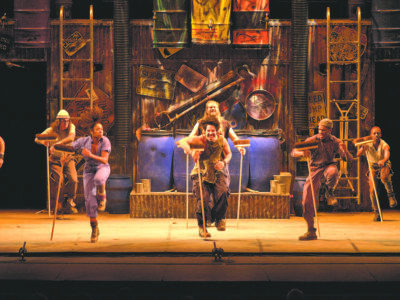
Brooms are among the many things that become percussion instruments in the hands of the performers of "Stomp," which plays Youngstown on Wednesday. (Submitted photo / Steve McNicholas)
Back in August, when “Stomp” cast member Jonathon Elkins did this phone interview, he was excited to be back on the road after a layoff of more than year.
“The crowd was probably one of the best we could have had,” he said the morning after his return to the stage. “The show was almost too easy because the crowd was so ready to see a show again and be entertained again and clapping for almost everything. We’ve been here rehearsing the last four days, running the numbers, the music and the choreography, and really just doing it for yourselves. Now there’s an audience, so the payoff is there, every time you do a little comedic bit or a flourish.”
Along with the excitement, there was the anxiety that came from a whole set of COVID-19 protocols that had to be followed on the road and the chance things could shut down.
About 24 hours after the interview, the Youngstown date on the tour was postponed until Jan. 5 at Powers Auditorium. COVID-related shutdowns have plagued other shows, from Broadway to the touring production of “Wicked,” which had to cancel its Sunday matinee in Cleveland due to numerous positive tests among cast members.
Sunrise Entertainment President Ken Haidaris, promoter of the Youngstown “Stomp” date, everything is on course for the show to go on as scheduled on Wednesday.
This is Elkins’ fifth tour with the percussion-driven theatrical experience created by Luke Cresswell and Steve McNicholas where eight performers create a cacophony of sound with items ranging from brooms to garbage cans to shopping carts. It opened at New York’s Orpheum Theatre in 1994 and ran for 26 years and about 11,000 performances before COVID-19 shut down live theater in March 2020.
After the long layoff, that first rehearsal was a challenge, even for the experienced cast.
“We couldn’t make it 20, 30 seconds before someone said, ‘We gotta stop. I don’t know where I am,'” Elkins said.
As tough as the first rehearsal might have been, the morning after might have been tougher.
“Every time you come back, you expect it to hurt,” he said. “You think, I have to start running, I have to do some sort of conditioning, something to help my body not be shocked by everything … Just stomping your feet on the stage and the shock going through your muscles, I felt that pretty much immediately. You wake up the next day and your fingers are swollen, your hands are sore.”
With most touring shows, cast members do all eight performances each week. Because of the physical demands of “Stomp,” 12 touring performers rotate into the eight on-stage roles, and Elkins can play one of three different roles at any show.
Elkins has a skill set uniquely suited to “Stomp.” The Michigan native performed with Drum Corps International and Winter Guard International ensembles through his home state, and he’s also been a member of the Detroit Pistons and Detroit Lions drumlines. In addition to his background as a percussionist, Elkins also studied improv comedy.
The interest in music came from his family. His grandfather was a drummer and his father is a guitar player.
“When I was 3 years old, 4 years old, seeing them in the basement jamming with each other, I was mesmerized,” he said. “Drums had that visual element, watching the drummer swing the sticks around the kit — ‘Wow, I want to do that.'”
The improv interest came when a comedy club near his home had an improv troupe and offered classes. Even after he was cast in “Stomp” and training in New York City for his first tour, Elkins took classes at Upright Citizens Brigade. When the tour has had an extended stay in Chicago, he’s taken classes at Second City.
But making music with broomsticks or basketballs isn’t the same as the precision and militaristic style that a musician learns in a drumline. There are subtle variations in the handles and how inflated the balls are, and they get passed among the performers. Elkins said he has to adjust what he does to keep the beat depending upon how flexible each broomstick is or how inflated each basketball may be.
“The props themselves are the ninth character,” he said. “Those props, they can really throw you for a loop, but the props allow for for a little bit of an organic sound. It might flex a little behind the beat or a little before the beat. You want the music to sound like it’s moving sometimes instead of sounding like a drum machine.”
Ticket
Packard band plays Memorial Day concert
Mandalorian’s clumsy debut on the big screen

Author finds ‘Unique Eats’ in Ohio
Ticket stubs
Titanic artifact exhibition opens in Cleveland “TITANIC: The Artifact Exhibition” opens today at the Great ...

Hahn captures ‘Iconic’ images for art poster