Trending
Locating a missing key card by counting the opponents' cards as they are played is one of the most satisfying experiences at the bridge table. But for many players, satisfaction can change to frustration when they find themselves unable to remember every card played. Players who experience this problem are best advised that the key to accurate counting lies in keeping track only of what is pertinent to the issue at hand
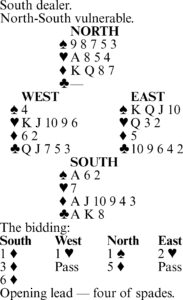
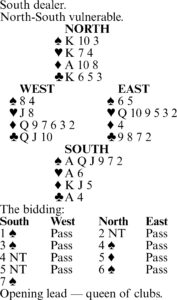
Consider this case where South is in seven spades. Declarer's only worry is a potential diamond loser. But before attempting to guess which way to finesse for the missing queen, South should try to learn as much as possible about the opponents' distribution in the other three suits.
South therefore decides to keep an eye on when and if either defender shows out in any of the other three suits. The actual rank of the cards in these suits as they are played doesn't really matter. South starts by taking the club lead with the ace, cashes the A-Q of trump, then plays the king of clubs and ruffs a club.
At this stage, all declarer knows is that the spades were divided 2-2 and the clubs 4-3. But when South next cashes the A-K of hearts and ruffs a heart -- on which West shows out -- he gets the break he's been looking for. Since East has thus far turned up with two spades, three clubs and six hearts, he cannot possibly hold more than two diamonds.
To complete the count, declarer leads a trump to the king and ruffs dummy's last club. When East follows to the club lead, his original diamond holding drops to one, giving South a sure thing. He simply cashes the diamond king (to guard against the singleton queen in the East hand), then takes the marked finesse through West to secure the slam.
Tomorrow: Bidding quiz.