
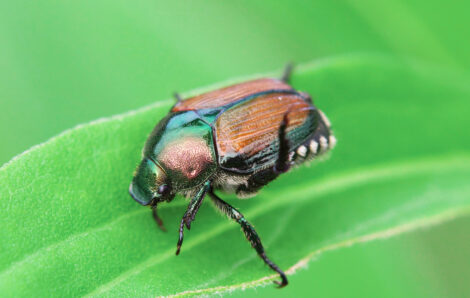
How to deal with Japanese beetles
Trending
They're almost here!
We generally see destructive Japanese beetles around the Fourth of July. A better way to know the time of their arrival is by using the OSU Growing Degree Days Site at https://go.osu.edu/growingdegreeday. This site helps you know when they are about to emerge.
Why are they such a problem? Because they don't belong here!
In 1916, in New Jersey, this insect was introduced from Japan. It has had major consequences on woods, gardens, yards, and all farmers and gardeners. They have no natural enemies here, though starlings, crows, moles, shrews and skunks eat them.
The cycle begins as 40 to 60 eggs are laid in moist soil in July.
Then, these white grubs feed on the roots of turf grasses, vegetables and seedlings. October finds the grubs burrowing deep into the soil to wait out winter. As soil warms in spring, the grubs feed on roots, making large patches of dead sod, as the grass plants do not have enough roots to sustain themselves. June to July is time to pupate, emerging as adults to eat, mate and reproduce.
As adults, they can eat leaves, flowers, and overripe and wounded fruit. They love grapes, roses, lindens, sassafras, Norway maple, Japanese maple and purple plum, along with other species. They seldom feed alone, instead feasting in groups, emitting a smell that attracts others. Thus, removing the first beetle without crushing it will reduce the chance for hundreds to come and eat your plants.
They love the sun and feed on foliage in a sunny location. Traps are unsuccessful and detrimental, as traps are baited with either a female pheromone (thus attracting males) and/or a tasty food type (thus attracting the beetles to anything along the flight paths).
To save lawns, the best action to take is to first identify the grubs as Japanese beetles (as there are other insect grubs that eat grass roots as well). Once identified, then the application of insecticide at a specific time in the cycle is vital. Be sure to read and follow all label directions before using. The OSU Extension office can help with identification.
To reduce adults, pick them off plants and place them into a can of soapy water.
To learn more about these insects, go to: https://go.osu.edu/japanesebeetle.