

Snowbirds brighten bird feeders in winter
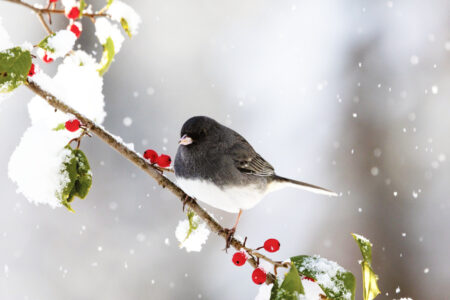
Submitted photo Officially called dark-eyed juncos (Junco hyemalis), these common local birds are often known as “snowbirds” because many migrate south each fall from Alaska, Canada and northern mountain regions of the United States to winter across much of the U.S., Mexico and the Gulf Coast.
It’s always a pleasure to watch the variety of feathered visitors at our backyard birdfeeders year-round, but snowbirds reign as our family’s unanimous winter favorite.
Who could resist those plump gray songbirds with their showy white bellies and tails? They crowd around the feeders, search the ground beneath for seed, then scatter to land on a porch rail, hide next to a planter box or flit in and out of tree and shrub branches. It’s not unusual to see six or more at a time, especially on a snowy day.
Officially called dark-eyed juncos (Junco hyemalis), they are often known as “snowbirds” because many migrate south each fall from Alaska, Canada and northern mountain regions of the United States to winter across much of the U.S., Mexico and the Gulf Coast. In early spring, they return north to their breeding grounds.
There are several subspecies of juncos.
The slate-gray dark-eyed juncos we see locally, with their striking white bellies and tails, are most common in the Eastern states; Western states see a brown species and several other color variations. All juncos are small birds, between 4 and 6 inches tall, with males somewhat larger and having brighter colored plumage than females.
Juncos are among the most populous birds in North America, according to Cornell University, citing studies that estimate their number at 630 million birds; Audubon reports that dark-eyed juncos total about 220 million.
Snowbirds rely heavily on seeds for nutrition, particularly in winter. In warmer months, insects make up about half their diet. They enjoy eating seeds from the ground or from a platform feeder, but Cornell recommends using other types of feeders to keep the seed dry and to ensure the birds are safe from predators. Favorite food choices are black oil sunflower seeds, cracked corn, hulled sunflower seeds, millet, milo and oats.
Consider planning ahead for these seasonal visitors and provide another food source by leaving some grassy areas on your property unmowed next fall. Dark-eyed juncos are known to use their acrobatic skills to climb tall grasses, pushing the seedheads to the ground to be eaten out of the sight of predators.
Once they return to their nesting spots in the north, juncos breed between March and May, usually laying three to five bluish-white spotted eggs at a time. They are monogamous — the females build the nest, a cup-shaped structure made of grasses and bark and lined with soft grass or hair — then male and female work together to collect insects for their baby birds.
Hatched with their eyes closed and featherless, the nestlings develop quickly. They are usually ready to fly and leave the nest in about two weeks. A junco pair generally has one to two broods per year, sometimes three.
Lifestyles
Alpha-gal meat allergy faded over four years
Q. I contracted alpha-gal meat allergy while living in Long Island, New York, over a decade ago. An observant ...
Health notes
To include or update items in the weekly Health News list, email information to tmunnell@tribtoday.com or ...
That’s going to be ITCHY
TO YOUR GOOD HEALTH: Helping those who fake illness is difficult
DEAR DR. ROACH: Could you address Munchausen syndrome and how to treat a person who might have it? What causes the ...
Bridge by Steve Becker
Precisely when to win a trick is a problem that often determines the outcome of a hand. The holdup play, so often ...
HINTS FROM HELOISE: Prying open bottles of nail polish
DEAR HELOISE: To open a bottle of nail polish that’s stuck, place a cup of water in the microwave for 1 ...