Desk job is causing you pain
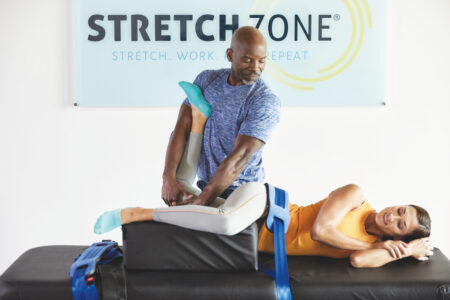
Photo courtesy of Stretch Zone Stretch Zone trainers use a combination of stretching exercises and strap equipment to help people increase their flexibility to combat the muscle pain caused by sedentary lifestyles. There are Stretch Zone facilities in Mentor and Sewickely, Pa.
For many people, the workday begins and ends in the same position: seated.
The modern worker spends hours hunched over keyboards, eyes glued to their monitors and hips locked in a seated position. While most people focus on countering the mental fatigue of a long workday, the physical toll is the quiet crisis.
Sitting puts active strain on your body, leads to poor posture, weakened muscles and spinal stress, and can cause chronic lower back pain and sciatica. After staying in one position for hours at a time, some muscle groups shorten while others disengage. As your hip flexors tighten, your glutes become less active and the chest muscles pull forward. You feel an ache as shoulders and lower back muscles have to compensate.
This is why desk workers often feel tension in the same places over and over again. The body is getting a workout through strained repetition. What starts as mild stiffness can eventually make everyday movement feel harder than it should, whether that means getting up from a chair, twisting to reach something or trying to stay active outside of work.
And that tension does not always stop when the workday ends. It can follow you into workouts, into your sleep, and into the general fatigue so many people now accept as part of modern life.
THE DIY BARRIER TO MOBILITY
Many people try to combat office stiffness with standard “DIY” stretching at their desks or in the gym. However, the human body has a built-in safety mechanism called the stretch reflex. When you stretch yourself and reach a certain point of tension, your muscles automatically contract to prevent a tear. This creates a physiological limit that is difficult to bypass on your own.
Stretch Zone’s practitioner assisted stretching utilizes a proprietary method to work with the nervous system rather than against it. By using a patented strapping system to stabilize the body and isolating specific muscle groups, a certified and trained professional can help the muscle relax into a deeper range of motion. This process “re-educates” the nervous system, allowing for greater flexibility and a more permanent release of the tension built up during 40-plus hours at a desk.
UNDERSTANDING DESK WORKER’S RECOVERY
We have long understood the anecdotal benefits of stretching, but recent data has provided scientific evidence of its impact. A 2026 study titled The Stretch Zone Effect, published in the Journal of Musculoskeletal Disorders and Treatment, evaluated the experience of adults through a 30-day standardized program. The results are particularly relevant for those living sedentary lifestyles.
The study found that 78% of participants experienced a reduction in pain, specifically easing the tension and discomfort that often plagues office workers.
Furthermore, 85% of participants improved their range of motion. For a desk-bound professional, these improvements are life-changing.These numbers translate into the ability to bend to tie your shoe or turn to check a blind spot without discomfort. It is about restoring the ability to fully participate in life outside of the office.
BEYOND FLEXIBILITY: ENERGY AND SLEEP
One of the most significant hurdles of a sedentary life is the accompanying “brain fog” and fatigue. Many people assume that because they are sitting all day, their bodies should feel rested. In reality, the opposite is often true.
When muscles stay tight and posture stays compromised, the body works harder than it needs to — a physical strain that can contribute to fatigue, stiffness and even poor sleep. So while flexibility is often the starting point, it is not the only benefit people notice.
In the Stretch Zone Effect study, 66% of participants reported higher energy and reduced fatigue. Additionally, 58% of participants reported better sleep, which led to improved recovery and overall wellbeing. Ultimately, 90% of participants felt a full-body benefit to their general health.
DON’T LET YOUR WORKDAY SET YOUR LIMITS
Just as a single day at a desk does not cause chronic pain, a single stretch does not fix it.
The study highlighted a clear “dose effect,” showing that those who attended sessions two to three times per week saw 25% greater gains in flexibility. The greatest gains were observed in the trunk, hips, and shoulders — the exact areas most compromised by a seated position. Repeated stretch sessions are needed to address the repeated 9-5 strain a desk job puts on our bodies.
Desk jobs and sedentary lifestyles are not going away, but the physical limitations they create don’t have to become your new normal. A regular practitioner assisted stretching routine can be a game changer for enjoying life outside of work, allowing you to enjoy activities without tension or discomfort, boosting energy and making everyday life more vibrant.
The closest Stretch Zones are in Mentor or Sewickley, Pa. Visit www.stretchzone.com for more information.
Lifestyles
Hints from Heloise: Clean showers with ease
DEAR HELOISE: The easiest way to clean a shower is with a squeegee. They come in different widths, and it only ...

Thursday evening TV
To Your Good Health: Dementia worsens after case of delirium
DEAR DR. ROACH: My 83-year-old sister underwent the simple procedure of replacing her pacemaker battery. She’s ...
Dear Annie: Marriage ledger: Should she move for new job?
DEAR ANNIE: I am middle-aged and lost my job during the pandemic when the company I had been with for years ...

Bridge by Steve Becker