

Leaves don’t always leave for winter
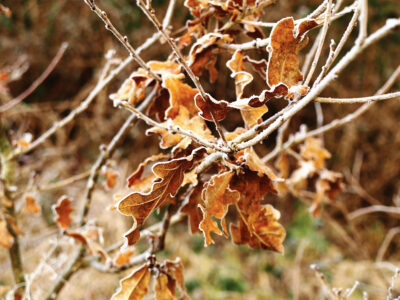
Submitted photo White, Pin and Red Oak trees are among the species of trees that do not lose their leaves in fall but instead experience marcescence.
Many of us observe the beauty of trees and bushes during winter, standing leafless and bare during cold months.
However, not all deciduous trees and bushes lose their leaves in the fall, but cling on the stem until spring. According to The Ohio State University’s Buckeye Yard and Garden Line, marcescence is the phenomenon where leaf withers but remains attached to the stem instead of falling off.
Marcescence originates from the Latin word “marcescere,” meaning “to fade.”
In autumn, a separation forms between the abscission layer and the leaf stem to allow leaves to detach from the branches of trees and shrubs.
Some trees will shed their leaves completely and others retain their leaves, forming an incomplete leaf separation. These remaining leaves will fall either in late winter or during spring bud break, with some theories suggesting that this process adds extra organic matter to the soil and helps retain soil moisture in the spring.
According to Illinois Extension, another theory suggests that by keeping dry leaves through winter, trees protect themselves from animals, such as deer that browse on tender buds and twigs when food is scarce.
Interesting enough, not all trees shed their leaves at the same time. Some drop their leaves from the canopy, or tree top, and retain some leaves on the lower limbs. Brown and tan withered leaves hang securely on the branches, even during high winds.
Regular leaf marcescence can often be seen in hardwood trees such as our White Oaks, Pin Oaks, Red Oaks, American Beeches, Hornbeams and Witch Hazels. Picture the gardener with her rake, waiting impatiently for all the leaves to completely fall so all her garden tools can be stored away for the winter, only to be frustrated by dried leaves that cling on to each branch!
Marcescence can benefit trees in some ways, but it can also pose risks. Retained leaves increase the branch’s surface area, making them more susceptible to breaking during strong winds or heavy snowfall.
Whether the leaf is separated from the petiole or not varies with each tree species. Walk around your neighborhood and notice which trees are marcescent and which are not. Identifying each of these trees or bushes can add to your knowledge of our natural world.
Lifestyles
Religion news
SERBIAN DAY: The 93rd annual Serbian Day will take place noon to 8 p.m. Sunday at Holy Trinity Serbian Orthodox ...

Trash and treasure sale to raise funds for church capital campaign
Storm scam: Don’t get swept away
Valley residents experienced a taste of natural disasters earlier this month, as a powerful storm plowed through ...
Senior news
RETIREES TO MEET: Howland Schools Retired Personnel will meet for lunch at 11:30 a.m. Aug. 4, at Shepherd of the ...
Unexpected hazard on the highways
For thousands of years, humans lived with minimal exposure to manmade chemicals. Today, though, we are surrounded ...
HINTS FROM HELOISE: How you can keep your skin healthy
DEAR HELOISE: Every skin care company claims to have the perfect solution to staying young, but the truth is that ...