

Yemen introduced the world to coffee
Coffeehouse culture booming
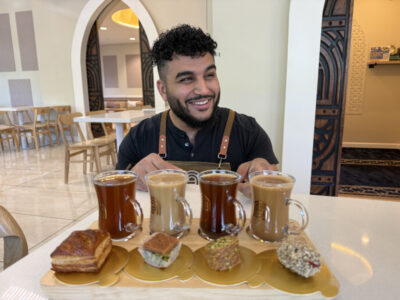
AP Franchisee Ahmad Badr serves a drink and treat sampler at Arwa Yemeni Coffee on April 6 in Sunnyvale, Calif.
SUNNYVALE, California — Hundreds of years ago, Yemen helped introduce the world to coffee. Lately, the mountainous, war-ravaged country that borders Saudi Arabia and Oman is exporting something else: its coffee culture.
Yemeni coffeehouses are opening at a rapid pace across the U.S. The number of cafes run by six major chains that serve Yemeni-style drinks grew 50% last year to 136, according to Technomic, a restaurant industry consulting company. The count doesn’t include the many smaller chains and independent cafes serving coffees and teas imported from Yemen.
Yemeni coffeehouses are meeting the moment for several reasons. They stay open late — sometimes past 3 a.m., especially during Ramadan — and provide a place to socialize for the growing number of Americans who don’t drink alcohol. Last year, a Gallup poll found that just 54% U.S. adults reported drinking alcohol, the lowest percentage in 90 years.
“Generally in the Middle East, our nightlife is coffee, right? People hang out at coffee shops, they play cards, they talk. We wanted to bring that here,” said Ahmad Badr, who owns an Arwa Yemeni Coffee franchise in Sunnyvale, California.
Another reason for the cafes’ popularity is the growing number of Americans of Arab descent. Between 2010 and 2024, the Arab American population in the U.S. rose by 43%, compared to around 10% growth for the U.S. population as a whole, according to the Arab American Institute.
While most Yemeni coffee shops are in places with high concentrations of Arab Americans, including Michigan, California and Texas, they’re also opening in locations as diverse as Alpharetta, Georgia; Overland Park, Kansas; and Portland, Maine.
Faris Almatrahi is the co-founder and owner of Texas-based Arwa Yemeni Coffee, a chain with 11 cafes across the U.S. and 30 more in development. He said an ongoing civil war in Yemen that began in 2014 has prevented Yemeni Americans like himself from visiting their homeland, so he has tried to evoke Yemen in his cafes.
Arwa locations are painted in natural desert tones, with archways that mimic mosques and lampshades shaped like the hats worn by Yemen’s coffee farmers.
“One of the ways to actually visit without traveling there was to bring that experience to the U.S., and that was a huge passion for us when we opened our first location,” Almatrahi said. “It was extremely emotional for all of us due to the fact that it really transported us to Yemen.”
But Almatrahi noted that most of his customers aren’t of Arab descent. In fact, Americans of all backgrounds are seeking out new global flavors and authentic experiences, according to market research company Datassential. Food trends are also spreading quickly through social media.
Menus vary, but Yemeni cafes generally serve specialties like Adeni tea, a spiced tea similar to chai, and qishr, a traditional drink made from the dried husks of coffee cherries. Familiar drinks like lattes might contain special spices or honey; at Arwa, lattes feature the outline of a camel stenciled in spices.
Bakery cases might contain khaliat nahal, or Yemeni honeycomb bread, a cheese-filled pastry drizzled with honey, or basboosa, a cake soaked in sugar syrup and often flavored with lemon or rose water. Many Yemeni menus also mix in more typical U.S. coffeeshop fare, like matcha lattes or berry refreshers.
Peter Giuliano, a researcher with the Specialty Coffee Association, a California-based nonprofit, said culturally specific cafes have been a key growth driver in the U.S. coffee industry for the last few years. In addition to Yemeni cafes, he cited the Latin-style chain Tierra Mia in California and Nguyen Coffee Supply, a New York-based company that roasts Vietnamese beans.
Lifestyles
A trip back home and memories of Father’s Day
It is Tuesday at 5:30 a.m. My husband Joe and son Benjamin left for work. Son Kevin is still sleeping. All is ...
There’s a beef about beef at the World Cup
DALLAS — Drop thousands of Argentina fans into Texas for the World Cup and the debate is inevitable. It’s not ...

Great pie for the Fourth of July

WEDNESDAY EVENING TV LISTINGS
TO YOUR GOOD HEALTH: Rectal cancer treatment works well
DEAR DR. ROACH: My daughter, who’s 44 years old, was recently diagnosed with rectal cancer. It’s stage III and ...
HINTS FROM HELOISE: Honey of a tip from the Valley
DEAR HELOISE: If you put a jar of honey on a sunny windowsill to liquify it, make sure to place the container in a ...