
Trending
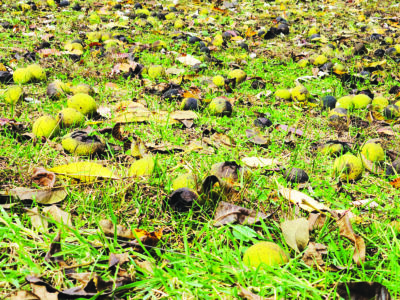
OK, they're really black walnuts that haven't turned black. But viewed from a distance, it's enough to send any Labrador retriever worth its weight in Milk Bones into a frenzy of tail-wagging exuberance.
It appears, at least in our backyard, that it's a mast year for walnuts and hickories. Mast is the botanical term for the wildlife food source produced by native trees and shrubs. Our native nuts are hard mast.
Black walnuts, Juglans nigra, are found in central and eastern North America. They do best in full sun and thrive in rich, moist, well-drained soils. In ideal conditions, the trees can become massive, growing to a height of 50 to 90 feet with a trunk diameter of 3 to 6 feet. They may live as long as 130 years. Walnuts typically lose lower branches to a height of about 20 feet as they grow.
Walnuts have pinnately compound leaves with nine to 21 leaflets. Male and female flowers are produced on each tree in the spring. Male flowers are 2-to-4-inch catkins, and female flowers form at the end of stalks, becoming fruit in the fall. The wind does pollination duty.
The roots, stems and leaves of walnuts produce a growth-inhibiting chemical called juglone. This allelopathic characteristic eliminates competition from many other plants that may attempt to grow within its zone. For this reason, along with it being a messy tree and a fall hazard (imagine trying to walk on golf balls buried under leaves), it is not recommended as a landscape tree.
Walnuts age from their green "tennis ball" appearance in early October to black in later fall. They possess a not unpleasant citrusy scent. The black husks eventually decompose, leaving the exposed nuts behind. The black, fleshy husks easily stain and can be used as a natural dye. It's easy to spot roadside walnut trees as the pavement appears stained black from traffic driving over fallen nuts.
Squirrels are the only local wildlife equipped with teeth strong enough to gnaw into the nuts. However, with the right technique and a lot of patience, they can be harvested and their distinctly rich and tangy flavor enjoyed. A variety of cracking techniques are offered online.
The real value of walnut lies in its wood. The wood is used in gunstocks, furniture and veneers. A top-quality walnut tree is determined by its trunk diameter, minimal defects and merchantable height -- the length of its trunk that can be used for lumber and veneer. Minimum is 8 to 10 feet, prime is several times that. See: https://woodlandstewards.osu.edu/ohio-timber-price-report for current timber values.
Our backyard walnut is a foot over the property line into a field behind us. I enjoy it as a home for wildlife, including nesting bluebirds. This "mother ship" of a tree has produced a grove of offspring over the years. Someday I'll get motivated and harvest a few of her nuts.
For details on this tree, go to http://go.osu.edu/blackwalnuts .
Steffen is an Ohio State University Master Gardener Volunteer in Mahoning County.