
Free colorectal cancer screening kits offered
Trending
BAZETTA -- Preferably, you'll make an appointment for a colonoscopy. At the very least, you'll take advantage of Steward Medical Group's free colorectal cancer screening kits, which are conducted in the privacy of one's home.
The goal is the same -- to prevent the state's second-most-deadly cancer from claiming another victim.
According to the Ohio Department of Health, lung and bronchus cancers account for 26.5 percent of all cancer fatalities in Ohio, followed by colon and rectal cancers at 8.7 percent.
"The best test is the one a person will come in for," gastroenterologist Amy Calderon, DO, said at the Steward Center for Radiology on Elm Road. "If you ask us, the best test is the colonoscopy because it's both diagnostic and therapeutic because if you find anything, you can do something about it. If people have polyps, they are taken out right then."
But for whatever reason -- fear of hospitals, skittishness toward exams, inconvenience or other excuse -- too many people won't schedule a colonoscopy, gastroenterologist Meredythe McNally, MD, said.
"People say, 'I won't do it because you might find something.' That's the whole point. … This is a preventable and treatable thing," McNally said. "If we find something, we can treat it and the survival rate is so much better, 90 percent vs. 11 or 14 percent.
"There's so much life to be lived and such a good survival rate. Why take the chance. I think that's kind of a no-brainer," she said.
March is National Colorectal Cancer Awareness Month, and Steward radiation oncology and laboratory services sites are giving away home screening kits for free testing.
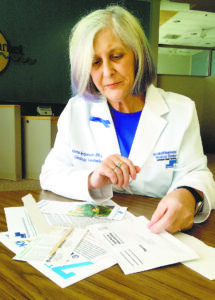
"The kits are basically just done as a red flag," Trumbull Regional Medical Center Oncology Coordinator Luana L. Andamasaris, RN, said. "They pick up blood, which is indicative of cancer."
Blood in the stool also may show the presence of precancerous polyps, which are abnormal growths of tissue. The lab also can check for DNA cell changes linked to cancer.
The home test is painless, private and less invasive than a colonoscopy; however, "There's no screening that's fun," Andamasaris said.
While colonoscopies are recommended every 10 years for most people, beginning at age 45, the home tests can be performed annually in the interim as an extra measure, she said.
COLORECTAL CANCER
Colorectal cancer occurs when cells in the colon or rectum multiply into abnormal growths called polyps. Over time, polyps can become cancerous.
Colorectal cancer also is referred to as colon cancer for short, but the colon and the rectum, while connected, are different. The colon is the large intestine. The rectum connects the colon to the anus.
Ideally, polyps will be found and removed before they become cancerous or, if there is cancer, before cancer cells spread beyond the polyp tissue. Once the cancer spreads, surgery may be needed to remove parts of the colon and to join what remains.
"Even if they have part of the colon removed, they still can function if it is caught early," Calderon said.
If cancer is confined to the layer of cells where it developed, the prognosis is a 90 percent survival rate for five years, Calderon said. Once cancer spreads to the lymph nodes, the survival rate drops to 70 percent. If it metastasizes, the survival rate drops to 15 percent.
"That's why we're screening early," Calderon said.
With colon cancer, treatment usually involves surgery to remove the cancer, then follow up with chemotherapy if necessary.
It's the opposite for rectal cancer. Doctors start with chemotherapy and radiation to shrink the tumor, then follow up with surgery as needed.
"Ohio generally seems to have a 10 percent higher mortality rate than the national average," Calderon said. The state ranks 35th-highest out of 50 states.
For incidences of colorectal screenings in people ages 50 to 75, Ohio ranks 26 out of the 50 states at 67.7 percent. Mahoning County is right at state average with 67.4 percent, with Trumbull lagging at 62.9 percent.
"Our goal is 80 percent screening,"Andamasaris said.
CAUSES AND PREVENTION
Mutations in DNA cells cause colorectal cancer, but what causes the mutations is largely unknown. However, there are genetic and lifestyle factors that increase a person's risk.
"A family history of intestinal problems does put a person at increased risk for colorectal cancer," McNally said. "Those people likely should have a colonoscopy every five years instead of every 10."
A family history of colorectal cancer, or polyps, or other intestinal issues doubles one's risk, doctors said. Inflammatory bowel diseases such as Crohn's disease or ulcerative colitis increases risks. Age also increases risks.
Warning signs that there might be a problem include chronic bleeding, changes in bowel movements, pressure or pain in the bowels, fatigue, anemia and weight loss.
"Blood in the stool shouldn't be ignored," Andamasaris said.
Among ways to help prevent colorectal cancer, she listed a healthy diet of whole grains, fruits and vegetables; decreasing red meat intake; decreasing alcohol intake; and getting regular exercise. Tobacco use and obesity also can be factors.
And, of course, regular screenings.
Access to cancer screening is problem in some areas, but that's not that problematic in the Mahoning Valley, McNally said. "Here, we have good access."
People fret about how preparation for screenings and the tests themselves.
"People worry about these things in the abstract, but it's not the worst thing you've done," McNally said. "It's safe."
xxxxxxxxxxx
COLORECTAL CANCER FACTS
Here are comparisons of rates of colon and rectum cancer in Trumbull and Mahoning counties. Numbers are cases per 100,000 residents.
• Incidences per year: Trumbull, 42.5; Mahoning, 41.9; state average, 41.3; U.S. average, 37.8.
• Mortality per year: Trumbull, 14.8; Mahoning, 15.7; state average, 15.1; U.S. average, 13.7.
• Percentage of adults ages 50 to 75 who met screening guidelines: Trumbull, 62.9 percent; Mahoning, 67.4 percent; state, 67.7 percent; U.S., 69.3 percent.
• Colon and rectum cancer incidences decreased 28 percent statewide between 1996 and 2018.
• Colon and rectum cancer deaths decreased 40 percent statewide between 1996 and 2018.
• Overall, Ohioans have a 65 percent survival rate after being diagnosed with colon or rectum cancer. The survival rate is 90 percent when caught at the "local stage," when cancer is present only in the layer of cells where they developed. Survival decreases to 73 percent at the "regional stage," when the cancer has spread beyond the original layer of tissue; and 15 percent if diagnosed at the "distant stage," the final stage of metastasis or cancerous growths at a distance from the original site.
• The highest percentage of colorectal cancers occur in the rectum, 22.6 percent and the nearby sigmoid colon, 16.5 percent, followed by cancers of the cecum, 14.9 percent; ascending colon, 13.9 percent; transverse colon, 6.4 percent; rectosigmoid junction, 5.6 percent; descending colon, 4.2 percent; appendix, 3.8 percent; hepatic flexure, 2.9 percent; and splenic flexure, 1.8. percent.
Source: Ohio Department of Health
xxxxxxxxxxxxxxx
WHERE TO GET THE KITS
Pick up a free colorectal cancer screening kit between 8 a.m. and 3:30 p.m. Monday through Friday through March 31 at the Trumbull Regional Medical Center Radiation Oncology Department, 1353 E. Market St., Suite 101, Warren.
Or pick them up at any of the Steward Laboratory services at:
• 20 Ohltown Road, Austintown
• 945 Boardman Canfield Road, Youngstown
• 2586 Elm Road, Building B, Bazetta;
• 811 Southwestern Run Road, Youngstown;
• 1350 E. Market St., Warren.