
Trump-Xi summit comes with high stakes for Taiwan
Trending
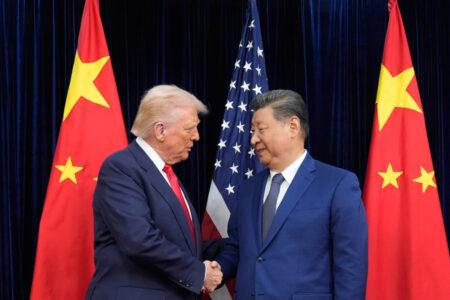
WASHINGTON (AP) -- President Donald Trump, in his return to the White House, has demonstrated greater ambivalence toward Taiwan, an approach that's raising questions ahead of this week's summit with Chinese President Xi Jinping about whether the U.S. leader could be open to dialing back support for the island democracy that Beijing views as its breakaway province.
Trump in December authorized an $11 billion arms package for Taiwan -- the largest weapons sale ever to the island -- but has not yet moved forward with delivery and even acknowledged that he's discussed the sale with Xi. He's groused that Taiwan "stole" America's semiconductor business and called on Taiwan to pay the U.S. for protection.
All the while, Trump has, with the threat of hefty tariffs, prodded Taipei to agree to massive investments in U.S. semiconductor manufacturing and to purchase billions of dollars' worth of U.S. liquefied natural gas and crude oil.
The president during an Oval Office exchange with reporters on Monday said that he expected Xi would ask him to hold back on arming Taiwan.
"I'm going to have that discussion with President Xi," Trump said about China's strong opposition to the U.S. providing weapons to Taiwan. "President Xi would like us not to, and I'll have that discussion."
Trump's rhetoric is fueling speculation in Beijing, Taipei and Washington about America's commitment to help the island defend itself and whether the Republican president could be persuaded to cede ground on the long-standing U.S. posture toward the island.
Taiwan's backers are concerned that Taipei will be "on the menu" when Trump and Xi sit down for talks, said retired U.S. Navy Rear Adm. Mark Montgomery.
"I do worry that we have a transactional president and a transactional opportunity could arise, and then we would have a challenge," said Montgomery, now with the Foundation for Defense of Democracies, a Washington think tank that supports robust U.S. backing of Taiwan.
RUBIO SAYS U.S. POLICY
IS UNCHANGED
The Chinese have signaled they intend to make Taiwan a central part of the talks. Chinese Foreign Minister Wang Yi raised Taiwan during a call with Secretary of State Marco Rubio to prepare for the trip, and urged the United States to "make the right choices" about its policies toward the island in order to safeguard "stability" between the two nations, according to a statement by the Chinese Foreign Ministry.
But Rubio said U.S. policy has not changed. "We don't want to see any forced or compelled change in the situation," he told reporters in Rome on Friday, saying it "would be destabilizing to the world." He noted that Taiwan would not be "a feature of our trip, but it'll certainly be an item that's discussed."
White House officials have underscored that Trump, who also approved $330 million in aircraft parts for Taiwan's military in November, has already approved more in military sales for Taiwan in the first year of his second term than the roughly $8.4 billion that Democratic President Joe Biden approved over his four years in office.
Taiwan has been under pressure from the Trump administration to increase its defense spending, and on Friday its lawmakers broke months of gridlock to approve $25 billion in arms purchases. It was significantly less than the $40 billion proposal put forward last year by Taiwan President Lai Ching-te. A senior Trump administration official, who spoke to reporters on the condition of anonymity under ground rules set by the White House, said it was disappointing that the parliament did not fully fund Lai's proposal.
Taiwanese government officials have expressed concern about China's rhetoric ahead of the summit, though they've also taken some comfort from Rubio's measured comments.
"(China) may attempt some maneuvering during the talks, but the U.S. has repeatedly reiterated, through both public and private channels, that its policy toward Taiwan remains unchanged," National Security Bureau Director-General Tsai Ming-yen told reporters.
The key question, China experts say, is just how far Xi will try to go in his effort to prod Trump closer to Beijing's view.