
Bald eagle cited as key to America’s identity at Austintown flag-raising ceremony
Trending
AUSTINTOWN -- As the U.S. blows out the 250 candles atop its birthday cake, the country continues to be led and guided by three forces that have allowed what it carved into stone to endure: the Declaration of Independence, the Constitution and the bald eagle, a longtime history professor and author contended.
"It has no legal force, but it has a powerful moral direction," George D. Beelen, who chaired Youngstown State University's history department, said, referring to the Declaration of Independence.
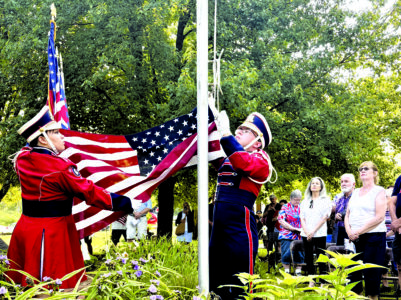
Beelen was the keynote speaker at an annual July 4 flag-raising ceremony and program Saturday morning at the Austin Log Cabin, 3798 Raccoon Road.
Hosting the 45-minute patriotic gathering, which also was an America250 event to celebrate the nation's 250th anniversary, was the Austintown Historical Society.
Margie Goldner, the society's president, served as master of ceremonies.
Calling it "a philosophy of democracy," the Declaration of Independence was written to be a guiding light that recognizes governments are "manmade," but provides enough latitude to ensure means are available to abolish rogue governments, then replace them with those more in alignment with democratic principles, said Beelen, who earned a doctorate degree in 1971 from Kent State University, taught eight years at Poland Seminary High School and penned a book titled "Genius Knows no Boundaries," which discusses the Ohio Cultural Alliance, a community organization he founded in 1987.
The OCA is now part of the Mahoning Valley Historical Society.
Beelen also told an outdoor crowd of several dozen veterans, elected officials, Austintown Fitch High School students and others that the Constitution is a relatively brief, logical, straightforward and simple document that, unlike the Declaration of Independence, has legal force. Even with 27 amendments, the blueprint for American governance is only about 6,500 words long, he noted.
The 27th Amendment, ratified in 1992, delays pay raises or cuts to congressional members until after the following House of Representatives election. In essence, it ensures lawmakers face voters and potential accountability at the ballot box before benefiting from salary changes.
As the nation celebrates 250 years since the fall of British rule and King George III, the document continues to be a work in progress. When first ratified, only white male property owners had the right to vote. Nevertheless, the Constitution also has allowed for changes to it to reflect and fit the times, Beelen explained, adding that the 19th Amendment, passed in 1920, gave women the right to vote.
Other notable and important built-in features the document provides are the separation of powers, individual sovereignty for citizens and a federalist structure of governance that allows for dual sovereignty between the federal and state governments, Beelen said.
In a seemingly contradictory way, the bald eagle is emblematic of American values, since it holds arrows that denote war in one set of talons and an olive branch that symbolizes peace in another, Beelen noted. The juxtaposition recognizes that the nation seeks peace within and beyond its borders, but also recognizes that occasionally war may be necessary to defend its sovereignty -- though with a high emphasis on exercising diplomacy first -- while preferring "ballots over bullets," he explained.
Beelen said that the U.S. has made many mistakes, such as nationalism, chauvinism, racism and jingoism. It's vital that, despite those and other imperfections, the nation stays strong while continuing to pursue peace and tranquility.
"Yes, it's hard to be strong and kind," Beelen said, adding that it's incumbent on people to uphold the principles of democracy in their lives.
Throughout its long and storied history, the nation also has benefited in each era from its share of heroic figures such as Presidents Theodore Roosevelt and Franklin D. Roosevelt, as well as Dr. Martin Luther King Jr. on the national level, along with local first responders, Beelen pointed out.
The longtime history professor noted that Theodore Roosevelt led the Progressive Era charge against the unchecked power of the "robber barons" (the Gilded Age industrialists who established monopolies in the oil, steel and railroad industries). Franklin D. Roosevelt guided the country through the Great Depression, and King employed the philosophy of Gandhian nonviolence during the civil rights movement to bring about social change, he continued.
Beelen also praised Kathleen "Kathy" Price, who established and directs an Austintown-based nonprofit organization called the Mission of Love Foundation. For nearly 40 years, the foundation has provided medical supplies, built clinics, delivered emergency vehicles to indigenous and vulnerable communities, and provided other forms of global humanitarian aid, he said.
Taking part in the flag raising-ceremony before Beelen's presentation were Aiden Pitt and Angeline Secre, captains of the Fitch High Color Guard.
Saturday's event was among thousands of America250 celebrations across the country in large cities to small towns and villages.
Following the program was a Fourth of July parade that began at noon near Kirk and Raccoon roads. The theme was "250 Years of Freedom: Honoring Our Past, Celebrating Our Future."