
SALUTING OUR VETS: Big Ben shines as fixer of jets in AF, clocks in the Valley
Trending
Ben Mischey
AGE: 93
RESIDENCE: Austintown
SERVICE BRANCH: Air Force
MILITARY HONORS: Various, including Good Conduct Medal and Sharpshooter Medal
OCCUPATION: Owner of Big Ben's Clock Shop in Austintown
FAMILY: Two daughters, Holly Mischey and Laura (Aaron) Zavadil; one granddaughter; and three great-grandchildren
AUSTINTOWN -- Ben Mischey has always been mechanically inclined.
"I guess it was in my genes. It was just something I liked to do," Mischey said.
He was born in Oshawa, Ontario, Canada. After high school in the 1940s, he got a job in a machine shop, but "the United States was more prosperous at that time, so a friend and I decided we'd enlist in one of the services."
The Navy was full, so he signed up for the Air Force. He did not want to tell his parents. "The day I got the call to report was the day I told them. That was the hardest thing," he said.
After boot camp at Sampson Air Force Base in New York and training at Chanute Air Force Base in Illinois, he was stationed at the Youngstown Air Force Base (now the Youngstown Air Reserve Station) as a mechanic working on fighter planes. It was 1952, and the base had been open less than a year.
At this time, he became an American citizen.
"The American Legion made all the arrangements. I studied as much as I could about American history. The judge said, 'If you're good enough to fight for the country, you're good enough to be a citizen,' and I didn't have to take a test."
Mischey hoped he would complete his enlistment in Youngstown, but that did not happen.
"I had 13 months left and I was sweating it out -- stay here or get shipped out someplace. Sure enough, there were two lines, one going to Saudi Arabia and the other to Greenland."
Mischey was sent to Thule Air Base (now Pituffik Space Base) in Greenland. Around that time, a few more senior people left.
"They made me sergeant and put me in charge of the machine shop. There was nobody else," he said.
Conditions in Greenland were harsh.
"It's pitch dark, and I have to work on a plane outside. I've got a man beside me with a generator giving me heat while I'm standing on a scaffold trying to take out a broken stud and you're talking 40 or 50 degrees below zero," Mischey said.
Besides constant darkness and extreme cold were fierce winds.
"We had different phases of storms. Phase 1 was just a normal storm with maybe 20-25 mile an hour winds. Phase 2 picked up to 40. And then Phase 3 could be 50 to 70 mile an hour winds. You couldn't stand on your feet," he said.
When a Phase 3 hit, everyone had to immediately take shelter.
"We'd head for the mess hall because they would cook for us, and we didn't have to eat C rations," Mischey said.
Fresh food was rarely shipped to Greenland, so they only ate well on Thanksgiving and Christmas.
"The only things I liked were the fruit cup and a pack of Lucky Strikes," he joked.
There was no plumbing.
"The water was delivered to each barracks. There were two tanks in the latrine. Fresh water came in for drinking and washing. Wastewater went into a waste tank. There were times during storms that the water tank was low but the waste tank was full and started to smell. We had jokers who would turn on the spigot and it ran onto the road. And it freezes," he said.
Although Mischey was not in Korea, the war there resulted in increased demand for people everywhere.
"Greenland was a fighter squadron base. Russian MiGs were flying around. We had 2,500 Army personnel and gun batteries at the top of the mountain as well as 5,000 Air Force personnel. We had a C-124 Globemaster that would fly out and parachute down just to keep testing. We had to stay on guard all the time," Mischey said.
In 1956, his enlistment was up. After the Korean War, all ranks were frozen.
"I was anticipating reenlisting if I would have gotten a fourth stripe, but that didn't work out so I got discharged," he said.
Since Mischey was married at the time, he returned to the Mahoning Valley. He worked at Youngstown Welding for more than 32 years, first as a machinist and then as a sales engineer. They manufactured everything from equipment for candy bars to parts on submarines.
"We made a complete torpedo tube. The piping was 25 feet long. When it was finished it went directly to the shipyard. It was made from Monel (a nickel-copper alloy) and brass. It was non-magnetic because anything magnetized on a submarine can be detected," Mischey said.
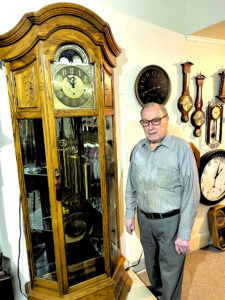
Around 1980, Mischey started fixing clocks on evenings and weekends, but eventually business increased. New management made his job less satisfying, so in 1993 he retired and devoted his time to Big Ben's Clock Shop.
"I've been in business all these years and I guess I've established a reputation," Mischey said.
He has sold countless clocks, but with the loss of suppliers as well as recent tariffs, he repairs more than he sells.
Mischey plans to continue as long as he can.
"The Man Upstairs is the one that controls me. But I'll keep working until I can't work anymore. Once I'm done, that's the end," he said.
Mischey takes pride in his service to his adopted country. Once when he drove over the Peace Bridge in Buffalo after a vacation, a border guard said smugly, "I see you were born in Canada. What are you doing over here?" Mischey responded, "I came here in 1952 to help you guys out during the Korean War." The guard didn't have a reply.
Mischey said he is glad for his military experience. "I was never sorry I joined. I was 19 and didn't know what I wanted to do. The service taught me respect and the confidence that I could go anywhere I want. I think I turned out pretty good."