
Panel charts the future of arts in the Valley
Trending
Billed as a "conversation," the "Mahoning Valley Civic Forum: State of the Arts" recognized the abundance of talented visual, performing and literature creatives in the area but, just as importantly, acknowledged the obstacles that keep the culture and entertainment scene from fully blooming.
Hosted by Thrive Mahoning Valley, it brought local organizations including LOOP Youngstown, Friends of the Mahoning River, SMARTS, Wean Foundation, League of Women Voters, Youngstown Press Club, Unitarian Universalist Church of Youngstown and the general public together to the free event Wednesday evening at the Ballroom at Penguin City Brewing.
"I see the Mahoning and Shenango valleys as an arts and culture ecosystem," said LOOP Youngstown board chair Karen Schubert. "I hope the LOOP can serve as a catalyst for cross-promotion and collaboration, the way indie bookstores are, for example, with the bookstore crawls, and the microbreweries cheering each other on. It's healthy when we lift each other up."
Initially, more than 50 attendees were encouraged to engage with one another and discuss the arts, culture and community with a focus on three questions:
* How are we building cities to be experienced, not just lived in?
* How effectively are we investing in artists?
* How are we investing in collaboration?
"I'm not directly involved in the arts and culture any longer," said Lori Factor of Canfield who previously organized the Summer Festival of the Arts, "but I'm still invested in what the arts and culture brings to the Youngstown area and the Valley. That's why I'm really interested in being here tonight and seeing what everybody has to say."
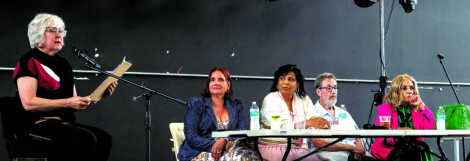
Schubert then moderated a dialogue among panelists with years of experience -- Becky Davis of the Butler Institute of American Art, artist and educator Bill Mullane, art patron and artist Dr. Virginia "Dee" Banks and Lynnette Forde of the Youngstown Foundation.
"We are not a team of experts on arts and culture," said Forde. "As a responsive grant maker, we have to listen and be prepared to read proposals that come into us from community experts who say that this is what is needed for people to live a vibrant life, and to have experiences that make a difference.
"We always look to those experts who are putting together proposals for their organizations, who are tapping into the voices of the community and their needs and who are soliciting those voices on a regular basis to tell us what's important to the community, and that leads our investment strategy."
Mentioning an area in downtown Pittsburgh that features multiple galleries, Banks used that as an opportunity to bring up the subject of funding for the arts.
"It costs money for these artists to rent space and then to put their art up. It doesn't Jiffy Pop up. On a local level, we need to open up our pocketbooks; whatever it is that we can contribute -- $25, $30, no amount is too small."
She added, "Are we still cultivating these big families to donate money to the arts like they're doing in a lot of other cities?"
While the panel leaned heavily towards the visual arts, their thoughts can transition to performing arts and literature as well.
Banks brought up Youngstown's jazz and music history. "I'm thinking specifically of Jeff Green [organizer of] Jazz in the Park. When he's passing out -- any of these musicians that are trying to put on shows -- when they're passing out these pamphlets, we have to not just say, 'We want...we'd like to do it.' or 'Wouldn't that be nice?'
"To put on these shows, it costs a lot of money. I think Jazz in the Park is a perfect example of how Jeff has created an environment for people to come out, bring their chairs and sit and listen to some great music."
Davis brought up how investing in youth will only benefit the area culturally.
"Years matter when it comes to visual and nonvisual [art]. The earlier you start, the better. You also have to have teachers who can teach an instrument or write a poem or use your voice to advocate for yourself or for your art and your work.
"There can never be too much investment in young people and in educators to be able to hone their crafts so they can share it. One of the assets we have to do that here is not just the preschool through 12th grade pipeline, but we also have sitting in the middle of this wonderful Valley, a university that is training the folks who play organ, who work at our arts institutions, who teach our children, who are leading services on Sunday...from music to reading and dance. So, you can never invest too much in training trainers who will help others understand and find their passion through expression and exploring themselves through the arts."
Mullane added to that, "The next challenge for the arts communities across the Valley is to figure out ways, especially our smaller organizations, more compact organizations, to leave their own space and begin to present and teach within church basements and...the Metropolitan Housing Authority has community centers. They'll bring the arts and the education to the communities, which becomes important."
In response to an audience question on the arts and civic engagement, Mullane said, "At its core the arts are our means of social and political engagement. They always have been and -- for good or ill -- the arts have the capability of changing a community's vision of itself. I think we do that every day."
For those who didn't make Wednesday's discussion, a one-hour recording of the panel as well as questions from attendees will be broadcast at 1 p.m. Friday on WYSU (88.5 FM).