
Author tackles McKinley memorial in latest book
Trending
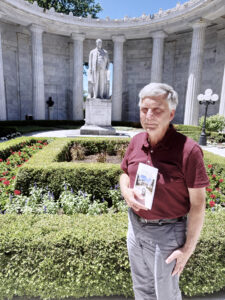
NILES -- Author Paul Rohrbaugh of New Middletown first became aware of the McKinley National Birthplace Memorial when he needed to draft a fourth-grade report about a United States president.
"I was awestruck by the white marble building in the middle of Niles and that motivated me to learn more about President McKinley over the years," he said.
After 21 years working at Youngstown State University, including as a librarian in the Beeghly College of Education, Rohrbaugh became an author. During his stint as a public services librarian, he had the opportunity to research and establish the provenance of artifacts relating to William McKinley, perform research about Niles' most favorite son and help others to do the same.
Rohrbaugh's interest in McKinley, as well as local history, resulted in his most recent book, "Friendship Memorialized: Joseph G. Butler and the McKinley National Birthplace Memorial."
What Valley residents do not realize is the prominent place and financial backing Joseph G. Butler, who lived the majority of his life in Youngstown, had in the construction of an edifice that would memorialize and honor his lifelong friend. Butler was born in Mercer County, Pa., but his family moved to Youngstown not long afterward.
William McKinley was the 25th U.S. President and served from 1897-1901. He was born in 1843 in Niles, the seventh of nine children, before his family moved to Poland for an opportunity at a better education, and where later he found work as a postal clerk and teacher. McKinley served in the American Civil War, attended Albany Law School, worked as an attorney in Canton, and served as a U.S. Congressman as well as Ohio governor prior to being nominated for president,
At the beginning of his second term, McKinley was assassinated by an anarchist while visiting the Pan-American Exposition in Buffalo, New York on Sept. 6, 1901. Rohrbaugh said the outpourings of grief were nationwide and effusive.
As a boy, McKinley enjoyed a close friendship with Joseph G. Butler -- a friendship that began in a one-room schoolhouse and continued throughout their adult years. Butler was one of the honorary pallbearers at McKinley's funeral in Canton, where his casket is interred.
So why a second memorial to McKinley when one already exists in Canton? Butler wrote, "Impressive as this memorial is, it was designed solely as a tomb and apparently did not attract visitors or serve to encourage to any great extent emulation of McKinley's virtues by future generations, which is the real function of an institution of his character."
Rohrbaugh gives a thorough overview of McKinley's life, achievements, shocking death and his contributions to the United States, both domestically and internationally, as a world power. McKinley is referred to as "the first modern president."
Rohrbaugh does not only write about the McKinley memorial. He offers an in-depth look at earlier, as well as more contemporary, presidential memorials, the places they hold, and the roles they fulfill in American culture. McKinley's memorial was the first to have a public library located inside, thanks to an Andrew Carnegie grant.
When he writes about the financing and building of the McKinley memorial, the book offers a glimpse of the myriad ways Butler encouraged donations from his fellow industrial magnates and politicians, as well as small scale donations from everyday men and women. If you came across Butler in any capacity, you were sure to donate to this very personal project.
Rohrbaugh said Butler was exceptional in the way he promoted his cause of building a fitting memorial, one that today holds the largest collection of McKinley artifacts -- more than at the Smithsonian or the National Archives, both located in our nation's capital.
Joseph G. Butler was a marvel at raising funds for worthy organizations and efforts that enhanced the city he loved, Rohrbaugh said. Tasked with securing funds for St. Elizabeth Hospital, he was able to complete it in one week. His devotion to groups that brought educational excellence and culture into the area is well documented.
Rohrbaugh covers the variety of fundraising activities, including the selling of McKinley dollar coins commissioned by Butler that became sources of revenue. All of Butler's efforts paid off when in 1915 the groundbreaking and cornerstone laying ceremonies took place -- 14 years after McKinley's assassination. The total cost of the memorial came to $278,840, which in 2026 would be equal to nearly $7.6 million.
The question to be asked is: why don't more people visit the McKinley memorial? The author writes about several factors. According to annual reports, it is estimated that less than 10,000 of the 300,000 visitors to the Niles memorial take the time to tour the museum each year; the majority come to utilize the resources available in the public library.
Another factor is that McKinley's status as a president has fluctuated over the years. As time moves on, other issues come to the fore along with other perspectives, leading to varying critiques of his leadership.
Lastly, there is a plethora of presidential memorials in our country, which has led to their diminishing importance. Today there is no qualification for building a presidential memorial, no matter how good or bad a presidential tenure is viewed, other than being elected president.
Rohrbaugh said the McKinley memorial is a statement piece because Butler wanted something that served the community as well as memorializing the fallen president. Shortly before he died in 1927, Joseph G. Butler wrote that the memorial "stands, a tribute of friendship, a testimony of national appreciation, an impressive memorial to a nation's hero, and serves, as he did in life, the welfare of the people."
"Our area has suffered a lot in the last four or five decades -- economic challenges, declining population, a mob presence -- that we have had to overcome. These negative influences almost define us. We need to share the whole story, the good stories. There are a lot of things we can be proud of. That is the source of my passion. I am proud of this area and I want other people to know the source of that pride," Rohrbaugh said.
"Friendship Memorialized: Joseph G. Butler Jr. and the McKinley National Birthplace Memorial" can be purchased online at http://www.hfdgames.com/pub.html.