
Trending
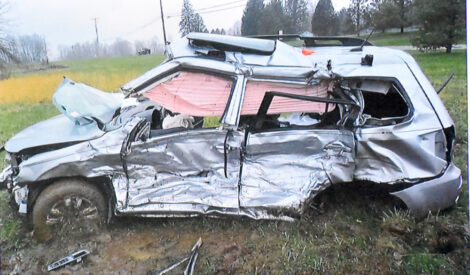
YOUNGSTOWN -- Coitsville Township Police Sgt. Charles Butch testified for nearly two hours Tuesday in the aggravated vehicular homicide trial of Robert C. Powell, 25, of North Carolina, in an April 10, 2025, crash at U.S. Route 422 and Hubbard Road that killed the driver of another vehicle, John Kulnis, 62, of New Castle, Pa.
Butch was the officer who investigated the 6:48 p.m. crash, went to the scene, observed Powell, administered field sobriety tests and arrested him.
Butch testified to having worked part-time for Coitsville from 1998 to 2010, then returning in 2022 as a full-time sergeant after working for the Campbell and Poland police departments. He has administered field sobriety tests more than 100 times, he said.
He explained that field sobriety testing involves the horizontal gaze nystagmus test, which looks for lack of smooth eye movement from one side to the other. The second test is a walk and turn. The third test is standing on one leg and counting.
Under questioning by Mahoning County Assistant Prosecutor Edward Walsh, Butch testified that Route 422 is four lanes wide and has a 55 mph speed limit, while Hubbard Road is two lanes and has a 40 mph speed limit. Kulnis was traveling on Route 422, which has no stop signs at the intersection.
Hubbard Road has stop signs on both sides. From the direction Powell was traveling on Hubbard Road, there is a stop sign and a sign that warns drivers that a stop sign is up ahead at Route 422, Butch testified.
Butch said that when he first encountered Powell the night of the crash, he asked Powell if he was OK, and Powell said he was. Butch said he observed that Powell's "speech seemed slurred." Butch then proceeded to "address" the victim's vehicle until he was no longer needed there.
Butch went back to Powell, who Butch said had a "slight accent." Walsh played Butch's body camera footage, during which Butch asked Powell "What happened?" Powell responded by talking about "working all day long in the rain" and other issues such as where he was staying.
Butch asked Powell about consuming alcohol and confronted Powell, "I can smell it, and your speech is slurred," Butch said on the recording.
When Walsh asked Butch what he observed that night, Butch said Powell's "balance was off," and he had a "strong smell of alcohol." The video showed the field sobriety tests. Butch said he saw "all six cues" in Powell's first two field sobriety tests.
In the walk and turn, Powell missed touching heel to toe multiple times and "raised his arms almost the entire time," Butch said. "He stepped off the line once, and he staggered in between the first time and second time," Butch testified. After administering all of the field sobriety tests, Butch arrested Powell on a charge of OVI.
Butch took Powell to the Campbell Police Department, where Powell refused to take a breath test. He took Powell to St. Elizabeth Youngstown Hospital, and hospital staff asked to draw blood for medical reasons, but Powell refused, Butch said.
In opening statements, Walsh said Powell was driving a Ford F-250, and Kulnis was driving a Subaru Forester. Powell told Butch he had two firearms in his truck, but it is illegal to have firearms in a motor vehicle when you are under the influence of alcohol, Walsh said.
Walsh said the main question in the trial is whether Powell was intoxicated at the time of the crash. The trial resumes Wednesday.
DEFENSE
Defense attorney Jeffrey Jakmides said in opening statements that Powell has no prior criminal history, and was in the Youngstown area running his own business assisting with underground utilities.
"He had never been on that road before. He was completely unfamiliar with this area," Jakmides said of Hubbard Road. Jakmides said two experts will testify that one of the stop signs at the intersection where the crash occurred is not in the right place.
"Stop signs are supposed to be right at the intersection," but the the stop sign in question was moved back about 80 feet, Jakmides said. "The stop sign on Robert's side was not at the intersection. It was back 82 feet. So Robert stopped at that stop sign and then proceeded through the intersection and there was a big crash," Jakmides said.
Jakmides wanted the jurors to consider the effect a crash involving two heavy vehicles has on a driver, including Powell.
"It's a shock. There is an emotional aspect to it. There is a physical aspect to it," Jakmides said. He asked the jurors to take that into consideration when watching the body camera video of Butch administering field sobriety tests to Powell.
In cross examination of Butch, Jakmides asked if a crash of this type would cause "some type of impact to the driver," and Butch agreed. Jakmides asked if Butch assessed Powell for an injury, and Butch said all he did was ask Powell if he was OK.
Jakmides asked if Butch knew that Powell was diagnosed at the hospital with a concussion, and Butch said he did not know that.
Jakmides asked Butch if he was aware that the Ohio State Highway Patrol expert in the case indicated that the stop sign near the intersection where Powell was traveling "is not placed properly," and Butch agreed. When Jakmides asked whether Butch would agree that the video shows that Butch was "irritated" with Powell at a couple of points, Butch disagreed, saying he felt his remarks were "being assertive."
Jakmides asked Butch about the National Highway Safety Administration manual on standard sobriety tests and asked the last time Butch got a refresher course on it. Butch said there was a new manual on it last fall.
When Jakmides asked when Butch last took the field sobriety course and was tested on it, Butch said it was between 2009 to 2020 when he worked for the Campbell Police Department. It could have been as many as 10 years ago, he agreed.
Jakmides asked if Butch asked Powell before he gave him the horizontal gaze nystagmus test whether Powell wore contacts or has any eye conditions and other things, and Butch agreed that he did not and that it is "required in the manual."
Butch agreed that he did not find that Powell's eyes were glassy, red or bloodshot. Butch agreed that he did know that Powell was raised in the South when Jakmides talked about a specific instance in which Butch said he observed Powell having slurred speech.
Jakmides asked Butch if, before he carries out some of the field sobriety tests, he is required by the manual to conduct an assessment of the person, and Butch said he does not recall. Jakmides noted that Butch learned after the walk and turn test that Powell had been in a train accident and had broken bones as a child, and Butch agreed.
Butch agreed that information could be relevant to the walk and turn test. Butch said he does not know whether Powell's ability to do the walk and turn test would be affected by his broken bones and the crash had just occurred a short time earlier.
Jakmides questioned whether Butch re-explained the different field sobriety tests to Powell multiple times to ensure that he understood them. Butch said he thinks he gave the "standard" amount of explanation.