
Maro: Nobody happy with not guilty verdicts
Trending
YOUNGSTOWN -- Mahoning County Prosecutor Lynn Maro hosted a Facebook Live program recently to address the "recent string of not guilty verdicts" that Mahoning County juries have issued in criminal trials since the start of the year.
Maro said that by her count, her office has seen five guilty verdicts in trials this year and six not guilty trial verdicts and said "Nobody's happy with that."
On the social media program, she reiterated a couple of points she made during her 2024 campaign for prosecutor and some successes in carrying them out.
But with her chief assistant criminal prosecutor, John Juhasz, by her side, she said the real reason they were broadcasting the 30-minute program was "because everybody has concern over the recent string of not guilty verdicts."
She has responded with comments several times after juries have dealt the prosecution tough losses from the jury box. This time, she talked about the things the juries have taught her office and the steps she and Juhasz are taking to reverse the not guilty string.
"We're as concerned about the not guilty verdicts as anyone, and we're working hard to try the tough cases to improve when we go into the courtroom and see what we can do to turn those not guilty verdicts to guilty verdicts," Maro said.
Juhasz said one thing prosecutors have learned from talking to jurors after the verdict is that they want more scientific evidence.
He did not refer to a specific case, but it was clear he was talking about the murder trial of Danyo Sellers, 19, accused of shooting into the parking lot where 15-year-old Amya Monserrat and others were attending a birthday party for another teen. Juhasz mentioned that jurors wanted surveillance video from the business showing the murder.
"The business had disconnected the video seven months earlier," Juhasz said, referring to the juror comment as an example of the "CSI effect," meaning the false notion by many people that "every piece of evidence has DNA on it" and every crime is captured on video.
Maro pointed out that the state crime lab sent law enforcement agencies a list of items that they will not test and the agency limits the number of items it will test, even in a homicide case. She said during jury selection, her office tries to get across to prospective jurors that there are limits on how much scientific evidence BCI can provide, but juries still want more.
Juhasz said another issue juries have trouble with sometimes is the idea that circumstantial evidence, meaning facts gleaned from other evidence, counts just as much as direct evidence, meaning something that a person viewed for themselves. Juhasz said when he has talked to jurors after a trial, they express an unwillingness to count
on circumstantial evidence as sufficient for conviction. Maro said her office is "going to keep prosecuting those cases because the law says we should."
Maro said feedback from jurors has resulted in her office doing additional training with its attorneys and local police departments. She said one aspect of American life that has shown up among jurors is a distrust of the government and questions about collection of evidence by police officers.
Juhasz said prosecutors have initiated discussions with the police to do trainings so that police departments can improve in areas jurors "found to be deficient.'"
Maro said her office has given police officers more feedback since she became prosecutor in January of 2024 to explain why criminal charges sometimes have to be reduced in a plea agreement. She said talking to the law enforcement agency about it can reduce the need to do that the next time. And prosecutors are also "looping back" to ask police officers to fill gaps in the case before the case goes to trial when necessary, she said.
Juhasz said additional training is being done for attorneys in the prosecutor's office on how to conduct jury selection. And on Fridays, the prosecutor's office holds "strategy sessions" with criminal prosecutors, which also helps to "plug some of those holes."
Maro said there were two not-guilty cases this year in which jurors said they thought prosecutors proved the case but they felt the defendant "suffered enough." She said it happens the most when the case involves a child who has died.
Maro mentioned jurors have said they were having trouble believing some witnesses. She said that is an example of a "difficult" case, saying, "We are going to keep trying those difficult cases moving forward at a much higher rate than" before Maro became prosecutor.
Maro said people watching the Facebook Live program asked about assistant prosecutor training. Maro said her staff "works very hard," and Juhasz has been trying cases for almost 43 years.
Maro said she will be in the courtroom more in the coming months trying cases herself.
"We are working with younger attorneys to train them. The senior attorneys are working to build stronger cases so that we can improve that conviction rate, but we're not going to stop trying tough cases," Maro said.
TURNOVER
The Mahoning County Prosecutor's office has seen significant turnover among its attorneys since about the time former prosecutor Paul Gains retired in late 2022, with many of the attorneys who handled major criminal trials moving on to other jobs.
They include Mike Yacovone, Jennifer McLaughlin, Kevin Trapp, Aaron Meikle and Jennifer Paris. Yacovone, McLaughlin and Paris handled the most significant trial in recent years when Brandon Crump Jr. was convicted in the death of 4-year-old Rowan Sweeney in February of 2024.
Maro and her predecessor, Gina DeGenova, who served as prosecutor from late 2022 until the end of 2024, brought on new people to replace those who left. Many of the new attorneys are young, though not all.
Maro said in 2025, her office tried 23 cases, and there were convictions in 65% of them. She said that is "consistent with the trend statewide'" and across the nation. She wants the percentage to be higher, she said.
Below are the not-guilty verdicts this year in major trials that were covered by The Vindicator, which does not usually cover low-level-felony trials.
JANUARY
On Jan. 14, 2026, Per'asia S. Godfrey, 19, was found not guilty of felonious assault and the lesser included offense of aggravated assault. She was accused of stabbing another woman during a large fracas on Cameron Avenue on the South Side of Youngstown.
On Jan. 20, 2026, prosecutors suffered a significant setback when a jury found Kenneth L. Carter, 35, and Terry Hopkins, 23, not guilty of murder and a gun specification, but found Carter guilty of improperly handling firearms in a motor vehicle in the Jan. 24, 2025, shooting death of Resean Graham, 42, in a home on Griselda Avenue on the South Side.
A notable hiccup in the trial was testimony that multiple Youngstown police officers had handled a watch taken from Carter not long after the homicide without the officers wearing sterile gloves, potentially contaminating possibly important physical evidence. Carter was later sentenced to 30 days in the Mahoning County jail and two years of probation.
FEBRUARY
A jury found Quentell Elhakim, 30, of West Middlesex, Pa., not guilty on all three rape counts in a Youngstown case that was unusual in that involved an adult accuser.
MARCH
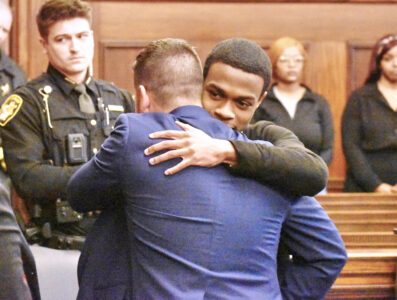
Perhaps the most dramatic not guilty verdict was that of Sellers in the death of Amya Monserrat, 15. The case was complicated by prosecutors revealing to jurors that they did not think Sellers' gunshots killed the girl. But they argued that Sellers' actions led to the gunfire and death.
The shot that killed her apparently came from someone at the birthday party who was concerned about the car Sellers' co-defendant, Saun Peterson, said he drove around the tavern.
Just before the trial, Peterson decided not to testify against Sellers. Peterson testified briefly, then invoked his Fifth Amendment rights and would not answer any more questions, leading to a mistrial and Sellers going back on trial the following week and being found not guilty. Peterson got the maximum of 20 1/2 to 26 1/2 years in prison April 15 for his role in the killing and for failing to live up to the terms of his plea agreement.
In a trial without a jury, Visiting Judge W. Wyatt McKay found Jabron L. Perry, 20, of Youngstown not guilty of three counts of felonious assault after a trial. Perry was believed to have fired 26 shots during a 5:21 a.m. melee at an afterparty at a business on Market Street in Youngstown on Aug. 17, 2025, that left three women with gunshot wounds, some of them serious.
McKay said he found that Perry and six other men who fired at least 68 shots for 22 seconds toward three women "must have shared" the belief that they were in danger of death "because they all shot in the direction of where the first shots were fired, and Perry had no duty to retreat under threat of deadly force.
APRIL
A jury found Lynell Stanley, 40, not guilty of two counts of felonious assault in an Oct. 13, 2025, incident in which he was accused of causing serious physical harm to two boys at a home on East Lucius Avenue in Youngstown and causing physical harm to the third boy by striking all of them.
GUILTY VERDICTS
Mixed in among the not guilty verdicts were three significant trials in which juries found the defendant guilty.
In a retrial, a jury found Dustin L. Ruiter, 51, guilty Feb. 6 on all 67 sex charges he faced in a trial in Mahoning County Common Pleas Court, and he was sentenced Feb. 11 to 68 years in prison.
A jury found Kelly P. Wiseman, 52, of Creed Road in Milton Township guilty March 11 on all four counts of felonious assault for shooting a gun toward the house of his neighbors July 30, 2024.
A jury found Marcus G Cobb, 62, guilty Wednesday of one count of felonious assault but not guilty of the other count of felonious assault for an incident in Youngstown in which prosecutors said Cobb approached a man who had called him a "hurtful and degrading name" at some point in the past and "without warning, whacked (the victim) on the head and his back multiple times with a metal pipe."
By comparison, of the 11 trials the newspaper covered in 2024,almost all resulted in guilty verdicts.
BRAD GESSNER
Austintown resident Brad Gessner, longtime chief counsel for the Summit County Prosecutor's Office, discussed trends and issues regarding criminal prosecutions recently with the understanding that he was not going to talk about the Mahoning County Prosecutor's Office.
Gessner, who worked as an assistant Mahoning County prosecutor from 1989 to 1996, lost in the Mahoning County Democratic Party primary in 2004 against Paul Gains for Mahoning County prosecutor.
Gessner also sought the Mahoning County Democratic Party Central Committee endorsement to replace Gains as county prosecutor in January 2023, but that endorsement went to Gina DeGenova.
Maro, a Republican, ran against DeGenova in the general election in November 2024, and won. Maro has more than 2 1/2 years left on her term in office. Neither Maro or Gessner are on the May 5 Mahoning County ballot.
Gessner has been with the Summit County Prosecutor's office since May of 2001, serving as chief assistant prosecutor in the criminal division from 2007 to 2013, then becoming chief counsel. Then-Summit County Prosecutor Sherri Bevan described Gessner's job as chief counsel being "responsible to assist me with all divisions of this office."
When Gessner was asked recently what some of the greatest challenges are in prosecuting criminal cases, he described similar issues as raised by Maro and Juhasz -- the CSI effect causing jurors to expect more evidence than reasonable and jurors having trouble accepting circumstantial evidence as valid.
Gessner said the foreperson in an important jury trial of his not long ago was interviewed after the trial and told a reporter that there were two jurors who would not accept circumstantial evidence even though the judge told the jurors "'This is the law. You have to follow it.' And in the jury room, two of them said, 'Look, you tell me there's snow on the ground. If I didn't see it fall, I'm not going to say it snowed.'"
Gessner said, "So you have all those things that affect your outcome and you get this not guilty [verdict] on a case you thought you should win." He said it also can also be difficult for a juror to believe a witness who is nervous on the witness stand.
"People that may be afraid, they may appear nervous. So someone doesn't think they're being truthful because they're nervous," Gessner said.
When he was asked if a couple of not-guilty verdicts can affect the decisions other defendants make about going to trial, he said yes.
"So I've seen that throughout my career. You get a loss and you might get two losses and then you're going to have a whole bunch more people say, 'I want to go to trial.' And when you take one or two of those down [convictions], then all of a sudden you see the pleas come in."
When Gessner was asked if a prosecutor's office can get demoralized by a string of not-guilty verdicts, he said, "I don't get demoralized. I get upset that I let my victim down. I let my police officers down. I maybe let the community down. And it means I'm going to work that much harder on the next one."
He said people don't go to work in a prosecutor's office to make a lot of money.
"You go in there to do a service to the community," Gesner said.
He said as a prosecutor, you "get bumps in the road. You get guilty sometimes. You get not guilty sometimes. But you pick yourself up and you get ready for your next case."
Gessner and another Summit County assistant prosecutor tried the Akeem Hargrove aggravated murder case in Mahoning County Common Pleas Court last August because of Maro having previously represented Hargrove as his defense attorney.
A jury found Hargrove guilty of aggravated murder, murder and gun specifications. Judge Anthony D'Apolito later sentenced Hargrove to life in prison without parole.