
65 fewer deer killed in third year of hunt
Trending
YOUNGSTOWN -- The third year of deer reductions in the Mill Creek MetroParks ended a week ago with 146 deer removed through hunting and U.S. Department of Agriculture sharpshooters -- 65 fewer than the 211 killed last year and the 204 that were killed the year before that.
Mill Creek MetroParks Natural Resources Manager Rachel Sobnosky said Friday two reasons come to mind for the lower number.
"After two years of harvest efforts that emphasized antlerless (female) deer, one could expect to see some reduction in the overall population," she said. "At the same time, extreme cold and heavy snowfall this winter may have limited hunter participation and deer movement."
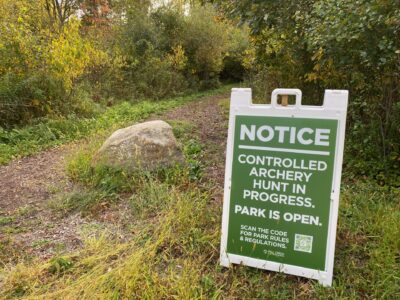
The most recent report of deer reductions Sobnosky provided for January supports the likelihood that a cold and snowy January had an impact. During January, hunters selected through an ODNR hunting lottery were allowed to remove deer through archery in Huntington Woods and Hitchcock Woods in Boardman.
But during that time, only one deer was harvested -- a doe Jan. 12 in Huntington Woods, the report states. None were taken the three other three weeks in January, including the final week of the month, which began with more than a foot of snow falling in much of Mahoning County Jan. 25. Cold conditions continued the rest of the week. During January the previous year, eight deer were removed, according to Vindicator files.
FINAL REPORT
Sobnosky said she will write a final report on this year's deer removals when she receives additional statistics and hunter-survey data from the ODNR.
She said that when that report is finished, it will be added to the White-tailed Deer Management page on the Mill Creek MetroParks web site, millcreekmetroparks.org. She said until she receives that data, including "effort data," it will be "difficult to attribute the lower harvest to any single cause."
Effort data has been provided in earlier deer reduction program final reports. In last year's report, hunters who participated in the program that year were asked to respond to survey questions such as whether they used the hunting permit they were granted (85 percent said yes), whether they brought a hunting partner (77 percent said yes) and how many days the hunter spent in the field during the days they were permitted to hunt.
Last year's report stated that hunters spent an average of "3.06 days afield, utilizing 44 percent of their allotted permit window." Firearm hunters spent an average of 1.5 days afield, utilizing 75 percent of their allotted permit window of two days.
Other data indicated that 69.8 percent harvested a deer during their hunt. And 45 percent of hunters stated that they encountered other hunters while they were afield. Forty-one percent said they encountered non-hunting park users while they were afield.
THE PARKS
The most recent report of deer reductions also provided totals for how many deer were removed by hunters in all of the parks where hunting took place:
Vickers Nature Preserve: 15
Hitchcock Woods: 14
Mill Creek Wildlife Sanctuary East: 12
Sawmill Creek Preserve: 12
Collier Preserve: 12
Mill Creek Wildlife Sanctuary West: 10
Huntington Woods: 10
Hawkins Marsh: 5
Springfield Forest: 2
MetroParks Farm: 0
UNREPORTED
Sobnosky said four deer reductions of the 96 from hunting cannot be placed in a specific park. They are referred to as "unreported," meaning the hunter checked in the deer through the ODNR Division of Wildlife game check system and the hunter indicated the deer was harvested as part of "controlled hunt" in the Mill Creek MetroParks.
But the hunter failed to report which MetroParks property the deer was taken from. Sobnosky said the MetroParks Division of Wildlife staff made numerous attempts to contact those hunters through email and phone but were unsuccessful in reaching them.
Those harvests are included in the total of 96 deer removed through hunting but are not listed with a specific park property where the deer was killed, she said. "As rules and regulations for the hunt state, failure to report harvested deer may result in the loss of ability for that hunter to participate in future controlled hunting opportunities at the MetroParks," Sobnosky stated.
In addition to the 96 deer removed by hunters, U.S. Department of Agriculture-employed sharpshooters removed 50 deer from Mill Creek Park over three dates through Nov. 20. Fifty is the number the ODNR gave the Mill Creek MetroParks permission to remove this year through sharpshooters.
The MetroParks removed 75 the previous year through sharpshooters and 38 the year before that.
Geoffrey Westerfield, ODNR's assistant wildlife management supervisor, told Sobnosky in an Oct. 1, 2025, email that he granted the Mill Creek MetroParks permission to remove 50 deer in Mill Creek Park that fall "after a considerable amount of time assessing your request, an assessment of both the data you submitted with your request along with data from previous years, the multiple site visits I have made to Mill Creek Park over the last month and the conversations we have had recently."
Deer reductions have not taken place in any area of Mill Creek Park in Youngstown because of Youngstown's law against discharging a firearm within the city limits.
The MetroParks has stated that a key reason for reducing the number of deer in the MetroParks is to restore vegetation in the parks.