
Marine veteran taught rifle skills
Used radio savvy to retrieve historic Apollo 11 capsule
Trending
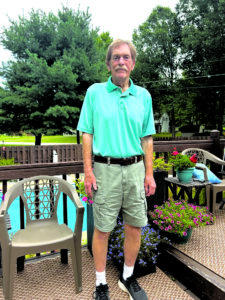
AUSTINTOWN -- In 1967, Richard Patterson took a full course load at Youngstown College while working at William B. Pollock Company as a machinist.
"If you didn't go full-time, you were draft eligible. There were no student loans, so I had to work to pay my way," Patterson said.
Faced with trigonometry and calculus, "I saw the handwriting on the wall."
When a friend from Boardman High School was killed in Vietnam, he decided to join the fight. "We grew up in the days of Hopalong Cassidy and the Lone Ranger, and I said we've got to do something about it," Patterson said.
He visited several recruiters before landing in the Marines.
"My dad was in the Navy, so I went to the Navy (recruiter's office) and there was nobody there. I went to the Air Force -- nobody there. At the end of the hall was a Marine standing with a cup of coffee. He said 'you might as well get the best training you can.' I signed up," he said.
Boot camp was at Parris Island, followed by Camp LeJeune, which Patterson described as "running around with different weapons and more intensive training." From there he went to Camp Pendleton in San Diego to learn radio relay.
"To make a call on the other side of a hill, we had to take a jeep on top of the hill with a receiver and transmitter. We'd get the call and relay it," Patterson said, noting it was risky because "the first thing the enemy wants to do is take out communications."
They told him not to unpack his bags as he would be deployed quickly. This went on for weeks. One day a captain said, "Come with me. You're going to be a typist."
He stayed at Camp Pendleton for the remainder of his enlistment.
"So there I sat. I was one of the first to get an electric typewriter. People came and went and had to be recorded. Nobody knew how to release an officer from active duty. I learned how to do that," Patterson said.
Besides typing, he became an instructor of M-16 rifles. They were transitioning from the M-14, which weighed 10 pounds and was 44 inches long. The M-16 weighed just 7 pounds and was 39 inches long.
Since Camp Pendleton was near Tijuana and there was no drinking age, soldiers would cross the border to "get loaded." One day he was sent there to bail a friend out of jail.
"You never saw a more pitiful scene in your life. Dirt floor, no plumbing," Patterson said.
In Mexico, he also saw his first bullfight and ate his first taco. He said he regretted both.
During The Tet Offensive in early 1968, Patterson expected to be sent to Vietnam. He believes he was not because his brother Jerre was already there.
"They frowned on that. They won't send two to the same combat area," he said.
Jerre Patterson was featured in the July 28 Vindicator.
He did use his radio training. In the summer of 1969, when Apollo 11 returned to Earth after landing on the moon, he helped retrieve the capsule.
"I saw the splashdown. We got it to shore and shipped it off." Patterson said.
In 1969, Patterson's enlistment was up and he typed his own DD-214. He considered staying in California, but found it hostile to veterans.
"We were called baby killers, spit upon and not appreciated or accepted," he said.
So he returned to his old job. Black Monday in 1977 affected the labor market, so he changed careers, becoming an instructor at Trumbull County Joint Vocational School in 1986. He taught adults blueprint reading and trigonometry, "which I did poorly at, so I had to reteach myself."
Then he worked with high school students. He preferred this because they were eager to learn, even those who were there as discipline.
"They got the word. I told them, 'This is it, pal. There's no jobs pumping gas anymore.'"
Patterson noted dramatic changes in technology, from 8.5- inch floppy disks to AutoCAD.
"I couldn't spell computer, let alone know what it was, so I had to break out the books. But I learned it," he said.
After 18 years at TCJVS, the program faced cutbacks, but in 2007 he taught at Ashtabula County Joint Vocational School (now A-Tech). He didn't mind the drive from Austintown, although coming home was tiring. He enjoyed taking an outdated program and modernizing it.
In 2015, Patterson retired. Health problems have limited traveling. He had a hip replacement and last year overcame cancer. His wife, Carol, said he doesn't like leaving "the girls."
"They're so active," he joked, pointing at the two dogs sleeping on the couch.
But they love to entertain. They have a swimming pool and friends come over every week. He makes his specialty -- fried bologna on the grill.
Regarding his military service he said, "We survived it and were grateful. There's a feeling of satisfaction that you did your duty and nothing more can be asked, I guess."