MVHS takes a trip to the past

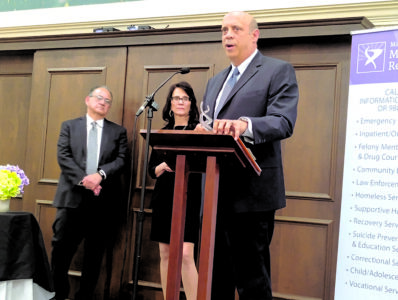
Correspondent photo / John Patrick Gatta Connie Jones, Stewart Media Archives Center project manager, discusses a video clip during the Tyler History Center’s “Exploring the 1960s & 70s in the Mahoning Valley through Media” presentation Thursday afternoon.
YOUNGSTOWN — It was a nostalgic trip for many of the packed crowd who attended the latest event in the Mahoning Valley Historical Society’s ongoing celebration of its 150th year, and a history lesson for all.
Focused on the significant societal and economic changes that enveloped the area, the Bites and Bits of History lunchtime program hosted Connie Jones, Stewart Media Archives Center project manager, who discussed “Exploring the 1960s & 70s in the Mahoning Valley through Media” Thursday afternoon at the Tyler History Center’s Thomas Ballroom.
Jones went through nearly two decades’ worth of events and paired her narration with video clips from that period.
The presentation highlighted life-altering events that changed America and the Mahoning Valley, including the May 4, 1970, shootings at Kent State University, the mob, fallout shelters, polio vaccines, civil rights protests, and the assassinations of President John F. Kennedy and Dr. Martin Luther King.
“I wanted to tell you a little bit more about our, my, little section of the world,” said Jones, who stressed that it was not an in-depth look at the two decades but a balance of entertaining and serious stories.
“This topic worked especially well for me because the TV news started in our area in the mid-1950s, Jones said, and she enjoyed putting the presentation together.
Subtly pointing out that the program could have gone on for hours, Jones pointed out the unique collection of the Stewart Media Archives Center. “I don’t believe there are too many collections like this in the country.”
She mentioned the collection has film and video from the mid-1950s to the year 2000, audio transcription disks from the 1930s through the mid-1960s and over 100 scrapbooks of media clippings from 1928 to 1973, plus antique radio and TV equipment, as well as thousands of photographs from former Vindicator and Business Journal photographer Paul Schell, WKBN and WFMJ.
The program opened with black-and-white footage of then-candidate John F. Kennedy’s 1959 visit to Youngstown. Later, Jones showed scenes of locals gathered outside the downtown Stambaugh Thompson storefront to watch the funeral procession for the assassinated president, the somber mood of Nov. 25, 1963, clashed with holiday decorations already in place.
“As you all know, the Mahoning Valley is known for its steel mills and mafia activity. You’ll see plenty of that in today’s video,” Jones said.
The presentation then shifted to early 1960s footage tied to the killing of mobster Sandy Naples, which set off a string of car bombings — dubbed “Youngstown Tune-Ups” — that killed his brother Billy and eventually the accused assassins.
“Under the orders of Attorney General Robert Kennedy, the FBI was ordered to make a full-scale investigation into the bombing. At that time there were a total of 82 underworld bombings,” Jones said.
Clips highlighting the area’s steel industry included the 79th Fighter Group visiting U.S. Steel, a press tour of upgrades at Youngstown Sheet & Tube’s strip mill, and a violent confrontation between Youngstown Teamsters 377 (aided by members from Cleveland, Akron, Canton and Detroit) and the Fraternal Association of Steel Haulers, which resulted in eight injuries and one death.
Attendees also saw scenes of a once-bustling downtown Youngstown, filled with shops, restaurants, cars and crowds.
Jones also showed an early 1960s clip featuring the city’s renovation.
“The first of 167 structures in the West Federal Street area got torn down as the city’s slum clearance project began,” she explained. The clearance was started to create industrial sites along the Mahoning River and near the city’s rail lines.”
Jones also showed a view of the Realty Building when it stood alone on its block, years before its explosion and destruction.
The lecture acknowledged shifts in local entertainment, including the Warner Theater transitioning to Powers Auditorium and later the DeYor Performing Arts Center, now home to multiple events and art spaces, as well as a clip of the now-vacant Paramount Theater.
It also focused on historical events such as the consecration of Bishop James Malone, Youngstown State University unveiling its new computer system, the closure of the New York Central Railroad passenger terminal, the opening of GM Lordstown in 1966 and retooling in 1977, more than 3,000 in attendance for a memorial for slain activist Dr. Martin Luther King Jr., ice skating at Lake Newport in Mill Creek Park and nearly 15,000 people at a Memorial Day parade.
The program jumped to 1976 to highlight the Valley’s political relevance when Democratic presidential nominee Jimmy Carter visited the area.
Jones’ session ended with Black Monday, when Youngstown Sheet & Tube closed its Campbell Works and 5,000 workers lost their jobs — a turning point that marked the collapse of the Mahoning Valley’s steel industry.
Despite the somber note, it sparked interest in a follow-up presentation exploring the region’s history through the 1980s and ’90s.
Local News
Mahoning County courts 5-9
Marriage licenses granted April 27 to May 1 in Mahoning County: Jonathan Mark Imler, 43, Youngstown, and Callie ...
Hubbard trustee questions cemetery board deficit
HUBBARD — City officials paused action at this week’s council meeting to approve a financial boost for a ...
Mill Creek deer hunts likely to continue
Average mortgage rate increases to 6.37%, a four-week high
The average long-term U.S. mortgage rate rose again this week, reflecting ongoing bond market volatility as surging ...
California congressman’s heartland tour makes stop at Ultium Cells