

Rally held to save TRMC
Staff photos / Chris McBride
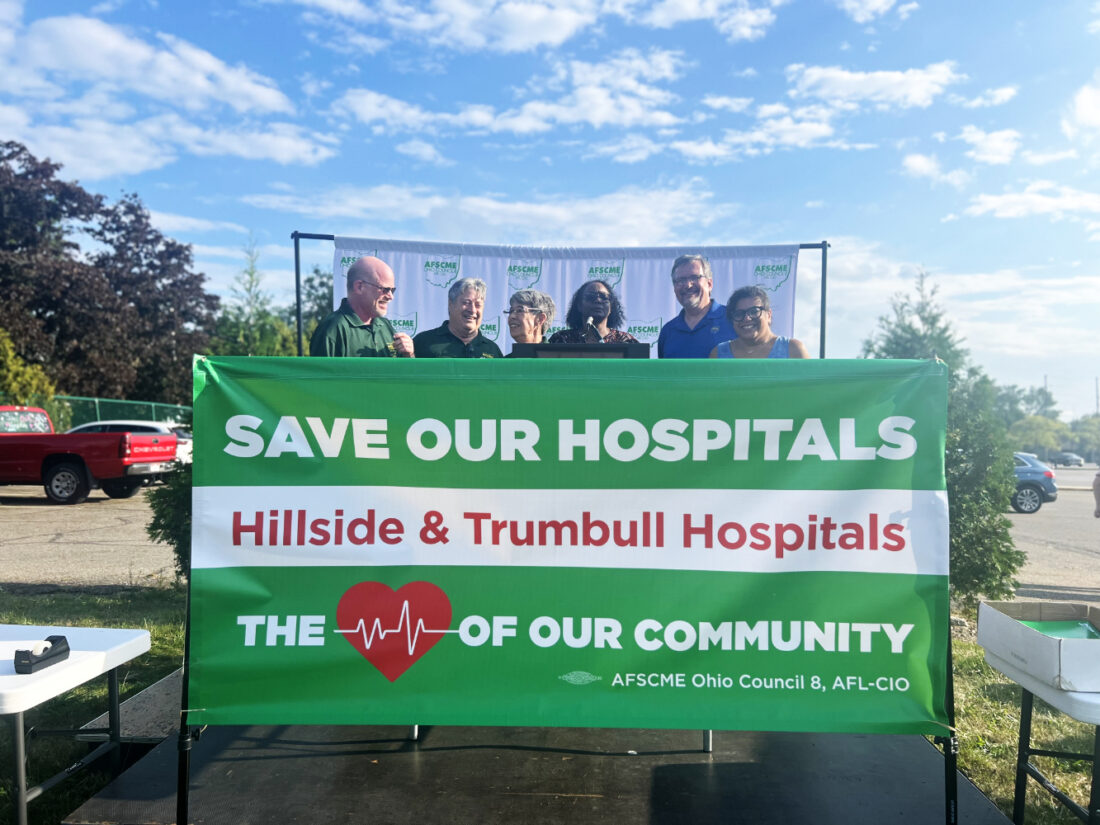
Members of AFSCME Ohio Council 8, ahead of Thursday afternoon’s rally to save community hospitals like Trumbull Regional Medical Center and Hillside Rehabilitation Hospital. Left to right: Sean Grayson, President of AFSCME Ohio Council 8; Thomas Connelly, President of American Federation of State, County and Municipal Employees Local 2026; Debbie Bindas, Youngstown Regional Director of AFSCME Ohio Council 8; Marcia Knox, First Vice President of AFSCME Ohio Council 8; Jack Norton, a TRMC registered nurse; Namita Waghray, Director of Communications for AFSCME Ohio Council 8
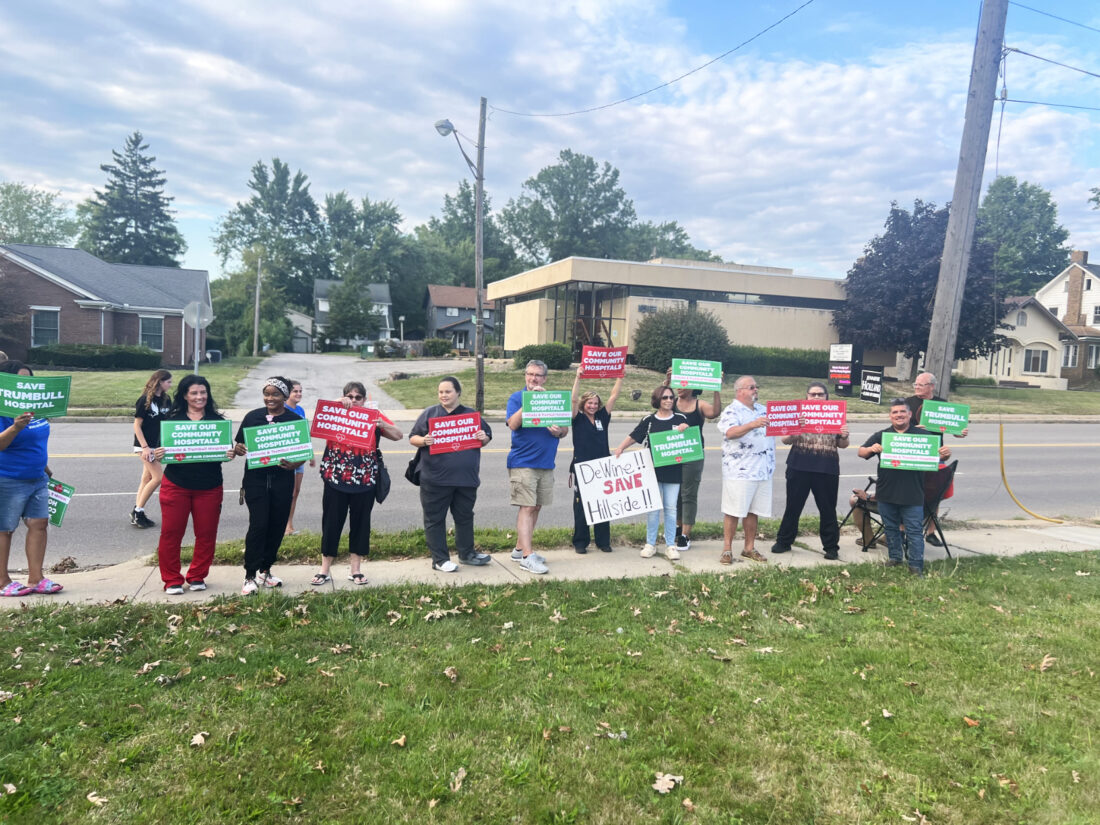
Supporters line East Market Street, holding signs and chanting in support of saving Trumbull Regional Medical Center from closure.
WARREN — A sea of people attended a rally outside Trumbull Regional Medical Center Thursday afternoon, standing in solidarity as they rallied to keep the doors of their community hospital open.
A group of local health care, business and community leaders as well as Warren City Hospital have been trying to raise money so Warren City Hospital can acquire the assets of Trumbull Regional, Hillside and certain other facilities and operate them.
It’s estimated it would take between $20 million and $30 million to do so for at least 90 days.Trumbull County commissioners and Warren City Council have approved conditional letters of support to commit up to $3 million each toward the effort to stave off closure.
On Thursday, the sounds of horns blaring echoed down East Market Street, a symbol of a community that understands the weight of what losing the hospital could mean.
Vanessa Satterthwaite, a behavioral health registered nurse and vice president of Local 2026 of the AFSCME union representing Trumbull Regional Medical Center nurses, spoke about the reason everyone gathered Thursday.
“We’re here to emphasize the need for two hospitals in Warren,” she said, citing the logistical challenges patients face, emphasizing the impact on those requiring specialized services and mental health care, which may not be available just down the road at St. Joseph Warren Hospital.
Our cardiac health services are accredited,” Satterthwaite said, “but St. Joe’s has sent patients to our cath lab because they don’t have one open. They just sent one on Friday and had they not come here they may have died.”
The rally comes at the backdrop of the Trumbull nurses union submitting a bid in effort to raise $30 million to keep the hospital open.
Among the crowd that filled the sidewalk were a group of women holding signs, each with a personal stake in the fate of Trumbull Regional Medical Center and Hillside Rehabilitation Hospital. One of them, Billie Fike, an employee of Hillside, was joined by not just her biological family, but her work family who came out in support.
“I know the backup that St. Joseph is going to get in their emergency room, not just for their patients, but for their EMTs,” Fike said “They (St. Joseph) were backed up at a normal rate, with EMTs lined all the way down the hallway. I can’t imagine what it’s going to be like now if they close this hospital.”
I’ve seen people born here and people die here in my own family,” Fike said. “I have a heart for this facility.”
Strolling through the parking lot on a mobility aide, Paul LaPolla, of McDonald, has been through the ringer for 67 years of receiving care at TRMC for years, so much so that he said he owes his life to the facility.
“I’ve had open heart surgery; I’ve gone to the wound center here for many years; they’ve done the best,” LaPolla said.
LaPolla wagers he knows the name of every doctor, nurse and staff member at the hospital, aside from his wife, Marcia LaPolla, the director of behavioral health services, who has been there for 44 years. “I’ve been in this hospital so many times in my life and it just brings me to tears,” he said.
The honking of horns continued throughout the rally.
For many, like Jack Norton, a registered nurse working in outpatient surgery at TRMC, the potential closure hits close to home. Norton and his wife, both long-time employees, face the possibility of losing their jobs and income. “I’ve been here 38 years and she’s been here about 18, so a long time. We’ve put a lot of our blood in here,” Norton said.
Aside from the lost income, Norton said the biggest issues from his vantage point are “doctors canceling cases,” which in turn has also led to “patients canceling and planning on going somewhere else,” as Norton says many of them fear they won’t be able to get the care they need from the hospital. Morale he says is low among his colleagues, but said many of them are “willing to stick it out and see what happens,” while others “are trying to find work elsewhere,” he said.
Sean Grayson, president of AFSCME Ohio Council 8, which represents 31,000 public service workers across the state, addressed the crowd, speaking to the hospital’s deep ties to the community since 1907.
“This isn’t just about jobs,” Grayson said. “It’s about a legacy of care that’s being threatened by mismanagement and profit-taking by owners who have no stake in our community.”
The medium-sized union, as described by Grayson, has pledged $300,000 to support the hospital’s survival, a testament to their commitment. “When you check into Trumbull Regional Medical Center, you’re getting cared for by your neighbor, your family member, your friend. That degree of trust is priceless and you can’t replace that,” he said.
A theme that echoed throughout the rally focused on the eyes of Governor Mike DeWine, as many of those who spoke at the rally voiced their thoughts on what more the governor’s office could be doing to help their efforts.
“We haven’t seen any assistance from the state government,” Grayson said, “despite reaching out early in the process. We’re still hopeful, though, that the state will step in and provide some assistance” much like officials in Pennsylvania and Massachusetts, who faced similar concerns over the closure of area hospitals.
Thomas Connelly, president of American Federation of State, County and Municipal Employees Local 2026, said in the midst of the uncertainty, hospital admissions have stopped. The only ones they’re taking are people pre-scheduled for surgery or procedures.”
Connelly said the emergency room is “essentially closed.” He described that it only opens for people who “are able to walk in and drive themselves in,” because otherwise, “ambulances don’t bring anybody to us.”
If they’re seriously ill,” Connelly said, “most of the ambulances have been rerouting to Mercy Health down the street.”
Speaking about the response from DeWine, Connelly referred to a letter sent out by the government. “It’s almost insulting. The governor put out a letter saying, ‘What are you worried about? There’s another hospital right down the street.”
Warren Mayor Doug Franklin delivered a message of solidarity to the crowd, “Stay strong. Stay together and stay united.”
The mayor shifted his attention toward Steward Health. “This is all a result of corporate greed and it lays at the feet of Steward Medical Group,” Franklin said. He later vowed, “I will use the full power and weight of my office to ring every doorbell, knock on every door, call everybody and bug the hell out of them.” Driving home the importance of the hospital, Franklin asked the crowd, “Who was born in this hospital? Who had children born in this hospital?” As many hands went up, the mayor said, “Look at that. So the question was asked, do we need two hospitals? I think it goes without saying — we definitely need the two hospitals.”
Local News
Hubbard passes data center moratorium
HUBBARD — City officials moved forward with action to quell residents’ concerns about a potential data center, ...

Video captures fight in Geno’s Drive-Thru
Liberty police respond to thefts
LIBERTY — Township police were busy over the weekend, responding to a break-in and an attempted break-in on the ...
Girard OKs shared services agreement with Liberty
GIRARD — For the first time in history, Girard city school officials have approved a shared services agreement ...
Youngstown police respond to weekend gunfire
YOUNGSTOWN — Residents of Dogwood Lane in the southwest area of the city reported seeing gunfire coming from two ...
Medina man pleads guilty to attempted felonious assault involving a child
YOUNGSTOWN — George Conrad Jr., 77, of Medina, pleaded guilty Monday in Mahoning County Common Pleas Court to one ...