

Bridge by Steve Becker for June 2
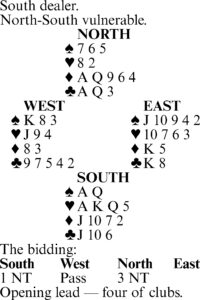
Experience shows that when a partnership has 26 points or more in their combined hands, a game can usually be made. But mere possession of these points doesn’t mean the game is automatically awarded to the side that has them. There is first the question of how declarer plays his cards.
Take this deal where South, with 29 points in the combined hands, mismanaged his assets. West led a club, and declarer played low from dummy, losing the finesse to East’s king. Back came the jack of spades, the queen losing to the king, and a spade continuation drove out the ace. When declarer then tried his third finesse — this time in diamonds — East won and cashed his spades to put South down two.
The hand shows how easy it is to fall victim to habit. It is certainly tempting to finesse West’s club lead, but declarer should put up the ace more quickly than he can say Rumpelstiltskin. Taking the ace assures the contract, while taking the finesse jeopardizes it. The finesse should therefore be rejected.
If South were dealing only with the problem of winning the maximum number of club tricks, he would of course finesse. But that is not his primary goal. He should be trying to make three notrump and should not allow himself to be diverted by the opportunity to take a finesse that is not needed to make the contract. He should instead take the ace of clubs, cross to the ace of hearts, lead the jack of diamonds and let it ride.
If the finesse loses, South has nine tricks. If it wins, South has at least 10 tricks. He should not concern himself with the location of the king of clubs. The 30 points he might gain by a successful club finesse are a drop in the bucket compared with the value of making a game.
Tomorrow: A slight misunderstanding.
(c)2026 King Features Syndicate Inc.
Lifestyles
Alpha-gal meat allergy faded over four years
Q. I contracted alpha-gal meat allergy while living in Long Island, New York, over a decade ago. An observant ...
Health notes
To include or update items in the weekly Health News list, email information to tmunnell@tribtoday.com or ...
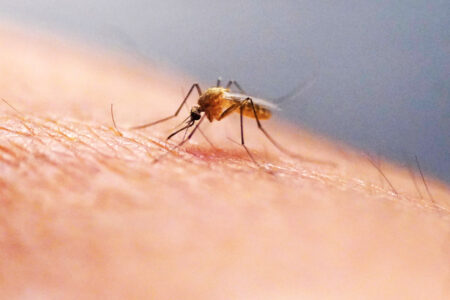
That’s going to be ITCHY
TO YOUR GOOD HEALTH: Helping those who fake illness is difficult
DEAR DR. ROACH: Could you address Munchausen syndrome and how to treat a person who might have it? What causes the ...
Bridge by Steve Becker
Precisely when to win a trick is a problem that often determines the outcome of a hand. The holdup play, so often ...
HINTS FROM HELOISE: Prying open bottles of nail polish
DEAR HELOISE: To open a bottle of nail polish that’s stuck, place a cup of water in the microwave for 1 ...