

Hubbard Legion honors its last living World War II vet
Art Kourian, 96, served in occupation unit in France
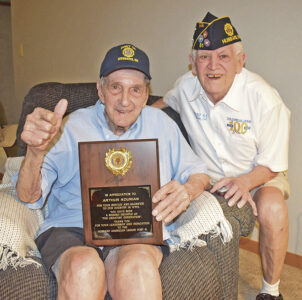
Staff photo / Ed Runyan Art Kourian, left, is seen with the plaque recently given to him by the Hubbard American Legion Post 51 of Hubbard for Kourian’s “service and sacrifice to our country in WWII” and for his time as commander of Post 51. At right is John Raica, current Post 51 commander.
HUBBARD — Art Kourian, who turns 97 on Sept. 19, is the only living member of Post 51 of the Hubbard American Legion who served in World War II, and its members thought that was worthy of recognition.
So last month, John Raica, post commander, and two other members visited Kourian’s home in Hubbard and took him a plaque they had made to honor him.
“Art is our last World War II veteran, and we felt we wanted to do something for him,” Raica said at Kourian’s home last week.
“I was the last one in Post 51 to actually have served in World War II,” Kourian said.
“I told Art he has to go for another four years until he hits 100 and then we will have a big dinner for him,” Raica said.
Raica also submitted Kourian’s name in 2023 to be placed on the honor roll in the World War II Museum in New Orleans. Kourian will forever be honored there for his military service.
“Because I am an honorary member of the World War II Museum, I posted all of my relatives who served in World War II,” Raica said.
Post 51 had four members who served in World War II when Raica became post commander in 2014. He took over when Kourian gave up the job after serving as Post commander for about eight years.
The plaque reads: “To Arthur Kourian for your service and sacrifice to our country in WWII. You have been a shining example of ‘The Greatest Generation.’ Thank you for your leadership and dedication to the Hubbard American Legion Post 51.”
Post 51 member Bill Shupienis, former post finance officer, wrote the words inscribed on the plaque. Kourian gives credit to “Commander Raica” for the decision to honor him. Kourian said Raica has done a “terrific job” as commander.
Raica served three years in U.S. Army intelligence at the former Fort Holabird in Baltimore from 1959-62. As soon as he left the U.S. Army, he went to work for the Central Intelligence Agency and worked there 30 years. He was a photo interpreter, retiring in 1992. He gives presentations locally on his work with the CIA.
Jim Kerrigan, service officer for the post, was also among those who presented the plaque to Kourian at his home in Hubbard.
“I was absolutely thrilled,” Kourian said of the plaque. “It’s one of the nicest gifts I can remember getting in all of the times I served in the Army. I had to thank John (Raica) and Bill Shupienis.”
Kourian noted that he had 10 first cousins who served in World War II, but none are alive today.
“They’re all gone. I can’t believe I’m still here,” Kourian said.
“You’re the last of the Mohicans, Art,” Raica said, a reference to the 1826 James Fenimore Cooper novel about wilderness adventure.
Kourian’s father served in World War I.
“He was an immigrant from Armenia, Turkey, came to the United States, and they drafted him. He served in the United States Army after coming from Turkey,” Kourian said.
Kourian said he may never get to see the World War II Museum in New Orleans because physical limitations make air travel difficult for him.
“The thing about World War II, it’s fading away. It was 80 years ago. It’s a passing generation,” he said.
The www.statistica.com website estimates there are about 60,000 U.S. World War II veterans alive today, and there will be fewer than 10,000 by 2030.
The website of the World War II Museum in New Orleans states that there are fewer than 1 percent of the 16.4 million Americans who served during World War II still alive.
“The National WWII Museum’s mission to tell the story of the American experience in the war that changed the world is more crucial than ever. Our museum is committed to honoring those who secured the freedom we cherish and carrying on the legacies of the WWII generation into the future,” the website reads.
KOURIAN’S SERVICE
Kourian was 17 when he graduated from high school in Queens, New York, and signed up to join the military in June 1945. Germany’s Adolph Hitler had already died in April, and Germany formally surrendered May 8, but the end of the war against Japan didn’t take place until Sept. 2.
“My neighbor was the director of the draft board, so when I submitted my birth certificate to the draft board, he didn’t question it. So, I was drafted in August of 1945, at Fort Dix, New Jersey,” Kourian said.
He was there about a week before being sent by train to Spartanburg, South Carolina, and to the Infantry Replacement Training Center at Camp Croft outside of Spartanburg.
“I was in the last infantry training class because the war against Germany had ended, and they had dropped the atomic bombs” on Hiroshima, Japan, on Aug. 6 and Nagasaki, Japan, on Aug. 9, Kourian said.
“In August of 1945, I was taking my basic training. Once the atomic bombs were dropped, we were being prepped for the invasion of Japan as infantry soldiers. So when the bombs dropped, they closed down the infantry training centers.”
He was back home for Christmas in 1945 on a pass and then went to Camp Kilmer in New Jersey and was taken by train to Staten Island, where he boarded the troop ship Webster Victory, which took him to Le Havre, France, just after Christmas.
“We were in occupation from January 1946 to December 1946,” Kourian said for an earlier Tribune and Vindicator story on his military service. “I was a guard patrolman in the Army of Occupation. And we were stationed at a huge depot outside of Rouen, France,” he said.
Wartime material such as tanks, Jeeps, trucks and material for building barracks were brought to the depot from all over Europe, like Germany, Belgium and France. “And they were beginning to bring all of this material back to an engineering base depot, and our job was to guard it,” he said.
About 1,100 German prisoners of war were held there, and Kourian and other guards kept watch over them.
He was honorably discharged from Camp Kilmer in February 1947 at age 19. During his time in Europe, he and several other soldiers visited four capital cities — London, Brussels, Berlin and Paris.
Kourian retired to Hubbard about 34 years ago after having lived many years in Van Nuys, California, and working as a technical writer in the aerospace industry.
Have an interesting story? Contact Ed Runyan by email at erunyan@vindy.com. Follow us on X, formerly Twitter, @TribToday.
Local News
PUCO grants significant rate increase for SOBE customers
The cost for steam heat for most of downtown Youngstown will greatly increase — 93% for a majority of them almost ...
Western Pennsylvania revolutionized energy
EDITOR’S NOTE: America would not be the nation it is today without its vast stores of natural resources. But ...
Youngstown City Schools bus drivers air healthcare concerns
YOUNGSTOWN — Initially, Stacey Kennedy had no intention of becoming a city school bus driver, but after a ...
YSU art camp draws Valley high schoolers
Man turns himself in on charge of assault
YOUNGSTOWN — Thomas J. Tubbs Jr., 61, will be arraigned today in Youngstown Municipal Court on a 3-year-old ...
Bill would require Border Patrol to adopt shelter dogs
Congressman Dave Joyce introduced a bill to require U.S. Customs and Border Protection to establish a pilot program ...