
Issue 1 opponents rally
Trending
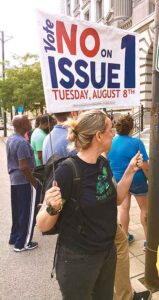
YOUNGSTOWN -- Natalia McRae spewed a litany of adjectives that left no doubt about her opposition to a controversial ballot initiative -- all of which began with "un."
"Issue 1 is unfair. Issue 1 is unjust. Issue 1 is unpopular. Issue 1 is undemocratic; and Issue 1 is unnecessary," McRae, a Youngstown State University social work major, said. "This is not a complicated topic."
McRae was among those who spoke at a rally that Mahoning Valley Sojourn to the Past hosted Tuesday afternoon on the Mahoning County Courthouse steps, urging people to vote "no" on the statewide initiative during an Aug. 8 special election.
Issue 1 is the sole item on the ballot.
If it's approved, Issue 1 would require all citizen-initiated amendments to the state constitution, which went into effect Sept. 1, 1851, to win a supermajority of at least 60 percent of the vote instead of the current 50 percent plus one simple majority.
Also, if the controversial issue passes, groups seeking to place an initiative on the ballot would need signatures from 5 percent of those who voted in the last gubernatorial election from all of the state's 88 counties rather than only 44 counties -- a move that would become effective Jan. 1, 2024. In addition, Issue 1 would do away with a 10-day curing period for groups who fail to garner enough valid signatures.
On Sept. 3, 1912, the state constitution was amended, giving Ohioans the right to initiate amendments to it, overturn laws the Legislature had passed and initiate new ones. Since that year, voters have passed 20 citizen-initiated amendments, including raising the minimum wage and ensuring additional rights for victims of crime.
On the other hand, between 1913 and 2014, Ohioans voted on 156 constitutional amendments that were legislatively referred to the ballot. Of those, 106 were approved.
Several speakers, including Miah Pierce, 20, a Sojourn to the Past member, told a crowd of about 50 that one of the most damaging and corrosive effects of the issue is that it would allow a 40 percent minority of people to trump the will and voices of the 60 percent majority -- and take away the concept of one man, one vote.
Pierce paraphrased the words of Mississippi civil rights icon Fannie Lou Hamer, who said during the 1964 Democratic Convention in Atlantic City, N.J., that she questioned the integrity of America if members of the Mississippi Freedom Democratic Party, a diverse and populist political organization, failed to be elected to represent all Mississippians.
"If Issue 1 is passed, I too question Ohio," Pierce said.
An extremely high bar already exists to amend the state constitution, so the issue would weaken a vital tool to introduce citizen-led initiatives to Ohioans, Kathy Gaige of the League of Women Voters of Greater Youngstown, noted.
John Rhodes, a Sojourn to the Past member who plans to attend Emory University in Atlanta, called the issue "an anti-democratic power grab," and said it will dilute efforts to ensure that the state Legislature "works for us, not special interests."
"It should have died at the state Legislature. If it passes, your voice will be silenced," state Rep. Lauren McNally, D-Youngstown, said.
Jaladah Aslam of the Dr. Martin Luther King Jr. Planning Committee of Youngstown was among those who urged attendees to vote "no" Tuesday and encourage others to follow suit.
McRae also quoted the late Vernon F. Dahmer of Hattiesburg, Miss., a civil rights leader who was killed in January 1966 -- the day after the White Knights of the Ku Klux Klan firebombed his home. His mantra was, "If you don't vote, you don't count."
Many of those who support Issue 1 contend it will prevent well-funded, out-of-state special interest groups from overriding the state's elected officials or circumvent the elected judiciary. They also say the current simple majority structure leaves the state constitution vulnerable to outside entities and internal radical agendas being enshrined.
In addition, a "yes" vote will require greater citizen participation across the state to place issues on the ballot to amend the constitution, many supporters say.
"By protecting our constitution, we can stop all the fringe elements, whether they be in California, New York, Illinois, wherever you want, conservative, liberal," Mike Gonidakis, the Ohio Right to Life's president who's also a Republican, said. "We determine what should be or not be in our constitution, and that's why we can take the 'for sale' sign off our state constitution by voting yes on Issue 1."
An Ohio Northern University poll, conducted late last month, showed Ohioans are evenly divided on the ballot initiative. The online survey of 675 registered voters statewide indicated that 42 percent approved of Issue 1 and 41 percent were opposed.
The 1 percent difference, however, is within the plus-or-minus 3.7 percent margin of error.
By contrast, a Suffolk University / USA Today phone poll indicated an overwhelming opposition to Issue 1.