
Austintown vet found new niche as chaplain
Trending
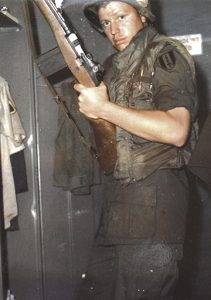
AUSTINTOWN -- The thing Dale Baringer of Austintown thinks people should know about his military service in the U.S. Army is what it led him to do years after returning home from Vietnam.
Baringer, 72, spent 1969 in Vietnam and returned to Fort Knox, Ky., in January 1970, where he had also undergone basic training in 1968. He earned an honorable discharge April 1, 1975.
In civilian life, he worked as a retail store manager. But where his story picks up again was 1998, when he joined the Tri-State Marine Corps League and became a volunteer chaplain. In that role, he would eventually preside over 1,200 area military funerals.
Baringer, who also became heavily involved in a hospice pin program, which honors military veterans with pins, says his service after he returned home has something to do with the post traumatic stress disorder he brought back from Vietnam.
"Because of what I saw in my post traumatic stress disorder, that's why I do what I do. That's where the volunteer work came in and working with veterans," he said.
"I had major problems with PTSD. I was able to hold a job … but it wasn't until I joined the Tri-State Marine Corps League in 1998 that I felt I had found my niche."
His time as chaplain followed his role as Santa Claus for a Toys for Tots program, which is run by the Marine Corps.
"I played Santa Claus because I used to be close to 300 pounds," he said. "I was playing Santa Claus for a Toys for Tots thing, and that's how they got me to join (Marine Corps League). "A friend who was (Marine Corps League) chaplain at the time talked me into becoming the chaplain so he could step down."
Baringer found his work with the Marine Corps League not only provided service to a veteran and the family at the time of death, but it also helped Baringer with his PTSD. He also became involved with the Disabled American Veterans and a military hospice pin program.
"To me it was just like a minister. It was my calling," he said of becoming a chaplain.
"As this stuff evolved, I found myself actually healing with my PTSD, and a lot of the guys who come on board with us, they say they say the same thing. This actually helped, actually cured me.
"And I say to this day the reason I do what I do is I do it for those who didn't come back, my brothers and sisters who didn't come back. I've held many a hand on the battlefield when there was nobody else around, and I was the only family that my brothers and sisters had.
"And it's kind of like that with this hospice program I volunteer for. I've been at Hospice House for hours holding a guy's hand."
He had one patient whose wife needed a break, so he held the man's hand for four hours.
"Shortly after I left, he passed away," Baringer said. "I had him as a patient for probably three months." Baringer said he has become very close with the families of veterans.
He said he has found that getting involved in the Marine Corps League has helped lots of other veterans as well -- people who got involved but did not see themselves as becoming a chaplain until they tried it.
"I get them to do a funeral, and then they want to do more," he said.
He became involved in a local Hospice pin program with the commandant of the local Marine Corps League. The pins are red, white and blue and shaped like a map of Ohio. Through the pin program, a volunteer like Baringer puts a pin on a veteran to thank him or her for his or her service.
"We just go in and recognize the veterans. We put a pin on them and give them a certificate. We render a salute." He remembers a man in a nursing home in the Boardman area who was 99 years old and still driving.
Baringer said he learned the man was one of the "Battling Bastards of Bastogne," soldiers who fought in Bastogne, Belgium, during World War II. "I had the fortune of pinning him, and he said it was the first time since World War II that he had been recognized for everything," Baringer said.
Baringer retired from the Marine Corps League in 2018.
Baringer's involvement with the hospice pin program began in 2013 and continued until the coronavirus hit.
"What was interesting to me is how many World War II guys didn't get recognized," he said. "Some of the first things they got recognized by was our pin programs. There are about eight of us who go to the homes of veterans. We've done that for about six years and for about 300 to 400 veterans per year."
The volunteers usually visit the veterans once per week.
"The reason I got interested in that is a lot of the people -- especially the wives -- didn't know what benefits they are entitled to, so it has helped me with working with the veteran's service commission to get them their (disability) benefits because a lot of these guys didn't get benefits."
He mentioned a Korean-era veteran who "didn't get a dime until I got involved with him," Baringer said.
Dale Baringer
AGE: 72
RESIDENCE: Austintown
SERVICE BRANCH: Army
MILITARY HONORS: National Defense medal, Vietnam Service medal and Vietnam Campaign medal.
OCCUPATION: Retired retail manager
FAMILY: four children; and seven grandchildren