
Digging deeper into profiling
Gathering delves into body cameras, policies
Trending
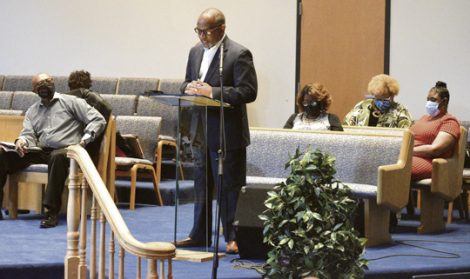
YOUNGSTOWN -- The second Policing in the Valley town hall at New Bethel Baptist Church on Tuesday picked up where the one last month left off -- digging deeper into racial profiling, body cameras and police policies.
But it also ended with more personal questions and remarks from retired Youngstown Detective Sgt. Delphine Baldwin-Casey, who talked about being "trained" to racially profile when she first went to work at the Youngstown Police Department decades ago.
The Next Steps Coalition that organized the meeting focused a lot of time on the Ohio Collaborative, an effort that began around 2015 to establish state standards for police use of force and other issues.
The chiefs of nine departments in attendance and Lt. Brad Bucey of the Canfield post of the Ohio State Highway Patrol were asked to discuss their progress in becoming certified in the standards.
Two departments that were in attendance -- the Mahoning County Sheriff's office and Austintown Police Department -- are certified in all three.
Being at that level means the department is certified in many areas, including "biasfree policing." Two departments in Trumbull County not present for the program also are certified at all three levels -- Niles and Weathersfield.
Chiefs Carl Frost of Beaver Township and Tim Roddy of Struthers said their departments do not use the collaborative certification process, but instead use the Lexipol system. Frost said Lexipol policies "meets or exceeds the collaborative policies."
The town hall was not attended by the public. Instead it was streamed live on Facebook and also will be available to view later.
Regarding body cameras, coalition members asked what the repercussions are for officers who fail to turn on the devices -- something that played a role in the shooting of an unarmed black man in Niles early last year.
Major Bill Cappabianca of the sheriff's office, which has body cameras, said, "That's a big no-no. It shouldn't happen" and "starts the discipline process."
Austintown police Chief Bob Gavalier said it took his officers some time to get used to operating the cameras, but not activating them at the proper time now is grounds for discipline.
All of the departments with cameras said they are required to be turned on at the start of an interaction with the public and turned off after it is over.
Youngstown police Chief Robin Lees said his department, which does not have cameras, passed on an opportunity to apply for one grant to buy cameras because the U.S. Department of Justice advised the department not to get them if the city cannot afford to pay the ongoing costs of storing the videos.
Lees said he believes cameras help a police department, but the cost is too high right now without help from the state.
Gavalier said his department was awarded a $30,000 grant to help with the $300,000 cost over three years, but the department still has not met all of the requirements to get the $30,000.
Baldwin-Casey asked questions that got personal, saying she asked police chiefs in a setting like this several years ago if they had racial profiling in their department.Three chiefs raised their hand. She asked the question again Tuesday. Apparently no one raised his hand.
Milton Township police Chief Chuck VanDyke said, "I'll field it. I'm not naive enough to think it doesn't happen. The issue is finding it. Ones who racially profile are smart enough to cover their tracks."
But he said his department "does a really good job of training. I know most of my officers really well. I don't see it."
Baldwin-Casey said a Youngstown officer taught her racial profiling when he told her that she should stop all black people driving down Mahoning Avenue.
"Stop them because blacks don't live on the West Side," he told her.
She said she has been stopped in more recent years without probable cause and asked the officer, "Why did you stop me? And they said if I had known it was you, I wouldn't have stopped you," she said.
At the end, Kenneth Simon, pastor of New Bethel, said racial profiling "happens all the time," happened to him when he was young and more recently as an adult and as a pastor.
"I've been stopped in every area of the county … because I was driving in a place where someone thought I shouldn't be," he said.
The next town hall will be 6 p.m. Sept. 1 at a location to be announced.