

Tending harmony
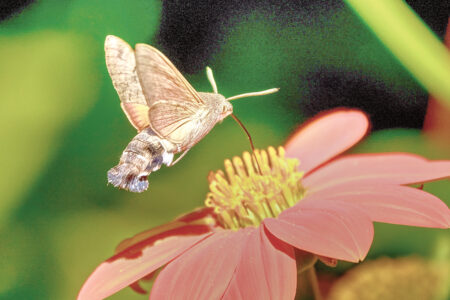
Submitted photo A moth uses its long tongue, known as a proboscis, to suck nectar from a flower.
In the insect world of Arthropoda is a special group called Lepidoptera. This group is noted for monarchs, swallowtails and other beautiful and important butterflies. But there is another group within Lepidoptera, the Sphingidae — or hawk moth — family that contains important pollinators often unfamiliar to gardeners, but I must voice a pet peeve I have about them.
The hawk moths — the clear-winged hawk moth, the sphinx moth, the five-spotted moth and the white-lined clearwing moth — are all the swiftest moth fliers with chubby bodies. These important pollinators hover in flight resembling hummingbirds. Their bodies and wings are densely covered with scales, giving them a fuzzy appearance. Each has a very long tongue, known as a proboscis, for sucking nectar. They are either crepuscular (dawn and evening) or nocturnal, though some favor daytime to forage. There are up to 135 species in the United States.
All moths undergo complete metamorphosis, developing from egg to larva (caterpillar), then pupa, and finally the adult moth. A female lays one or more eggs on a host plant and continues on to other plants, depositing the next potential generation. When the egg hatches, the caterpillar begins feeding on the host plant selected by the female moth.
One of the most familiar sphinx moth caterpillars to gardeners is the tobacco hornworm. It is fleshy and green with lines down the sides and an incredible horn on the end. People get hysterical and immediately have to kill that thing on their beloved tomato plant. This caterpillar loves many plants in the Solanaceae, or nightshade, family, which consists of around 2,300 species of flowering plants and garden favorites like ground cherry, tomatillo, egg plant, potato, tomato, peppers, petunias and tobacco.
I proposed a compromise to my husband years ago. We bought extra tomato plants and planted them far from the garden, so when we stumbled on a caterpillar, we had a sanctuary to move them to for the rest of their feeding time. I bought some again for this year, so we can do it again. It is fairly easy to spot either a skeletonized leaf or the large blackish castings excreted in large amounts. With a bit of checking the plant, the culprit can be found and dispatched to its new host plant, to eat, grow and thrive. Then after pupating, when you sit by your beautiful echinaceas and an amazing hawk moth hovers near you, as you feel a slight breeze from wingbeats, you can be proud as you smugly say, “I made that happen!”
Lifestyles
Religion news
SERBIAN DAY: The 93rd annual Serbian Day will take place noon to 8 p.m. Sunday at Holy Trinity Serbian Orthodox ...

Trash and treasure sale to raise funds for church capital campaign
Storm scam: Don’t get swept away
Valley residents experienced a taste of natural disasters earlier this month, as a powerful storm plowed through ...
Senior news
RETIREES TO MEET: Howland Schools Retired Personnel will meet for lunch at 11:30 a.m. Aug. 4, at Shepherd of the ...
Unexpected hazard on the highways
For thousands of years, humans lived with minimal exposure to manmade chemicals. Today, though, we are surrounded ...
HINTS FROM HELOISE: How you can keep your skin healthy
DEAR HELOISE: Every skin care company claims to have the perfect solution to staying young, but the truth is that ...