Bridge by Steve Becker
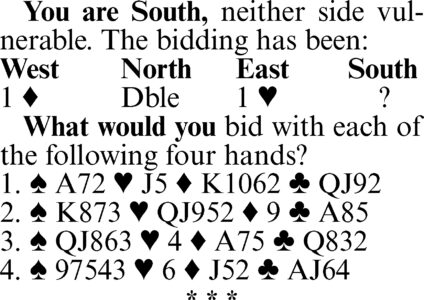
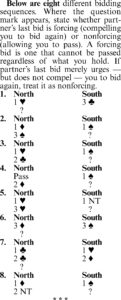
1. Two notrump. When partner doubles for takeout at his first turn to bid, he implies support for the unbid suits and at least the values for an opening bid. In replying to the double, you should attempt to show the degree of strength you have in much the same way as you would if he had opened the bidding.
While East’s one heart bid relieves you of the obligation to respond, this 11-point hand might produce a game opposite a double, so a jump to two notrump (invitational) is in order. The absence of a heart stopper should not deter you from bidding notrump, as partner is virtually certain to have some heart strength for his double.
2. Double. Something is rotten in the state of Denmark. East is probably fooling around, and the best way to expose this is by doubling. If the bidding now takes a new turn, which is highly likely, you can next show your spades. Partner will thus learn that you have heart and spade length as well as the high-card strength necessary for such bidding.
3. Two spades. This hand offers a good chance for game opposite a typical takeout double, and you should let partner know this by jumping to two spades (invitational). Partner’s double implies spade support, so the only question is how strong his hand is. If you evaluate your hand on a point-count basis, you have nine points in high cards and three more points for your singleton heart. Some players might even jump directly to four spades, which is certainly a reasonable alternative.
4. One spade. You have ample strength for a voluntary response, so you should speak up right now. Though your spades are nothing to brag about, you have to make do with what you were dealt. Remember that you are leaning on an opening bid and implied spade support from partner. To pass at this point, in effect telling partner that you are perfectly happy to let the opponents play in one heart, is inconceivable.
Tomorrow: A precautionary measure.
Bridge by Steve Becker
The expert declarer runs into just as many difficult guessing situations as anyone else, but usually manages either to guess right or to somehow avoid the guess altogether.
For example, take this deal where West leads the four of diamonds against three notrump. Declarer wins East’s jack with the queen, bringing his total to eight sure tricks. The question remaining is how he can give himself the best chance to develop a ninth.
One possibility is to lead a club to the king at some point in the play, hoping that East has the ace. Another possibility is to rely on a spade finesse against the queen. The trouble with this is that South has to guess which way to take the two-way finesse.
But declarer’s best approach by far is to make no effort whatsoever to guess where any of the missing key cards are located. Instead he enlists West’s aid by forcing him to break one of the two critical suits.
After winning the diamond lead, South cashes the K-Q-J of hearts and then plays the ace and another diamond. This allows West to cash his three diamond tricks as South discards two clubs from dummy and a heart and a club from his hand. Whatever West plays next, however, whether a spade or a club, presents South with his ninth trick.
Note that in setting the stage for the endplay, South must be careful to cash only three heart tricks, not four. If he cashes all four hearts before putting West on lead with a diamond, he may have trouble discarding on West’s last diamond and might go down one against best defense.
Tomorrow: Bidding quiz.
Bridge by Steve Becker
Harry Fishbein, one of New York’s early experts, liked to tell the story about the unfortunate player who was dealt seven diamonds and six clubs and, naturally, found his partner with the same distribution, but in the major suits.
The bidding zoomed merrily along until the seven-level was reached, at which point the unfortunate player had to choose which of his partner’s two suits to support — and he guessed wrong.
Fishbein had a somewhat similar experience when he held the South cards in today’s deal and his partner bid and rebid hearts opposite his void. Fishbein tried three spades next, hoping his partner would either bid three notrump or raise clubs.
But North next cuebid the ace of diamonds, and Fishbein was reluctantly obliged to bid four hearts, despite his void, reliving the story he had told so often.
Fortunately, matters took a turn for the better when his partner belatedly showed club support, prompting Fishbein to bid six clubs. He then proceeded to make the slam by careful play.
Fishbein won the spade lead with the ace, played a club to the queen and discarded the 10-5 of spades on the A-K of hearts. Now, instead of drawing trump, as many players might have done, he ruffed a heart before cashing the A-K of clubs.
Next, he led a diamond, losing the nine to East’s king, ruffed the spade return and tried a second diamond finesse. When the jack held, Fishbein was home. He ruffed a heart to establish dummy’s ten, and in that way overcame the 4-2 diamond division. Had he neglected to ruff a heart at trick five before drawing trump, he would have gone down.
Tomorrow: A tough nut to crack.
Bridge by Steve Becker
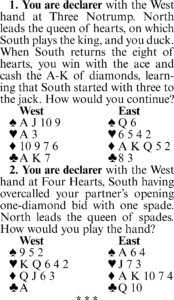
Some of the simplest plays are, despite their simplicity, difficult to perceive. Take this case where South was in four hearts and West led a trump. After winning with the queen, South led a low spade toward the jack, hoping to find West with the king and in that way finish with 10 or 11 tricks.
But East won the jack with the king and returned a trump, holding South to nine tricks. Dummy’s ace of clubs thus withered on the vine, and South eventually lost two diamonds and another spade to go down one.
All declarer had to do to guarantee the contract was to play the queen of spades at trick two instead of the deuce! Barring exceptional distribution, this play was likely to produce at least 10 tricks.
In the actual layout, what could East do if he took the queen of spades with the king? His best return, a trump, would leave South with 10 tricks consisting of two spades, six hearts, a diamond and a club.
If East refused to take the queen with the king, South would next play the ace of spades, ruff a spade, discard a loser on the ace of clubs and finish with 11 tricks.
The outcome would be essentially the same if West held the king of spades. He would run into the same dead end as East.
Admittedly, it is not easy to think of leading the queen of spades at trick two, because it is not customary to lead the queen initially with A-Q-x-x facing J-x. However, that is hardly a good reason for failing to make that play in this particular case.
Tomorrow: A bridge player’s nightmare.
Bridge by Steve Becker
This deal occurred in the final of the 1992 U.S. Women’s Team Championship to select America’s representative to the 1992 Women’s Team Olympiad.
When the deal was first played, Nancy Passell and Nell Cahn reached four spades as shown against two members of the eventual winning squad, Amalya Kearse and Jacqui Mitchell. Cahn, South, won the opening diamond lead with dummy’s ace and led a spade to the jack and king.
West’s club shift was taken by dummy’s ace, and Cahn led a second spade, winning the queen when East followed low. Declarer then conceded a spade to East, who exited with a club to dummy’s king.
Cahn now had to guess how to attack the heart suit, and she solved the problem immediately by leading the queen, covered by the king and ace. West’s jack of hearts took the next trick, and declarer claimed the remainder, making four.
At the second table, Tobi Deutsch and Mildred Breed ended up in four hearts with North the declarer after a transfer sequence. The seemingly stronger eight-card trump fit came with a built-in flaw, however, and the opponents were quick to exploit it.
Sue Picus, East, led a club to declarer’s ace, and Deutsch misguessed how to initiate the trump suit by leading the nine and letting it ride.
Sharon Osberg, West, won with the jack and quickly shifted to the K-10 of spades. Picus took the ten with the ace and returned a spade for Osberg to ruff, and the contract was down one.
Note that if declarer had led the queen of hearts rather than the nine at trick two, or had simply played the ace and another heart, West could not have obtained a ruff, and North would have gotten home unscathed with 10 tricks.
Tomorrow: Steppingstone to success.
Bridge by Steve Becker
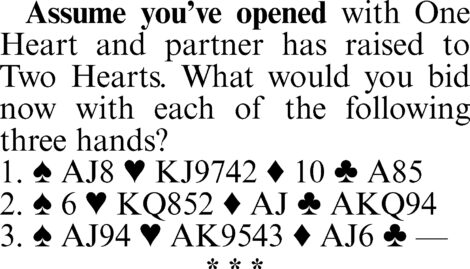
1. Three hearts. Although you have only 13 high-card points, there is a reasonable chance of making 10 tricks, so you should not throw in the towel by passing. Also, for those optimists who see the world through rose-colored glasses, it would be wrong to leap straightaway to four hearts.
Whether you can make a game depends on the size and shape of partner’s two-heart bid. If you bid three hearts and he holds a maximum raise such as [S]Q4 [H]A853 [D]9643 [C]K72, he will gladly accept your invitation and carry on to four.
But if partner holds something like [S]K95 [H]Q863 [D]J82 [C]964, he will pass, and you might have trouble making even nine tricks.
Alternatively, you could bid two spades or three clubs (forcing) as a way of inviting game. The point is that you are not in position to decide unilaterally whether there’s a game in the combined hands, so you should enlist partner’s help.
2. Four notrump. Slam is a distinct possibility, and the best way to investigate it is via Blackwood. You plan to bid six hearts if partner shows one ace by bidding five diamonds. If partner’s ace is in the trump suit, you should have an excellent chance to make six; if it’s in spades, you might still have a shot at the slam.
Despite the fact that you might not make 12 tricks even if partner has an ace, you should go for the slam because, opposite most of the hands partner could hold, you’d be a favorite to make six.
3. Two spades. There is no question about making a game; the question is whether there’s a slam. Two spades (forcing) is the first move in that direction.
Partner does not necessarily need a maximum raise for a slam to be made. If he has no values in clubs, you probably do have a slam. Thus, partner could have only the king of spades and king of diamonds and a slam would be feasible. Or partner could have [S]5 [H]QJ82 [D]K843 [C] 9762, and a slam would be virtually unbeatable. In any case, if partner cooperates in any way after your planned cuebids in spades and diamonds, you should undertake a slam.
Tomorrow: Search for a missing damsel.
(c)2026 King Features Syndicate Inc.
Bridge by Steve Becker
Signaling is the main method by which defenders communicate with each other during the play. Properly transmitted, the messages conveyed help the defenders decide when to stop, start or continue playing a suit.
Signals are not given automatically, however. Instead, a defender should first assess all the pertinent aspects of a deal before deciding which approach offers the best chance to defeat the contract.
Consider this case, for example. West led the club king and, after East played the encouraging eight, continued with the ace and another club. East ruffed, but that was the end of the line for the defense. Declarer won East’s heart return, drew trump and discarded his diamond loser on the club queen to finish with 10 tricks.
East’s defense left something to be desired. He should not have signaled for a club continuation by playing the eight at trick one, even though it is normal to do that to indicate a doubleton. He should have realized that it was more important to suggest a diamond shift than to get a club ruff since he already had a guaranteed trump trick that did not require a club ruff to ensure it.
East therefore should have played the club three at trick one to discourage partner from continuing the suit. Forced to direct his attention elsewhere, West presumably would have found the killing diamond shift, since that was the only suit that offered any real hope of defeating the contract.
South could not have prevailed against this defense. Whether he elected to finesse the queen of diamonds or not, the defenders sooner or later would have scored four tricks — two clubs, a diamond and a trump — before declarer could come to 10.
Tomorrow: Bidding quiz.
Bridge by Steve Becker
Declarer would surely play more accurately if he could see the defenders’ cards. In some deals, though, it is not necessary to see the adverse cards; declarer can visualize them just as if he were looking directly at them, because the bidding or plays already made tell him everything he needs to know.
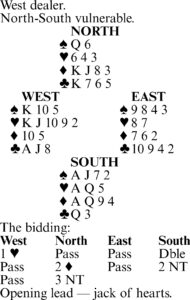
Consider this case where West leads the jack of hearts against three notrump. South wins with the queen and can credit West, who opened the bidding, with every one of the missing 11 high-card points. So all declarer has to do is to utilize this information to assure scoring nine tricks.
This should not be difficult once South puts his mind to the task. At trick two, he leads the spade deuce toward the queen. If West goes up with the king, South has nine tricks consisting of three spades, two hearts, and four diamonds.
If West plays low at trick two, dummy’s queen wins, giving South eight tricks: two spades, two hearts and four diamonds. He then leads a club to get his ninth.
A lazy declarer who makes no effort to diagnose where the missing high cards are located could easily misplay the hand. For example, he might cross to dummy with a diamond at trick two in order to try a spade finesse.
West would then win with the king and force out the ace of hearts, and South would eventually go down one as a consequence of his failure to think things out at the beginning.
Tomorrow: Planning the play.
Bridge by Steve Becker
France won the 1992 World Team Olympiad, handily defeating the United States in the 96-board final.
Oddly enough, the deal that contributed most to the French cause came not in the final, but in its quarterfinal match against Denmark. Going into the last hand of that 64-board match, the Danes led by 2 IMPs. The deal shown then occurred, and the outcome hung in the balance.
When a Danish pair held the East-West cards, they reached three spades and made nine tricks, seemingly an excellent result. The auction shown occurred at the other table, with Knut and Lars Blakset of Denmark seated North-South.
The Blaksets bid aggressively to reach three hearts. If South made three hearts or went down one, the Danes would win the match. Even if declarer went down two for a loss of 2 IMPs, the match would be tied, with a short playoff to follow. Only if he went down three could the match be lost.
West cashed two spades and then shifted to the king of diamonds. At this point, declarer could have made the contract by taking the ace, crossing to dummy with a club, leading a heart to the queen and cashing the A-J of hearts. South could then run clubs until West ruffed in, losing only that trick and a diamond to go with the two spades already lost.
But Lars Blakset let the diamond king hold, after which West reverted to spades. Declarer ruffed in dummy, discarding a club, and led the heart jack, covered by the king and ace. If he had now cashed the heart queen and then started running clubs, he would have gone down one and won the match.
Instead, Blakset played a club to the ace and led a heart to the nine. Curtains! West won with the ten and returned a spade, forcing declarer to ruff and lose control of the hand. When the smoke cleared, Blakset was down three and the French had scored a 2-IMP victory.
Tomorrow: The art of visualization.