

Wildflowers color our roads
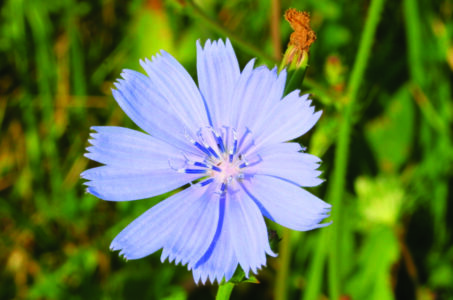
Submitted photo / Curtin Young Although the name isn’t common, looking at chicory, a light blue wildflower, one can instantly recognize the plant that’s found on roadsides.
Blue daisy, cornflower and blue dandelion are just a few names that refer to chicory, a light blue perennial gracing our roadsides and streets in both rural and urban areas.
Originating in the Mediterranean region, it was cultivated and grown for salad greens but is now primarily found in markets.
Chicory will grow in a variety of soils, among lawns, fields and waste areas. It begins with a 2- to 6-inch rosette, with toothed, alternate, lance-shaped leaves. Eventually, it grows long stems with pale blue flowers blooming apart along the stem.
In the morning, the flower opens and closes during noon’s intense sunlight. Each flower opens for one day, but as there are many blooms on each stem, blooms are continually opening.
Their tap root system is thick, strong and deep and contains a milky juice. Growing 1 to 5 feet tall, stems near the ground are hairy and upper areas of the stem are leafless and appear without leaves. If cut, thick milky sap emerges.
The blooming period is from June to September, and according to Ohio State University, each plant can produce 3,000 seeds. Whether you use chicory leaves for a salad, tea or a seasoning, this plant can also be appreciated for its beauty. And, the root is used in coffee.
A biennial wildflower and a member of the carrot family, originally from Europe, Queen Anne’s Lace is usually found in sun and partial shade among roadsides, fields and waste areas. During its second year of growth, the 2- to 4-foot plant has umbels, or rounded tops of lacy white flowers that are actually compound flowers, comprised of thousands of tiny flowers clustered around a dark red center.
A folk tale tells of Queen Ann, “while crocheting, pricking her finger” and to this day, the Queen Anne’s Lace flower shows a tiny drop of her blood.
Each flower stalk produces the flower seed, and when dry, the umbel begins curling inward, dispersing its seed on unsuspecting furry animals or bird feathers that brush a against it, only to drop and plant the seed farther away.
To prevent seed dispersal, seedheads should be removed before they mature. This adaptable plant can cause dermatitis and is inedible. Although it is considered a noxious weed in 35 states, it is a host plant for the eastern black swallowtail butterfly and other beneficial insects, providing nectar.
While driving on freeways or roadsides, a flash of pink might catch your attention. This bright pink flower belongs to the family of peas called the perennial pea, which can either climb with attached tendrils or cover the ground.
Part of the legume family, it has stems that the University of North Carolina describes as “wings,” leaf-like tissue that extends outward from the stem for easy identification. Although inedible and often 6 feet long, it produces seed pods (legumes) at maturity and will split the pods, sending them flying to scatter in another location and reseed.
This pioneer plant is not native but has been naturalized in almost every state. The University of Michigan states that these legumes have a mutual relationship with bacteria, and provide nitrogen to the soil composition.
These plants are disease-free and can be planted in gardens, on a trellis or fence or on a sloping landscape to prevent erosion.
Look for these wildflowers and appreciate nature’s beauty during our summer. To learn more about them, go to https://go.osu.edu/chicory; https://go.osu.edu/annelace; and https://go.osu.edu/roadsidepea.
Kane Shipka is an Ohio State University Extension Master Gardener Volunteer in Mahoning County.
Lifestyles
Lovina helps family prepare for church service
It is a dreary April morning with no sun in sight. We had a thunderstorm during the night with lots of strong wind ...
Lessons from California
Every great wine region has garnered respect for its vintages by growing quality fruit and developing winemakers ...

The quiche that made Michael Anthony love leeks
TO YOUR GOOD HEALTH: Endometrial cancer and its treatments
DEAR DR. ROACH: Can you comment on endometrial cancer? I have stage IV, and I’m in my 50s. I remain concerned ...
Bridge by Steve Becker
No declarer worth his salt should deliberately jeopardize making a game in order to try for a 30-point overtrick. ...
DEAR ANNIE: Later-in-life baby only needs family’s love
DEAR ANNIE: My husband and I are raising a surprise baby at a stage in life when we thought our child-rearing years ...