Improving clay soil, a sticky subject
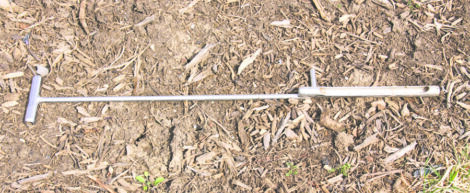
Testing your soil can help you determine the level of organic matter to know what improvements need made for the future. (Submitted photo)
Soils that contain a large amount of clay character have always been a challenge to gardeners. When it is wet, clay soil tends to be sticky and difficult to work; when dry, clay soil will be hard and full of lumps.
The reason for these properties becomes clear when we examine the particles that make up soil.
Soils are all composed of sand, silt and clay particles in different proportions. Particles of clay soil are distinguished from larger silt and sand particles by their size alone and not by their chemistry.
Where sand particles are visible without magnification, clay particles are so small that they are not visible even under light microscope magnification. If clay particles were imagined to be as large as sand particles, then a single sand particle would become roughly the size of a pool ball. This large difference in particle size is reflected in the resulting soil properties.
The large sand particles lead to a very porous soil that will have large air pockets and not hold water. Because of the tiny clay particle size, the tiny pieces pack tightly together and the resulting soil has very few air pockets. As a result of this close packing, water drains very slowly through the clay mass. Also, plant roots will have difficulty penetrating through such a dense soil.
It might seem reasonable that adding sand to clay soil might provide a more suitable workable soil. However, that addition alone will more likely lead to a soil consistency more like cement.
The best way to improve clay soil is to add organic material (OM). Compost, leaf mold, animal manure and green plant material (e.g. from tuning over a cover crop) are especially good at altering the structure of heavy clay soil.
The addition of these organic materials combined with agitation as simple as turning with a garden fork or using a tiller, can form (clay+OM) aggregates that are structurally much larger particles than the clay alone. As a result, the soil will contain relatively large air and water spaces between the particles and they will allow plant root penetration with ease.
As a bonus, both the suspended clay particles and the organic matter in the aggregates will bind and release valuable mineral nutrients to your plants. The more you can improve your soil, the better your plants will grow and the happier you’ll be with your garden and landscape!
To learn more about amending your soil, go to: http://go.osu.edu/amendment.
To learn more about soil testing, go to http://go.osu.edu/soiltesting.
• Snyder is an Ohio State University Extension Master Gardener Volunteer in Mahoning County.
Lifestyles
Parkinson’s Awareness Month: Things to know
April is Parkinson’s Awareness Month. Some people may be asking what Parkinson's disease is, while others ...

Bridge by Steve Becker
Hints from Heloise: With scent, less is more
DEAR HELOISE: The French have a saying: “Scents are made to be discovered, not announced.” — David K., in ...

How some seniors benefit from looking after their grandchildren

Friday evening TV